
Reviewed · AUDIO TOURS
Santorini: Akrotiri Entry Ticket and Audio Guide
Akrotiri rewards patient curiosity. I love the freedom to pause and rewind the offline audio guide, and I love the site itself, where streets, homes, and vivid clues to daily life survived beneath volcanic ash. The main drawback is that the audio’s directions can be hard to match with the ruins, especially when sections are closed or objects discussed are now in museums elsewhere.
This is a self-guided visit, not a guided group tour. You download the app and ticket before arriving, then explore at your own speed. At $41 per person, it is good value if you want context beyond the short signs, but less so if you are happy reading the displays or sharing one phone between several people.
In This Review
- Key points to know before you go
- Why Akrotiri is one of Santorini’s most unusual sights
- Getting ready for a phone-based visit
- Entering Akrotiri and finding your bearings
- Walking through the prehistoric town
- The Square of the Double Horns
- The House of the Ladies and the clues to daily life
- What the volcanic burial preserved
- How good is the audio guide?
- Is $41 a fair price?
- Who will enjoy this most?
- Should you book the Akrotiri audio tour?
- FAQ
- Where is Akrotiri located?
- What does the $41 ticket include?
- Is there a live guide?
- What languages are available?
- Do I need my own smartphone?
- Can I use the audio without mobile data?
- How much storage does the app need?
- Is the ticket tied to a specific time?
- Is Akrotiri wheelchair accessible?
- What should I bring?
Key points to know before you go
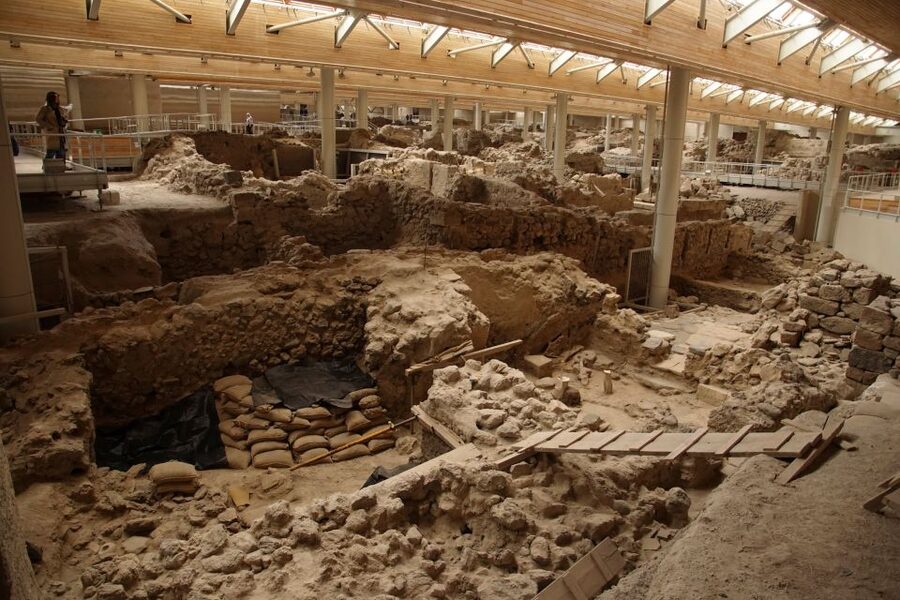
- Akrotiri is protected under a huge shelter: You get shade throughout the visit, making this a useful stop on a hot Santorini day.
- The audio works offline: Download the text, narration, and maps before arrival so poor phone service does not cause trouble.
- The ruins show a real Bronze Age town: Look for streets, large homes called Xeste, the Square of the Double Horns, and the House of the Ladies.
- You explore independently: There is no live guide, no scheduled group, and no chance to ask questions along the way.
- The route may not perfectly match the narration: Closed areas and relocated finds can make some audio stops confusing.
- One device is enough: The booking is made per device used, not per person, so plan your headphones and phone arrangement carefully.
Why Akrotiri is one of Santorini’s most unusual sights
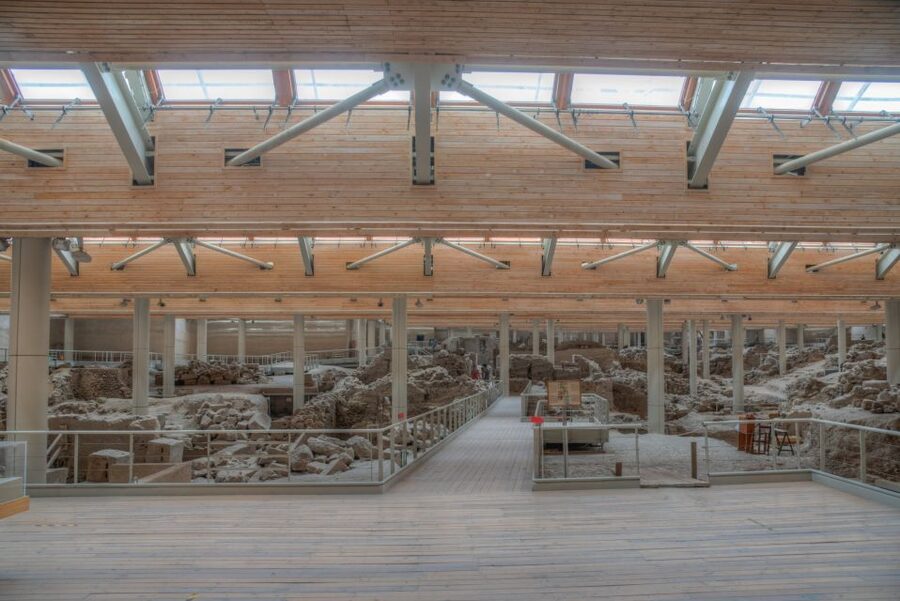
Santorini is famous for white villages and caldera views, but Akrotiri tells a much older story. This prehistoric Cycladic settlement was buried by the eruption of the Santorini volcano, preserving a snapshot of life just before the inhabitants fled the growing danger.
That comparison has earned Akrotiri the nickname the Pompeii of the Aegean. The comparison is useful, though not exact. Akrotiri is smaller than Pompeii, and you will not walk through a sprawling Roman city. Its importance comes from its age, the planning of its buildings, and the remarkable condition of a settlement more than 3,000 years old.
I find the site most rewarding when you slow down. At first, you may see walls, stairways, and roofless rooms. Then the audio adds the missing pieces: how the town was laid out, what its homes suggest about wealth, and how archaeologists read evidence of ordinary life from a place abandoned under pressure.
A few more Santorini half-days to weigh up
- Athens: Acropolis Ticket with Optional Audio or Live Guide
★ 4.2 · 11,055 reviews - Athens: Cape Sounio & Poseidon Temple Trip with Audio Guide
★ 4.4 · 4,521 reviews - Athens: Acropolis Ticket with Audio Guide
★ 4.0 · 3,575 reviews
Getting ready for a phone-based visit
The practical work happens before you reach the entrance. After booking, you receive an email with instructions and an activation link for the ticket and audio tour. Check your spam folder if the message does not appear, and download everything before leaving your hotel.
You need an Android phone running version 5.0 or later, or a compatible iPhone. The app does not work with Windows phones, iPhone 5 or 5C, older iPod Touch and iPad models, or the first-generation iPad Mini. Allow about 100 to 150 MB of storage.
Bring a charged phone and headphones. The content includes audio narration, written information, and maps for offline use, so you should not need mobile data once it is downloaded. This matters because phone service around the site may be poor.
The audio is available in English, French, Italian, and German. If you are booking for a couple or family, remember that the purchase is per device, not per participant. You can listen together with a shared set of headphones, but separate devices make it easier to move at different speeds.
Entering Akrotiri and finding your bearings
The audio tour begins inside Akrotiri. There is no live guide waiting for you, and no separate meeting point for a group. You present the entrance material and then orient yourself within the site.
This first moment is important because the route has caused confusion for some people. The entrance staff may direct you one way, while the audio may appear to begin with another section. Take a minute to check the app, identify the opening stop, and compare its map or title with the signs around you.
The selected time slot applies to entry to the museum only, while the archaeological site may be entered at any time on the selected date. Since the wording can be confusing, read the booking instructions carefully before you arrive. Do not assume the audio will function like a timed guided tour.
The entire archaeological area is covered by a large shelter. You have shade throughout the visit, which is a major practical benefit in summer. Sunscreen is still sensible for the time spent outside the building or walking to and from the entrance, but you will not be standing in full sun while examining the ruins.
Walking through the prehistoric town
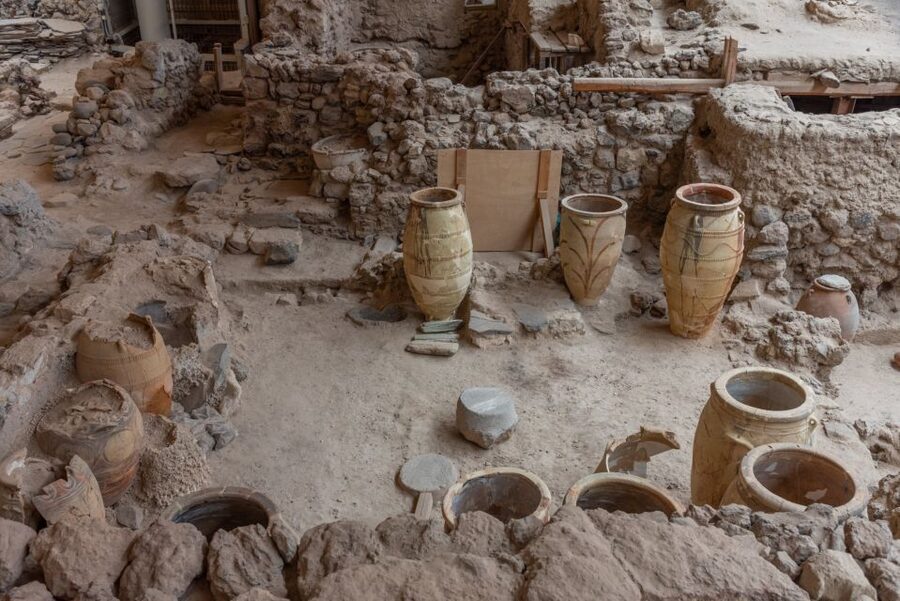
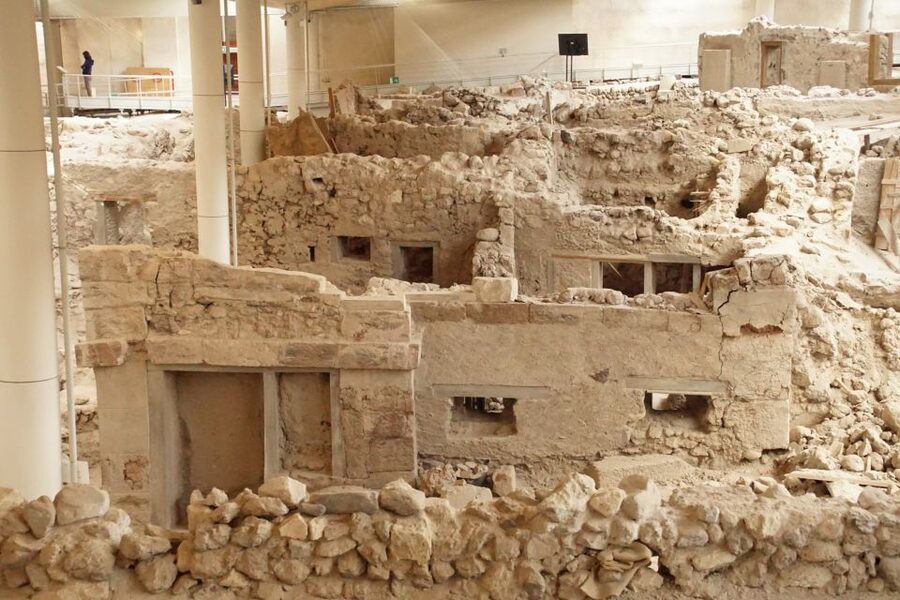
The central pleasure of Akrotiri is seeing an actual town plan rather than a few isolated stones. Paths let you look down into rooms and along streets, giving you a sense of how the settlement was organized.
The audio explains the arrangement as you move through the remains. It is designed as a series of short stories rather than one long lecture, covering the buildings, archaeological evidence, and small details about the people who lived here.
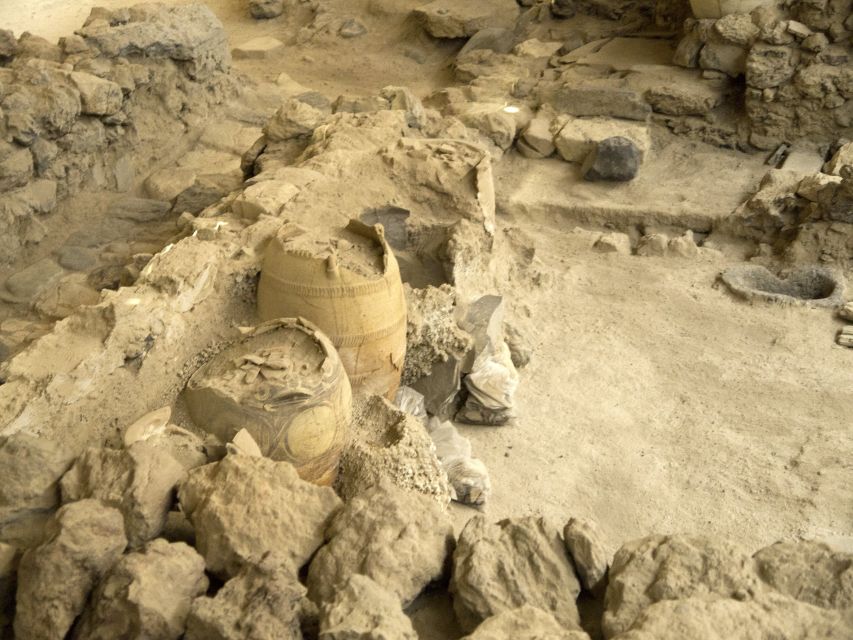
You will see evidence of substantial homes known as Xeste. These residences suggest that Akrotiri was not a simple village. The size and design of the buildings point to a developed community with skilled builders, social differences, and an organized urban life.
This is where the audio can add real value. The signs provide useful facts, but they cannot always explain what a wall, doorway, or room meant. A good narration helps you picture a living town rather than a silent excavation.
Still, keep your eyes on the site instead of treating the visit like a podcast. Some audio descriptions are difficult to place. Titles do not always correspond clearly with the labels on display, and the order may not match the path you naturally follow.
Same stretch of coastline, a completely different day out:
- Santorini Classic Catamaran Cruise with BBQ, Drinks and Transfers
★ 5.0 · 3,933 reviews - Half-Day Exclusive Catamaran Cruise in Santorini with Meal and Open Bar
★ 5.0 · 2,975 reviews - Santorini Gold Catamaran Cruise with Snorkel, BBQ & Open Bar
★ 4.8 · 2,822 reviews - Private Santorini Tailor Made – Choice of the Guest!
★ 5.0 · 1,972 reviews
The Square of the Double Horns
The Square of the Double Horns is one of the named places to look for during the visit. As with other parts of Akrotiri, the interest is not just in the name. The square helps you understand how the town included open public areas alongside private homes and narrow routes.
Listen for the explanation of how the space fits into the wider settlement. Then take time to look around before pressing on. The self-guided format lets you stop, rewind, and replay a section, which is especially helpful when the site is busy or you are trying to connect the narration with several visible walls.
The biggest limitation is that the audio may refer to objects or features that are no longer in their original place. Some finds are displayed in museums in Fira or Athens. If the narration seems to describe something you cannot see, that may be why. Do not waste time searching every room for an object that has been moved.
The House of the Ladies and the clues to daily life
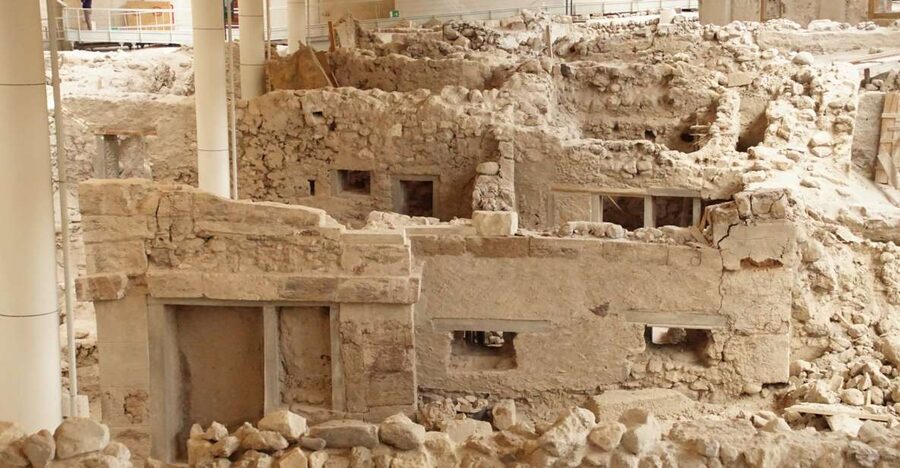
The House of the Ladies is another key stop. Its name points to the kind of detailed interpretation that makes Akrotiri worthwhile. Rather than seeing only construction remains, you get a glimpse into the people, homes, and routines behind them.
The audio discusses stories and details connected with daily life, as well as the more affluent Xeste buildings. This is the section where the visit can shift from archaeology lesson to human story. You begin thinking about residents making decisions, working, decorating their homes, and finally leaving as the volcano grew more threatening.
Some narration is technical. If you prefer plain explanations, use the pause and rewind controls instead of trying to absorb every sentence while walking. The material is intended to be educational, and a few sections may feel dense if you want a quick sightseeing stop.
The signs are in English as well, and they provide a useful backup. I would use both formats: listen for the broader story, then read the nearby panel to confirm what you are looking at.
What the volcanic burial preserved
Akrotiri’s most striking feature is the way volcanic ash sealed the town. The eruption buried buildings and contents, leaving behind a rare record of Bronze Age life.
The site does not simply show a city destroyed in the same way you might picture a battlefield ruin. Its power comes from the sudden interruption of ordinary life. Buildings, streets, and objects offer clues to a community that had time to leave as the volcano became more dangerous, yet left a town that was later covered and preserved.
The audio uses this setting to explain why the site matters. You learn not only about architecture but also about the relationship between the settlement and the eruption. That extra context helps you understand why Akrotiri is more than an attractive collection of ruins.
The comparison with Pompeii can create high expectations. If you have visited Pompeii, Akrotiri may feel smaller and less extensive. I would not choose it because you expect another Pompeii. Choose it because it gives you an older, more compact look at a prehistoric society, with architecture and preservation that many people find astonishing.
How good is the audio guide?
The audio is strongest when it supplies background that the short signs cannot. It explains the buildings, the evidence found at the site, and the lives of the people who used the town. Several parts are clear, well prepared, and easy to replay.
The self-guided format also suits independent visitors. You are not tied to a group’s pace, and you can stop whenever a room or wall catches your attention. If you are visiting with someone who reads slowly, takes photographs, or needs regular pauses, this flexibility is useful.
The weak point is navigation. Location markers are not always obvious, and the narration may tell you to look at something without making it clear where to stand. Sections can be roped off, and the route may have changed since the audio was recorded.
For that reason, I would treat the guide as a helpful companion, not a perfect set of turn-by-turn directions. Keep the site map and signs in view. If the app’s sequence becomes confusing, continue with the physical route and listen to the relevant sections when the subject becomes clear.
A live guide would be better for questions and instant correction. You could ask where a feature is, what has moved to a museum, or why a room matters. The audio ticket costs less than a private guided experience, though, and it gives you control over the length and pace of the visit.
Is $41 a fair price?
At $41 per person, the ticket is not a throwaway add-on. Its value depends on how much explanation you want.
The admission itself gives you access to an important prehistoric site, and the audio adds a layer of interpretation without requiring you to join a group. If you enjoy archaeology and want to understand the layout, homes, and volcanic burial, the combination can justify the price.
The calculation changes if you plan to share one device, rely mainly on signs, or prefer a short walk through the ruins. The audio is purchased per device, so a couple may not need two bookings if they are comfortable listening together.
Also check the wider ticket choices before buying. A separate three-site ticket is available across three days, and it may suit you better if you plan to visit several related archaeological sites. Free and reduced admission tickets can only be obtained on-site.
The activity is non-refundable, so confirm your date, phone compatibility, and download plan before paying.
Who will enjoy this most?
I would recommend it to adults, families with older children, and anyone who wants more than a quick photo stop. It suits people who like to read, listen, and examine buildings at their own speed.
It is also a smart choice on a very hot day. The shelter keeps the archaeological area shaded, and you can take pauses without falling behind a group.
You may want another option if you need a live guide, ask many questions, or dislike managing an app while sightseeing. Visitors with mobility concerns should know that the site is listed as wheelchair accessible, though you should still follow the site’s current instructions and marked route.
Wear comfortable shoes, bring headphones, and charge your phone fully. Heavy hiking footwear is not required based on the nature of the visit, but you should still choose shoes suitable for walking through an archaeological site.
Should you book the Akrotiri audio tour?
Book it if you want the freedom of a self-guided visit and care about the story behind the ruins. The site is exceptional, and the audio can turn walls and rooms into evidence of a vanished Bronze Age community.
I would not book it expecting flawless navigation or a substitute for a live archaeologist. Download the material early, allow time to get oriented, and use the signs when the narration and route disagree.
For most independent visitors, the ticket is worthwhile because Akrotiri can seem quiet and puzzling without context. If you prefer a simple walk and do not mind missing some detail, admission alone may be enough. If you want the best explanation available in a flexible format, this is a practical choice.
FAQ
Where is Akrotiri located?
Akrotiri is in Santorini, in Greece’s South Aegean region.
What does the $41 ticket include?
It includes adult entry to the prehistoric site of Akrotiri and a self-guided audio tour for a smartphone.
Is there a live guide?
No. This is a downloadable audio tour with no live guide or group meeting point.
What languages are available?
The audio guide is available in English, French, Italian, and German.
Do I need my own smartphone?
Yes. A compatible Android or iOS smartphone is required. A smartphone and headphones are not included.
Can I use the audio without mobile data?
Yes. The text, audio narration, and maps can be downloaded for offline use.
How much storage does the app need?
You should have about 100 to 150 MB of free storage on your phone.
Is the ticket tied to a specific time?
The selected time slot is binding for entrance to the museum. You may enter the archaeological site at any time on the selected date.
Is Akrotiri wheelchair accessible?
Yes. The site is listed as wheelchair accessible.
What should I bring?
Bring comfortable shoes, sunscreen, headphones, and a fully charged smartphone.
Just added around Santorini
- Small-Group Tour: Best of Santorini★ 4.7 · 42 reviews
- Santorini Volcano, Hot Springs Adventure★ 3.6 · 54 reviews
- Santorini Wine Roads: Tour of 3 Wineries with a Sommelier★ 4.8 · 79 reviews
- Santorini: Private Sightseeing Tour with Local Guide★ 4.9 · 105 reviews
- Santorini: Wine Tour with Sunset in Oia★ 4.6 · 199 reviews
- Santorini: Tour of Wineries with Wine Tasting & Food★ 5.0 · 279 reviews
- From Santorini: Volcano Cruise With Oia Sunset★ 4.3 · 97 reviews
- Santorini: Small-Group Highlights Tour of Venetian Castles★ 4.9 · 83 reviews
Audio Tours, compared.


Cape Sounio & Poseidon Temple Trip with Audio Guide
Read our review →
Acropolis Museum Ticket with optional Audio Guide
Read our review →
Acropolis Ticket & Optional Self-Guided Audio Tours
Read our review →
Parthenon & Acropolis Museum with Audio or Live Tour Option
Read our review →
Knossos Palace Entry Ticket with Optional Audio Guide
Read our review →Browse the lists this tour appears in