Reviewed · FULL-DAY
Argolis Private Full Day tour
Ancient kingdoms lie beyond Athens. This private Argolis day tour links the Corinth Canal, Ancient Corinth, Mycenae, Nafplio, Tolon, and Epidaurus in roughly nine to ten hours, with pickup and drop-off in Athens or at Piraeus Port. It is a long day, but it gives you a satisfying look at the Peloponnese without arranging several trains, buses, and taxis.
I like the private vehicle and the freedom to shape the day around your interests. I also like the mix of major archaeological sites, a seaside lunch stop, and the small historical city of Nafplio. The main drawback is that the driver cannot enter the archaeological sites with you. For fuller explanations inside Corinth, Mycenae, and Epidaurus, you need to arrange the optional licensed guide for 400 euros in cash.
In This Review
- Key points to know before booking
- Why this private Peloponnese day works
- Corinth Canal: a 20-minute engineering stop
- Ancient Corinth and the Temple of Apollo
- Mycenae: the day’s Bronze Age centerpiece
- Nafplio: a welcome change of pace
- Tolon lunch beside the Saronic Gulf
- Epidaurus and its remarkable theater
- Driver service, transport, and the guide question
- Is $533.95 good value?
- Who should book this tour?
- Final verdict: a smart long day beyond Athens
- FAQ
- How long does the Argolis private tour last?
- What destinations are included?
- Is pickup included from Athens or Piraeus Port?
- Are entrance fees included?
- Is a licensed tour guide included?
- Can I cancel the tour for a full refund?
Key points to know before booking
- Corinth Canal is a quick but worthwhile first stop: You get about 20 minutes to see the dramatic cut through the Isthmus and take photographs.
- The day covers three major ancient sites: Ancient Corinth, Mycenae, and Epidaurus each offer a different window into Greek history.
- Mycenae is the most important stop for Bronze Age fans: Its Lion Gate and hilltop citadel connect directly with the Mycenaean period of Greek civilization.
- Nafplio and Tolon slow the pace: Nafplio offers a pleasant historic town break, while Tolon provides a family-run seaside lunch setting.
- The price makes most sense for a small group: At $533.95 for up to three people, the cost is easier to justify when shared.
- A licensed guide is optional, not included: Your English-speaking driver explains the sites from outside, but site interpretation is your responsibility unless you add a guide.
Why this private Peloponnese day works
The appeal here is simple: you can leave your Athens hotel or Piraeus cruise terminal in a private, air-conditioned vehicle and spend the day seeing places that are awkward to combine on your own. WiFi and bottled water are included, and the vehicle is private to your group.
The route also gives you a useful contrast. Corinth shows a busy ancient commercial center shaped by trade. Mycenae takes you much further back, to the Bronze Age. Epidaurus brings you to a sanctuary and theater built around healing, performance, and civic life. Nafplio and Tolon add modern Greek atmosphere between the ruins.
This is not a slow archaeological study tour. You get about 45 minutes at Ancient Corinth, one hour at Mycenae, and 45 minutes at Epidaurus. Those visits allow you to see the principal sights, but you will need to keep moving and make good use of the driver’s explanations.
The private format helps. You do not wait for unknown passengers or follow a fixed group schedule. If your group cares more about ancient sites than shopping, you can ask for more time where possible. If you need a break, the town and seaside stops keep the day from becoming one long march over sunlit stones.
A few more Athens half-days to weigh up
- All Day Cruise -3 Islands to Agistri,Moni, Aegina with lunch and drinks included
★ 5.0 · 4,958 reviews - From Athens: Delphi Full Day V.R. Audio Guided Tour
★ 4.6 · 3,028 reviews - Athens Full Day Private Tour
★ 5.0 · 2,903 reviews
Corinth Canal: a 20-minute engineering stop
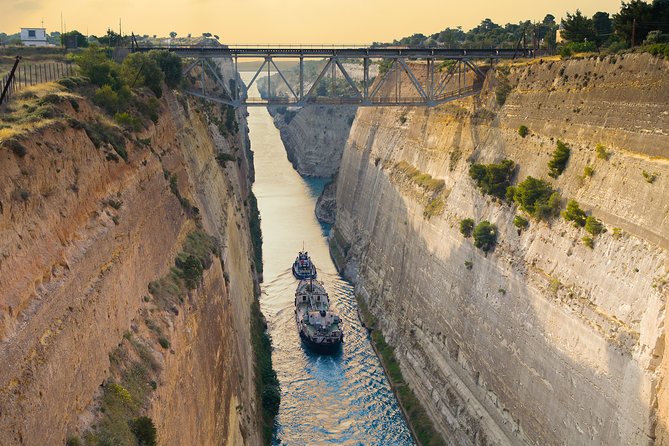
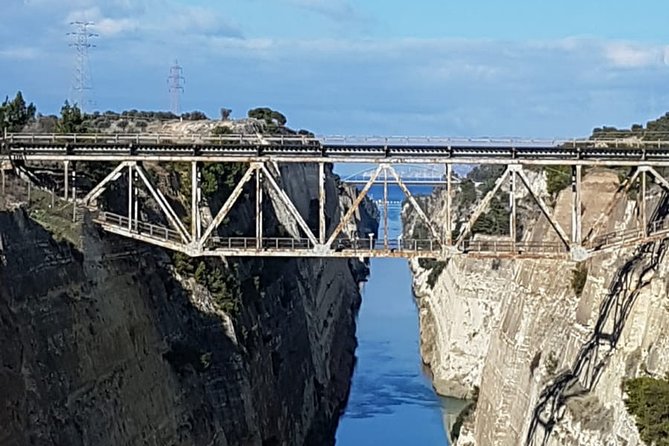
The Corinth Canal is one of those places that is easier to understand in person than on a map. It cuts through the narrow Isthmus of Corinth, linking the Gulf of Corinth with the Saronic Gulf. The channel separates the Peloponnese from mainland Greece, at least in practical geographic terms.
You will have about 20 minutes here. That is enough to look down into the canal, see the steep walls, and take photographs, but not enough for a lingering visit. The canal is 6.4 kilometers long and only about 21.4 meters wide at its base, so most modern ships cannot use it.
Its story is unusually long. People proposed cutting through the Isthmus in classical times, and an attempt was made in the first century. Modern construction began in 1881 and finished in 1893 after geological and financial troubles. Landslides and the canal’s narrow width later limited its commercial value.
I consider this a good opening stop because it breaks up the drive from Athens and gives you a clear sense of the geography ahead. Do not expect a full attraction with a long program. Think of it as a sharp visual introduction to the Peloponnese.
Admission is not included, so confirm the current access arrangements when booking. The tour information lists no entrance fee for this stop, but it does identify admission tickets as excluded.
Ancient Corinth and the Temple of Apollo
Ancient Corinth deserves more than a quick glance, and the planned 45 minutes will feel short if you enjoy archaeology. The city occupied a powerful position on the Isthmus, where traffic and trade moved between central Greece and the Peloponnese. That location helped Corinth rival Athens and Thebes in wealth and influence.
The site has layers from Greek, Roman, Byzantine, and later periods. Corinth began as an important Greek city, founded colonies such as Syracuse and Corfu, joined major conflicts, and eventually became a Roman colony under Julius Caesar in 44 BCE. Under Roman rule, it served as the administrative center of the province of Achaea.
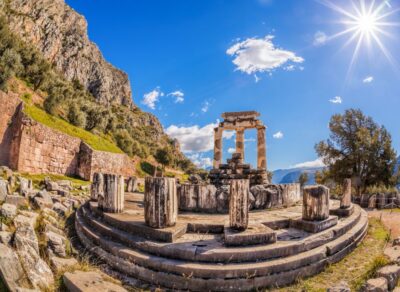
The first sight that catches your eye is the Temple of Apollo. Built around the middle of the sixth century BCE, it is especially notable for its large monolithic columns. Seven columns still remain, a striking fragment of the city’s earlier glory.
The agora gives you a sense of Corinth as an organized public center rather than a collection of isolated ruins. You can see the remains of the Basilica Iulia, the bema or speaking platform, and the broad Lechaion Road. The road once functioned as a commercial center, lined with shops under covered galleries. Its paved surface remains one of the most effective parts of the visit because you can still follow the route through the ancient city.
Look for the Fountain of Peirene near the gateway to Lechaion Road. Its spring was famous for clear water and was linked in myth with Pegasus. The Roman Odeion and the theater add another layer, showing how performance and public entertainment fit into Corinthian life.
Your driver can explain the history and point out the main features, but cannot accompany you inside the site. That legal restriction matters. If you want a structured walk through the agora, temple, roads, and museum, the optional licensed guide is worth considering, especially for first-time archaeology visitors.
Mycenae: the day’s Bronze Age centerpiece
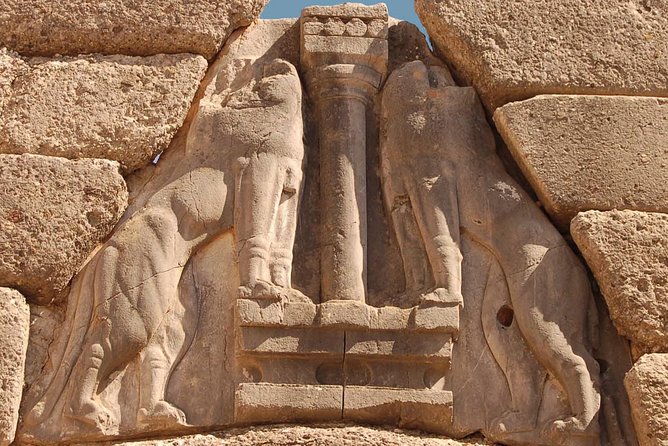
Mycenae is likely to be the emotional high point for anyone drawn to Homer, Bronze Age Greece, or ancient fortifications. The site sits on a hill in Argolis, about 120 kilometers southwest of Athens and around 48 kilometers south of Corinth. Its elevated position helped it control routes across the northeastern Peloponnese.
Mycenae gave its name to the Mycenaean period, broadly dated from about 1600 to 1100 BCE. At its peak around 1350 BCE, the citadel and lower town may have held 30,000 people across roughly 32 hectares. Even in ruin, the hilltop setting helps you understand why this was a military center.
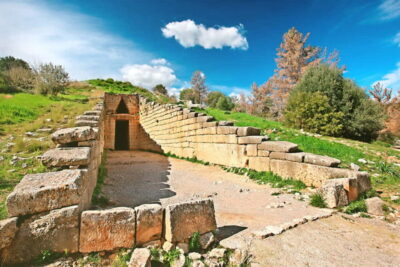
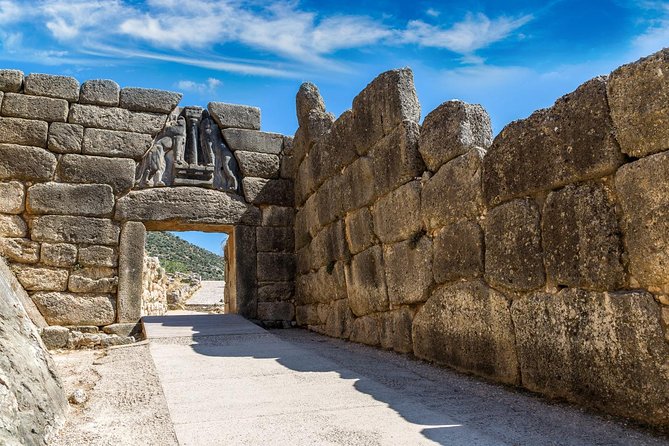
The Lion Gate is the essential sight. It formed the main entrance to the citadel and became the clue that helped early modern investigators identify the site from the description given by the ancient writer Pausanias. The massive stones around the entrance also give Mycenae a different character from the more open public spaces at Corinth.
You will have about one hour here. That is enough for the principal ruins, but the uneven, uphill setting can make the visit feel active, especially in warm weather. Wear firm shoes, carry the bottled water provided, and use the time wisely rather than trying to inspect every corner.
The tour description identifies Mycenae as an archaeological site, not a guided museum visit. Your driver can offer background before you enter, but the best experience comes from adding the licensed guide if you want the myths, architecture, and Bronze Age setting explained as you walk.
Admission is not included. The listed combined entrance cost for Ancient Corinth, Mycenae, and Epidaurus is 55 euros per adult. Set aside this amount in addition to the tour price.
Same stretch of coastline, a completely different day out:
- Athens: Acropolis & up to 5 Archaeological Sites Combo Pass
★ 4.4 · 12,619 reviews - Athens: Acropolis Ticket with Optional Audio or Live Guide
★ 4.2 · 11,055 reviews - Athens: Acropolis, Parthenon & Acropolis Museum Guided Tour
★ 4.8 · 9,316 reviews - Athens: Cape Sounion & Poseidon Temple Sunset Half-Day Trip
★ 4.8 · 8,241 reviews
Nafplio: a welcome change of pace
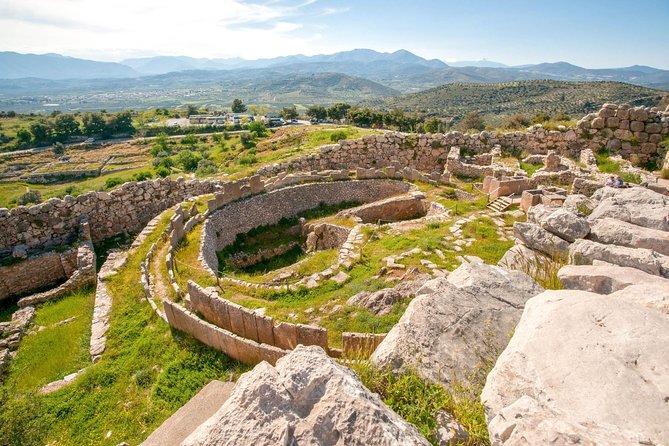
After the ancient sites, Nafplio gives you a needed change of rhythm. The seaport town spreads up the hills near the northern end of the Argolic Gulf and has served as an important port under Byzantine, Venetian, Ottoman, and Greek rule.
Nafplio was the capital of the First Hellenic Republic and later the Kingdom of Greece from the beginning of the Greek Revolution in 1821 until 1834. That short period gives the town unusual importance in modern Greek history. You are not simply stopping at a pretty harbor town. You are standing in one of the first political centers of the new Greek state.
The planned stop lasts about 40 minutes and is free. That is enough to stretch your legs, look around the waterfront, and get a feel for the town, but not enough for a full exploration of its fortresses, streets, and museums. The schedule treats Nafplio as a pause, not the main attraction.
I like this part of the route because it prevents the day from becoming too heavy with ruins. If you are hoping for a long café break or time to browse shops, ask about the schedule before departure. The route has several fixed archaeological visits, and traffic can affect how much free time remains.
Tolon lunch beside the Saronic Gulf
Tolon, about seven kilometers east of Nafplio, is the lunch stop. The meal takes place at a traditional family-owned restaurant with a view of the Saronic Gulf, but lunch is not included in the tour price.
The scheduled time is about 45 minutes. That makes this a practical meal stop rather than an extended coastal afternoon. You can expect the setting to provide a pleasant break, though the exact menu and cost are not specified, so plan to pay separately.
I see this as one of the most appealing human touches in the itinerary. After temples, fortifications, and ancient roads, a family-run restaurant gives you time to sit down and enjoy a local meal in a modern Greek setting. One highly praised account specifically highlighted the seaside lunch as yummy, so this is a good place to ask the driver for help with the day’s food choices.
If lunch is a priority, keep an eye on the clock. The tour still has Epidaurus ahead, and the full route must eventually return to Athens or Piraeus.
Epidaurus and its remarkable theater
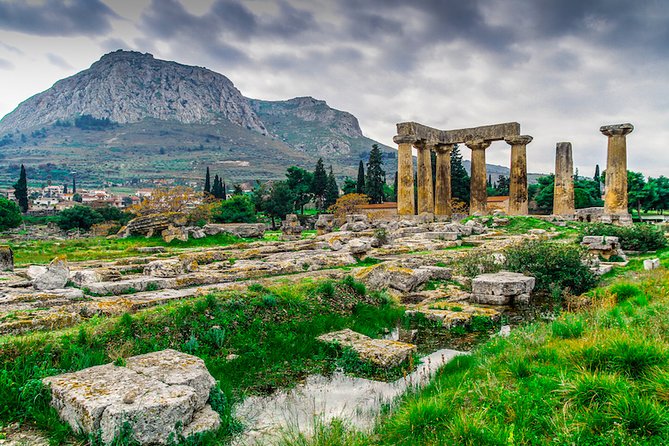
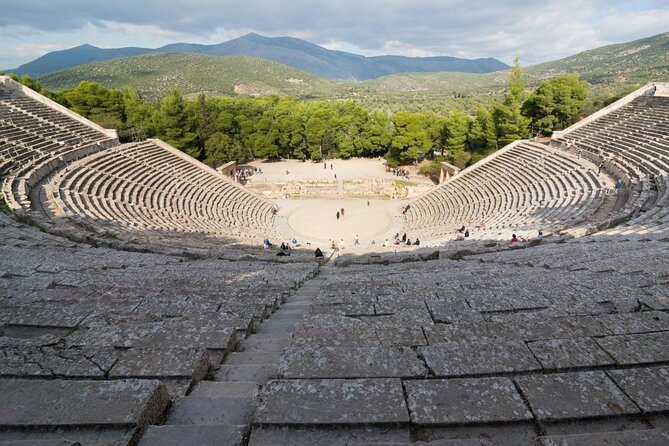
The Ancient Theatre of Epidaurus closes the sightseeing portion with one of Greece’s most memorable ancient structures. The theater dates from the third century BCE and is part of the Sanctuary of Asclepius, a healing center that also served as a place of culture and worship.
The theater is famous for its acoustics. Its circular orchestra and carefully arranged seating remain unusually well preserved, and the space is still used for performances today. If you stand in the lower area while someone speaks from the center, you can appreciate how the design carries sound across the seats.
You will have about 45 minutes here. That allows time to see the theater and understand its setting, though it may feel brief if you want to explore the wider sanctuary. The theater is the clear priority on a tightly scheduled day.
Epidaurus also helps explain ancient Greek life beyond temples and battles. Healing, music, drama, religion, and public gatherings were connected here. I find it a fitting final stop because the visit is both visually striking and easy to grasp without a long lecture.
Entrance is extra, included in the combined 55 euro per adult estimate with Corinth and Mycenae. As at the other sites, your driver cannot guide you inside unless you add the optional licensed guide.
Driver service, transport, and the guide question
The tour includes private transportation in an air-conditioned vehicle, hotel or Piraeus pickup and drop-off, WiFi, and bottled water. An English-speaking professional driver provides background on the monuments and explains points about ancient and modern Greece during the journey.
The driver is not a licensed site guide. This is the single most important practical detail to understand before paying. You will receive useful orientation in the vehicle, but once you enter an archaeological site, you explore independently unless you arrange the licensed guide.
The optional English-speaking guide costs 400 euros in cash and depends on availability. For a couple or small group mainly interested in scenery and the famous sights, the driver’s explanations may be enough. For history-minded visitors, families with older children, or anyone who wants the ruins to make sense, the extra cost can be worthwhile.
Pickup is offered from Athens hotels and Piraeus Port. At the airport, the driver meets you at the customs exit holding an H.P. Tours sign with your name. At Piraeus, there are three terminals. You meet the driver at the exit for your terminal, but if Terminal B or C has a closed exit gate, you take the shuttle to Terminal A, a ride of about three minutes, where the driver waits.
Airport pickup and drop-off can be arranged for an additional fee, depending on the vehicle. Most people can participate, and public transportation is nearby, although this experience itself relies on private transport.
Is $533.95 good value?
The listed price is $533.95 per group of up to three people. Shared three ways, that is about $178 per person before entrance fees, lunch, and any optional guide. For two people, the per-person cost rises, but you gain a private vehicle and a route that would be cumbersome to arrange independently in one day.
The value is strongest if you are arriving by cruise ship or staying in Athens for a short time. Pickup and drop-off remove much of the planning, and the private format means you are not fitting into someone else’s group timetable.
Budget for three main extras:
- 55 euros per adult for admission to Ancient Corinth, Mycenae, and Epidaurus
- Lunch in Tolon
- 400 euros in cash if you add the licensed guide
The price is less attractive for solo visitors, since the group rate is designed for up to three people. It also becomes a costly choice if your main goal is a slow visit to one site. You are paying for distance, convenience, and the ability to combine several places in a single day.
The experience has a perfect five-star rating from 31 reviews, with 100 percent recommending it. The praise centers on punctual pickup, a comfortable and safe ride, helpful explanations, personalization, and the seaside lunch. Jimmy is singled out for making one private tour feel especially tailored, so you can request him when booking, but do not assume he will be available.
Who should book this tour?
I would choose this tour if you want to see several major sites in one day and prefer a private car to public transportation. It suits couples, families, and small groups sharing the cost, particularly those staying in Athens or arriving at Piraeus.
It is also a strong choice for cruise passengers. The port pickup instructions are clear, and the return to Piraeus is built into the service. Still, confirm the timing carefully with the operator if your ship has a fixed departure time, since the day lasts nine to ten hours and road conditions can change the schedule.
History enthusiasts should strongly consider the licensed guide. Without one, you will see the sites and receive explanations during the drives, but you will not have an expert walking among the ruins with you.
You might choose another arrangement if you want a relaxed coastal day, a long lunch, or extensive time in Nafplio. This is an ambitious sightseeing circuit. Its reward is range, not leisure.
Final verdict: a smart long day beyond Athens
I recommend the Argolis Private Full Day Tour for anyone who wants Corinth, Mycenae, Nafplio, and Epidaurus without taking on the transport planning. The private vehicle, flexible format, comfortable ride, and well-liked service make the long route manageable.
Book it when your priority is seeing a lot of the Peloponnese in limited time. Add the licensed guide if the ancient sites are the main reason you are going. If you want a slower, more focused visit, choose fewer destinations and spend longer in each. For a first introduction to Argolis, though, this route gives you an impressive sweep from Bronze Age citadel to Greek theater, with a good plate of food and sea air in between.
FAQ
How long does the Argolis private tour last?
The tour lasts approximately nine to ten hours.
What destinations are included?
The route includes the Corinth Canal, Ancient Corinth, the Archaeological Site of Mycenae, Nafplio, Tolon, and the Ancient Theatre of Epidaurus.
Is pickup included from Athens or Piraeus Port?
Yes. Hotel pickup and drop-off in Athens and pickup and drop-off at Piraeus Port are included. Airport pickup and drop-off can be arranged for an additional fee.
Are entrance fees included?
No. Entrance to Ancient Corinth, Mycenae, and Epidaurus is not included. The listed combined cost is 55 euros per adult.
Is a licensed tour guide included?
No. The English-speaking driver explains the monuments and history but cannot enter the sites as a guide. A licensed English-speaking guide can be arranged for 400 euros in cash, subject to availability.
Can I cancel the tour for a full refund?
Yes. You can cancel at least 24 hours before the experience start time for a full refund. Cancellations and changes made less than 24 hours before the start time are not accepted for a refund.
Just added around Athens
- Delphi One Day Trip from Athens★ 4.0 · 98 reviews
- Private Delphi and Hosios Loukas Monastery – Great Lunch and Drinks Included★ 5.0 · 36 reviews
- Mercedes Private Tour to Delphi and Arachova★ 5.0 · 30 reviews
- Day tour to Ancient Olympia,Ancient Sparta Mycenae Including Meal★ 5.0 · 54 reviews
- Athens: Half Day Trip To Cape Sounio/Poseidon Temple Semi Private★ 5.0 · 131 reviews
- Athens Half-Day Private Tour Acropolis, Parthenon City Highlights★ 5.0 · 35 reviews
- From Athens: Day Tour to Mykonos★ 5.0 · 64 reviews
- Culinary Secrets of Downtown Athens★ 5.0 · 103 reviews
Full-Day, compared.
From the Port of Kos: Full Day Boat Cruise to 3 Islands
Read our review →
All Day Cruise -3 Islands to Agistri,Moni, Aegina with lunch and drinks included
Read our review →
Full-Day Samaria Gorge Trek Excursion & Guide
Read our review →