

Reviewed · CITY TOURS
Athens: City Sightseeing Hop-On Hop-Off Bus Tour
See Athens without wearing out your shoes. This open-top bus gives you an easy first look at the Acropolis, Parthenon, Plaka, and major museums, while letting you get off whenever a stop catches your eye. I like the clear route system and the helpful staff at many stops, but the service finishes fairly early on the Athens route, and the extra lines may cost more than expected.
I also like the freedom of a 24-hour, 48-hour, or 72-hour pass. You can use the bus as a moving introduction to Athens, then as practical transport between sights. The main drawback is that the voucher must first be exchanged for a ticket, and the Piraeus and Riviera routes have much fewer departures than the city route.
In This Review
- Key points at a glance
- My take on the Athens sightseeing bus
- Syntagma Square and the start of the city route
- Acropolis, Plaka, and the Parthenon stops
- Temple of Olympian Zeus, gardens, and the Olympic Stadium
- Museums, libraries, and Omonoia
- Piraeus: useful for cruise passengers and port views
- The Riviera route and Vouliagmeni Lake
- How to use one, two, or three days
- Audio commentary, staff, and comfort
- Is the $25 price good value?
- The best way to plan your day
- Should you book this Athens bus tour?
- FAQ
- How long are the available bus passes?
- What time does the Athens route operate?
- How long does the full Athens route take?
- Does the ticket include Piraeus and the Riviera?
- How often does the Piraeus route run?
- How often does the Riviera route run?
- Are attraction entrance fees included?
- Can I use a mobile voucher?
- Is the bus wheelchair accessible?
Key points at a glance
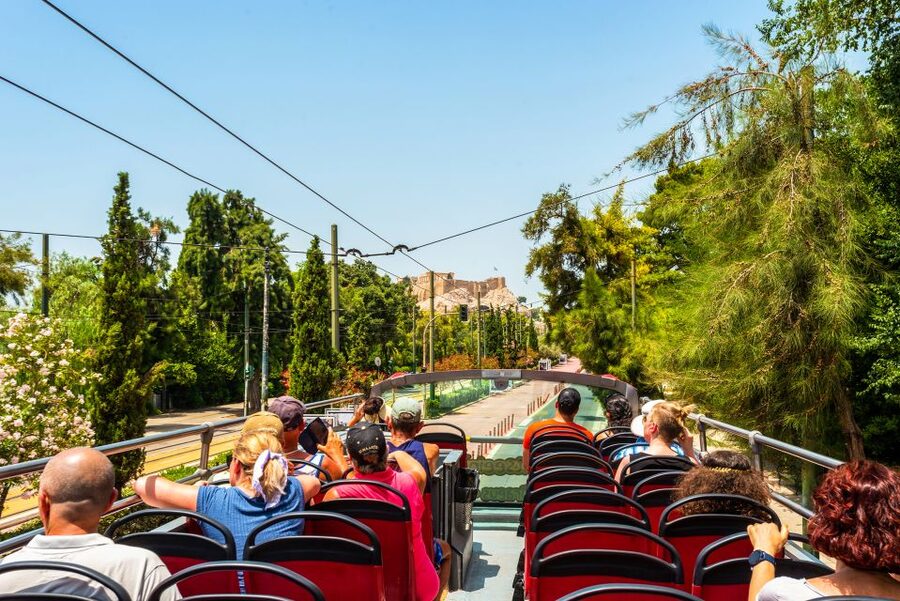
- Three ways to see Athens: Choose the city route alone, or add Piraeus and the southern beach route.
- Best first stop: Syntagma Square is the main city terminal and a useful place to redeem your voucher.
- Strong Acropolis coverage: Several stops serve the Acropolis, Plaka, and Acropolis Museum.
- Beach access included with the right ticket: The Riviera route reaches Glyfada, Vouliagmeni Lake, and several beaches.
- Useful in hot weather: The upper deck gives you views, while air-conditioned lower seating offers a break from the sun.
- Allow time for slow sections: The Athens circuit takes about 90 minutes, and waits can stretch your sightseeing day.
My take on the Athens sightseeing bus

I see this as a good orientation tour and a useful transport pass, not a replacement for walking through Athens. You will see the city’s headline sights from the road, hear basic historical commentary, and get a sense of how the central districts fit together. The real value comes when you combine the ride with carefully chosen stops.
The standard Athens route takes about 90 minutes from start to finish. Buses are scheduled every 20 to 30 minutes, though the actual wait can vary with traffic. The first published departure from Syntagma Square is 8:30am, and the last is 4:30pm, so do not assume this is an evening sightseeing service.
The bus is open-top and double-decker. The upper level gives you the best view and the easiest photo angles, but the ride can be sunny and windy. Some buses have shaded sections, and the lower level offers air conditioning, which matters greatly during a hot Athens afternoon.
The audio commentary is available in English, Spanish, Turkish, Chinese, French, German, Greek, Italian, Japanese, Portuguese, Russian, Hebrew, and Dutch. The driver speaks English. Headphones are included, and the commentary is generally timed to the stops, although the quality of the content can feel a little dated in places.
A few more Athens half-days to weigh up
- Athens: Acropolis & up to 5 Archaeological Sites Combo Pass
★ 4.4 · 12,619 reviews - Athens: Acropolis Ticket with Optional Audio or Live Guide
★ 4.2 · 11,055 reviews - Athens: Acropolis, Parthenon & Acropolis Museum Guided Tour
★ 4.8 · 9,316 reviews
Syntagma Square and the start of the city route
Syntagma Square is the most practical starting point for many people. It is Stop A1, the main Athens terminal, and the place where you can redeem your mobile or printed voucher with an agent before boarding.
The square gives you a useful first look at central Athens. From here, the route connects the historic center with museums, parks, shopping areas, and neighborhoods farther from the Acropolis. If you have only one day, I would begin with one full circuit before deciding where to get off.
There is also a small perk here: a free glass of Greek beer, except on Sundays and bank holidays. The beer is available at Stop A1. It is not a reason to buy the ticket, but it is a pleasant way to finish a ride or pause before continuing through the city.
Keep your voucher ready. It is accepted on a phone or as a printed page, but it is not itself the bus ticket. An agent at a stop or on the bus must redeem it first. This is a small step, but missing it can cause confusion at the beginning.
Acropolis, Plaka, and the Parthenon stops

The strongest part of the Athens route is its coverage around the Acropolis. Stops include Acropolis and Plaka, the Acropolis Museum, and the Acropolis and Parthenon interchange.
Do not expect the bus to take you inside the Acropolis grounds. Entrance tickets are not included, and you will need to explore the archaeological site on foot. What the bus does well is place you close to the main sightseeing area without requiring you to work out the city transport system first.
The Acropolis and Plaka stop is useful for wandering the old central streets. Plaka has shops, restaurants, and lanes that reward a slow walk. The nearby Acropolis Museum stop is better if you want to spend serious time indoors with ancient sculptures and archaeological displays.
The Acropolis and Parthenon stop also serves as the interchange for the Piraeus route. That makes it important for anyone using the expanded ticket. Check the route color and destination before boarding, since the Athens, Piraeus, and Riviera services are separate lines.
The bus gives you a fine outside view of the Acropolis area, but the best photographs usually come after you get off. From the upper deck, you have only a few seconds to frame a passing monument, and traffic can make the view unpredictable.
Temple of Olympian Zeus, gardens, and the Olympic Stadium

Stop 5 serves the Temple of Olympian Zeus, one of the major ancient sites along the route. The temple’s massive surviving columns are easy to spot from the bus, but you will need an attraction ticket if you want to enter.
The nearby Parliament and National Gardens stops are useful for a change of pace. The National Garden is a quiet green space in the center of Athens, and it makes a sensible break after the crowded Acropolis district. You can use the bus to reach the garden, walk for a while, then continue from the nearby stop.
The route also serves the Ancient Olympic Stadium. This is another place where the bus works best as a link between sights. You can get off, explore at your own speed, and catch a later bus instead of arranging a taxi for every short move.
The route uses two listings for Parliament and National Gardens, Stop 6 and Stop 9B. Pay attention to the direction of travel. The city circuit doubles back in places, so a ride that looks short on the map can take longer than expected.
Same stretch of coastline, a completely different day out:
- Athens: Cape Sounion & Poseidon Temple Sunset Half-Day Trip
★ 4.8 · 8,241 reviews - Athens: Acropolis and Parthenon Guided Walking Tour
★ 4.6 · 5,882 reviews - All Day Cruise -3 Islands to Agistri,Moni, Aegina with lunch and drinks included
★ 5.0 · 4,958 reviews - Athens, Piraeus, and Coastline: Blue Hop-On Hop-Off Bus
★ 3.9 · 4,849 reviews
Museums, libraries, and Omonoia
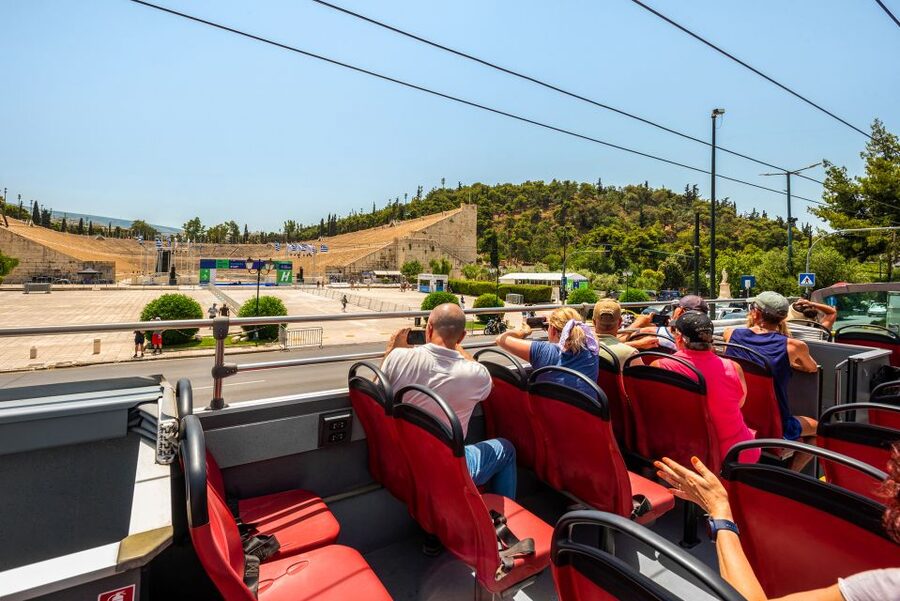
Stop 7, listed as the Four Museums, is aimed at people who want more than ancient temples. Stop 8 serves the National Gallery, while Stops 10 and 11 bring you toward the National Library and National Archaeological Museum.
The National Archaeological Museum is especially useful if you want a broad view of Greek art and archaeology beyond the Acropolis. The bus stop makes it easier to place the museum into a busy sightseeing day, though you should allow plenty of time inside rather than treating it as a quick photo stop.
Omonoia Square is Stop 12. It gives you access to a different part of central Athens and helps connect the main tourist core with the city’s wider commercial areas. Karaiskaki Square, Monastiraki Square, and Kotzia Square complete the route.
Monastiraki is one of the most useful stops for a break, shopping, and food. It is also a good place to end a ride and continue on foot. The bus commentary points out shopping opportunities along the route, but you should still use your own judgment about where to spend your limited time.
Piraeus: useful for cruise passengers and port views
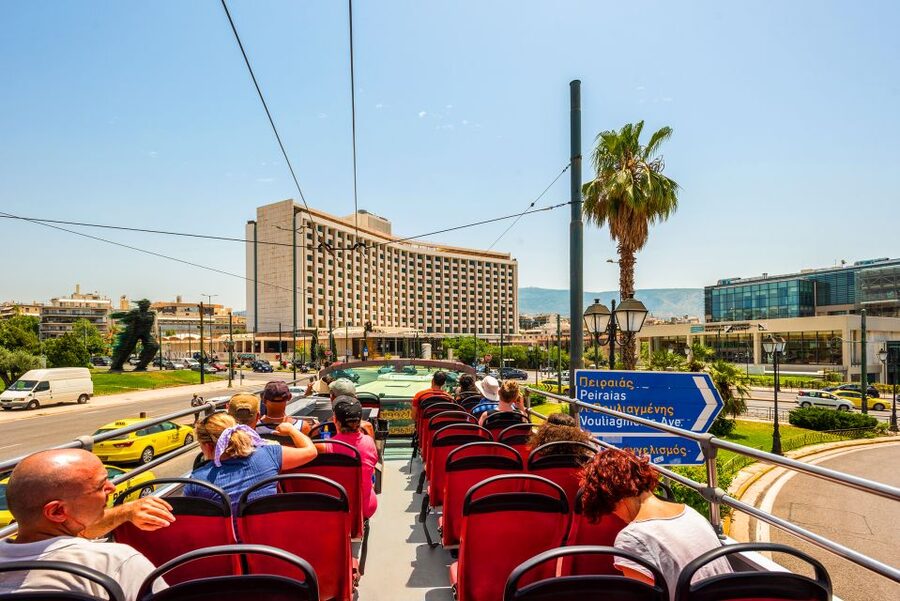
The Piraeus route takes about 80 minutes, with published departures at 11am and 3pm. It connects with the Athens route at the Acropolis and Parthenon stop.
This line is particularly practical if you are staying near the port or arriving on a cruise ship. Stops include the cruise terminals, the Lions Gate, the Archaeological Museum of Piraeus, Votsalakia Beach, and Mikrolimano Harbour.
The Municipal Theatre and Planetarium add a more local side to the ride. The route is not just a shuttle between Athens and a ship. It also shows you parts of the port city that you would likely miss if you stayed near the Acropolis.
Plan this route carefully. With only two listed departures, missing a bus has a much greater effect than missing one on the Athens circuit. You also need to confirm that your selected ticket includes Piraeus. Several ticket options do not cover every line, and an upgrade may be required.
The Riviera route and Vouliagmeni Lake
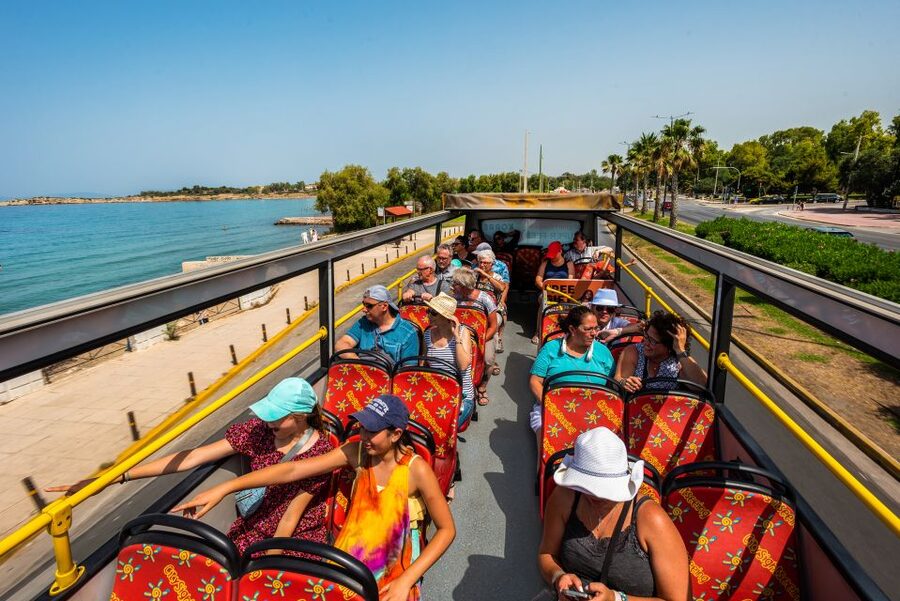
The Beach and Riviera route takes about 110 minutes and runs at 11am, 1pm, and 3pm. It begins from the Acropolis and Plaka interchange and follows the coast toward the southern suburbs.
The route includes the Stavros Niarchos Foundation, Flisvos, Edem, several beaches, Glyfada town, Agios Kosmas, and the area around the Planetarium. It also reaches Vouliagmeni Lake, one of the most distinctive stops on the extended route.
This is a worthwhile addition if you have at least two days, or if you have already seen the central monuments. The Riviera ride gives you a different picture of Athens, with coastal neighborhoods and beach areas replacing the ancient ruins and museums.
Do not choose this route expecting a quick beach transfer. The full circuit takes nearly two hours, and the limited departures require planning. If you want to get off at Vouliagmeni Lake or a beach, check the return timing before leaving the bus.
The exact ticket matters here. The expanded Athens, Beach-Riviera, and Piraeus option provides access to all three routes. Some passengers have found that the other lines require an additional fee, reported as about €5 per person for a route. Check the inclusions at checkout rather than assuming every pass covers the full network.
How to use one, two, or three days
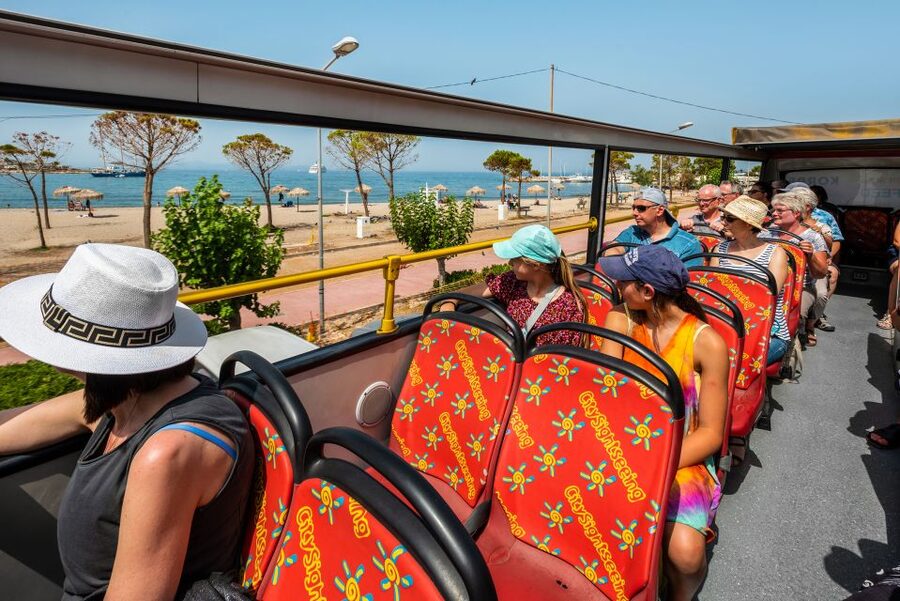
A 24-hour pass works best for a short visit. I would take one complete Athens circuit early, note the places that interest you, then get off at the Acropolis, Acropolis Museum, National Gardens, or Monastiraki. You can usually cover the central route in a day, but you will need to keep moving.
A 48-hour pass is the most balanced choice for many visitors. Use the first day for the Acropolis area and central Athens. Use the second for museums, the National Garden, the Ancient Olympic Stadium, or the Riviera route.
A 72-hour pass makes more sense if you want all three routes without rushing. You can devote one day to Athens, one to Piraeus, and one to the coast. It also gives you more flexibility if heat, traffic, or a long museum visit changes your plans.
The pass is valid for the selected period, not simply for a single ride. That lets you treat the bus as a flexible connection between districts. Still, do not build a tight schedule around exact arrival times. Athens traffic can slow the circuit, and some stops have longer gaps than others.
Audio commentary, staff, and comfort

The audio guide is one of the better practical features. It gives you a basic explanation of the history and culture as you pass the sights, and the commentary is coordinated with many stops. That helps you decide where to get off instead of riding past places without context.
Sound quality can vary. Some riders have found the guide difficult to hear, while others found the audio clear and all headphone ports working. Bring your own earphones only if you prefer them, but the tour includes headphones.
Staff at the stops are a real help, especially when you are sorting out routes or connections. Agents can explain where to board, exchange the voucher, and help you shorten a journey when the route doubles back. This is useful at the Acropolis interchange and at the more complicated Piraeus connections.
Free WiFi is included. Air conditioning is available on the lower level, while the upper deck provides the better view. Smoking and pets are not allowed, and the buses are wheelchair accessible.
Is the $25 price good value?
At about $25 per person, the basic pass is fairly priced if you use it for more than a single circuit. It becomes better value when you use the bus for transport between several sights, especially if you dislike changing between unfamiliar city services.
The pass is less attractive if you only want a narrated ride and do not plan to get off. It is also less useful if your hotel is far from every stop. One practical tip is to choose accommodation near a route stop if you expect to rely on the bus for most of your sightseeing.
The extra routes can change the calculation. Piraeus and the Riviera are worthwhile, but only if you have enough time to use them. Before paying, confirm whether your chosen option includes both routes or whether an extra €5 charge applies.
Attractions are not included, and neither are food or drinks apart from the free beer at Stop A1 under the stated conditions. You are paying for transport, commentary, and flexibility, not admission to the Acropolis, museums, temples, or beaches.
The best way to plan your day
I would start by redeeming the voucher at Syntagma Square or another staffed stop. Then take a short ride or one full circuit to understand the route direction and the interchange points.
For the Acropolis, get off near the Acropolis or Plaka stops and allow time to walk. For the museum, use the dedicated Acropolis Museum stop rather than assuming every bus stop is equally close.
In summer, ride early or in the late afternoon. The upper deck is exposed, and the heat can make a long circuit tiring. In cooler weather, the bus gives you shelter, though you should still bring your identification because a passport or ID card is listed as required.
Keep your phone ready for route information, but do not rely only on the bus for a strict appointment. Published times are clear, yet road traffic and stopovers can affect the day. The Athens route has frequent service, but Piraeus and Riviera departures are limited.
Should you book this Athens bus tour?
Book it if you want a low-stress introduction to Athens, need simple links between major sights, or are traveling during very hot weather. It is also a sensible choice for a short stay, a cruise stop, families, and anyone who prefers not to begin with the metro.
Choose the 48-hour option if you want a relaxed balance between central Athens and one additional area. Choose 72 hours if Piraeus, the coast, and Vouliagmeni Lake are all on your list.
Skip the expanded ticket if you only care about the Acropolis and central museums. In that case, the Athens route alone should be enough. The bus will not replace walking or museum time, but it gives you a comfortable overview and a practical way to connect the city’s main sights.
FAQ
How long are the available bus passes?
You can choose a 24-hour, 48-hour, or 72-hour pass.
What time does the Athens route operate?
The first published Athens route departure from Syntagma Square is at 8:30am, and the last is at 4:30pm. Buses are scheduled every 20 to 30 minutes.
How long does the full Athens route take?
The Athens circuit takes about 90 minutes.
Does the ticket include Piraeus and the Riviera?
Only the Athens, Beach-Riviera with Piraeus ticket includes access to the Riviera Beach and Piraeus routes. Check your selected option because other lines may require an upgrade.
How often does the Piraeus route run?
The Piraeus route has published departures at 11am and 3pm, and the full route takes about 80 minutes.
How often does the Riviera route run?
The Beach and Riviera route has published departures at 11am, 1pm, and 3pm. The full route takes about 110 minutes.
Are attraction entrance fees included?
No. Tickets for the Acropolis, Parthenon, museums, temples, and other attractions are not included.
Can I use a mobile voucher?
Yes. Mobile and printed vouchers are accepted, but you must redeem the voucher with an agent at a stop or on the bus before boarding.
Is the bus wheelchair accessible?
Yes, the activity is listed as wheelchair accessible.
Just added around Athens
- Delphi One Day Trip from Athens★ 4.0 · 98 reviews
- Mercedes Private Tour to Delphi and Arachova★ 5.0 · 30 reviews
- Private Delphi and Hosios Loukas Monastery – Great Lunch and Drinks Included★ 5.0 · 36 reviews
- Day tour to Ancient Olympia,Ancient Sparta Mycenae Including Meal★ 5.0 · 54 reviews
- Athens: Half Day Trip To Cape Sounio/Poseidon Temple Semi Private★ 5.0 · 131 reviews
- Athens Half-Day Private Tour Acropolis, Parthenon City Highlights★ 5.0 · 35 reviews
- From Athens: Day Tour to Mykonos★ 5.0 · 64 reviews
- Culinary Secrets of Downtown Athens★ 5.0 · 103 reviews
City Tours, compared.

City Sightseeing Athens, Piraeus & Beach Riviera Hop-On Hop-Off Bus Tours
Read our review →
City Pass with Acropolis, Museums, Hop-On Hop-Off Bus
Read our review →
The Acropolis, Athens Walking City Tour and Acropolis Museum
Read our review →

Acropolis Walking Tour, Including Syntagma Square & City Center
Read our review →

Browse the lists this tour appears in