
Reviewed · HISTORICAL TOURS
Athens: History of Rebellion Walking Tour
Athens has more stories than its ancient stones suggest. This 2.5-hour walk connects Ottoman rule, the Greek Revolution, fascism, military oppression, protest, and social justice, giving you a more modern and personal way to understand the city. I especially like the route through Syntagma Square, where national ceremonies and modern protests meet, and the time spent in Exarchia, a neighborhood tied to anarchist politics, refugee support, LGBT+ life, artists, and resistance. The main drawback is that this is a walking and standing tour with a political focus, so it may not suit you if you want only ancient monuments or need an accessible route.
Guide Maelle receives especially warm praise for her clear explanations, humor, kindness, and ability to connect dates with ordinary life. She also offers practical recommendations for food, shopping, sights, and other Greek destinations. At $44.04 per person, the tour costs more than a basic orientation walk, but the small-group format and unusual subject make it a strong choice if you want to understand modern Athens rather than simply photograph it.
In This Review
- Key points before you book
- Why this tour changes your view of Athens
- Starting at Monastiraki Square
- Churches, side streets, and overlooked stories
- Syntagma Square and the public heart of protest
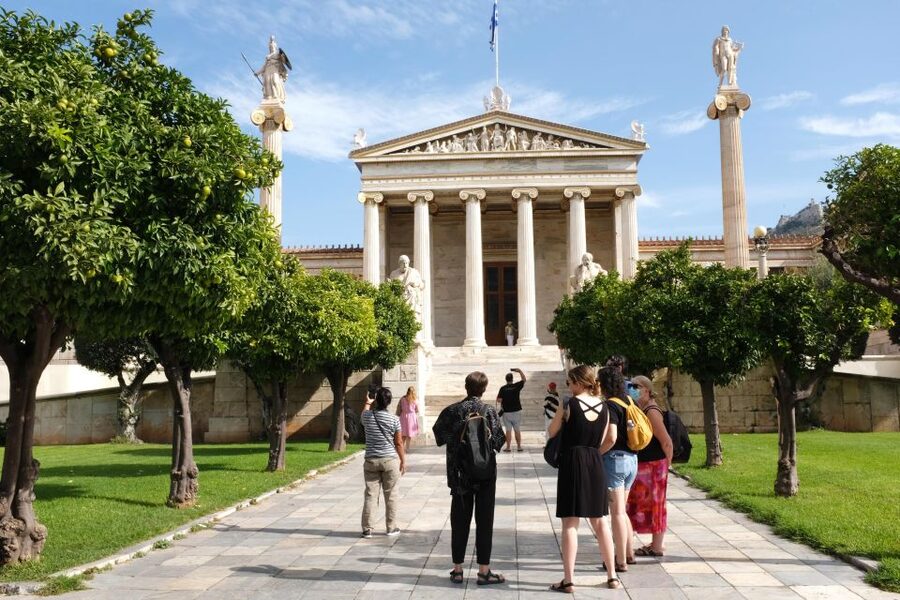
- Kolonaki and the Academy of Athens
- Entering Exarchia, Athens’s most political neighborhood
- Maelle’s guiding style and the small-group advantage
- Timing, walking effort, and practical value
- Who should book this Athens walking tour?
- Should you book the History of Rebellion Walking Tour?
- FAQ
- Where does the Athens History of Rebellion Walking Tour start?
- Where does the tour finish?
- How long does the walking tour last?
- Which languages are available?
- Is the tour suitable for people with mobility impairments?
- Can I cancel the tour or pay later?
Key points before you book
- From Monastiraki to Exarchia: Follow a route from the Ottoman period and Greek independence to present-day activism.
- Small groups matter: The format leaves room for questions and serious discussion, rather than a one-way speech.
- Maelle is a major strength: Her style combines political context, personal warmth, humor, and useful Athens advice.
- Exarchia is the centerpiece: You see a side of Athens shaped by anarchist, collectivist, artistic, refugee, and LGBT+ communities.
- Plan for two to three hours on foot: Comfortable shoes, water, sun protection, and a hat are sensible.
- Best for curious visitors: This tour suits people interested in modern Greek society, political movements, and less familiar stories.
Why this tour changes your view of Athens

Most first visits to Athens revolve around the Acropolis, ancient temples, and classical mythology. Those sights deserve your time, but they explain only one layer of the city. This walk asks a different question: how did Athenians respond when power came from outside, when governments became repressive, and when ordinary people pushed back?
The route begins with Athens under Ottoman rule, then moves through the birth of the modern Greek state and the struggles that followed. You hear about people who became symbols of resistance, along with broad popular movements that opposed fascism, violence, and political oppression.
I like this structure because the city becomes a set of connected stories rather than a string of unrelated stops. A square is not just a square. A church is not only a church. A piece of street art can become a prompt for discussing memory, authority, class, policing, or who gets to claim public space.
The tour also reaches subjects that can be uncomfortable. Exarchia is presented as a living community with its own political identity, not as a colorful backdrop for visitors. You will hear about police repression, gentrification, social justice, and the effort to protect a collectivist way of life. That approach asks you to listen with care and avoid treating local struggles as entertainment.
More Walking Tours in Athens
- Athens: Acropolis and Parthenon Guided Walking Tour
★ 4.6 · 5,882 reviews - Greek Food Walking Tour in Athens
★ 5.0 · 4,740 reviews - Acropolis: Acropolis and Parthenon Guided Walking Tour
★ 4.7 · 3,442 reviews
Starting at Monastiraki Square
Meet in Monastiraki Square, in front of Pantanassa Church, at Pl. Monastirakiou 2. Look for a guide holding a sign marked Athens City of Rebellion.
Monastiraki is a practical starting point because it is easy to reach and already places you in one of central Athens’s busiest public spaces. The first short stop sets the tone: you begin by considering what the city was like under Ottoman rule and how resistance helped inspire the Greek Revolution around 200 years ago.
The early section is brief, but it gives the rest of the walk a useful foundation. Instead of treating independence as a single heroic event, the guide links it to people, movements, and competing ideas about freedom. That context helps you understand why later political struggles in Athens often return to questions of sovereignty, justice, and public participation.
Expect to pause outdoors while the guide speaks. Monastiraki can be crowded, and the city’s traffic and street activity may compete with conversation. Stay close to the guide, listen carefully, and avoid arriving in a rush.
Churches, side streets, and overlooked stories
From Monastiraki, the route passes the Metropolitan Church of Athens. You do not spend a long time there, but its presence adds another piece to the city’s political and social story.
A short stop at an unspecified lesser-known location follows. The exact details are not given in advance, which is part of the appeal, but you should not expect a major museum visit or an elaborate interior tour. These pauses are used to point out places connected with the city’s less familiar past.
This is where Maelle’s approach seems most useful. The strongest descriptions of her guiding style praise her ability to put modern Greek events in a clear order, answer questions patiently, and explain difficult subjects without turning the walk into a lecture. She also brings humor into the discussion, which helps when the material becomes heavy.
The route does not offer the polished, predictable experience of a standard monument tour. You are likely to spend more time discussing meaning than admiring architecture. If you prefer a guide who keeps moving and lists facts quickly, this may feel slower. If you want context, conversation, and room to ask why, it should suit you well.
Syntagma Square and the public heart of protest

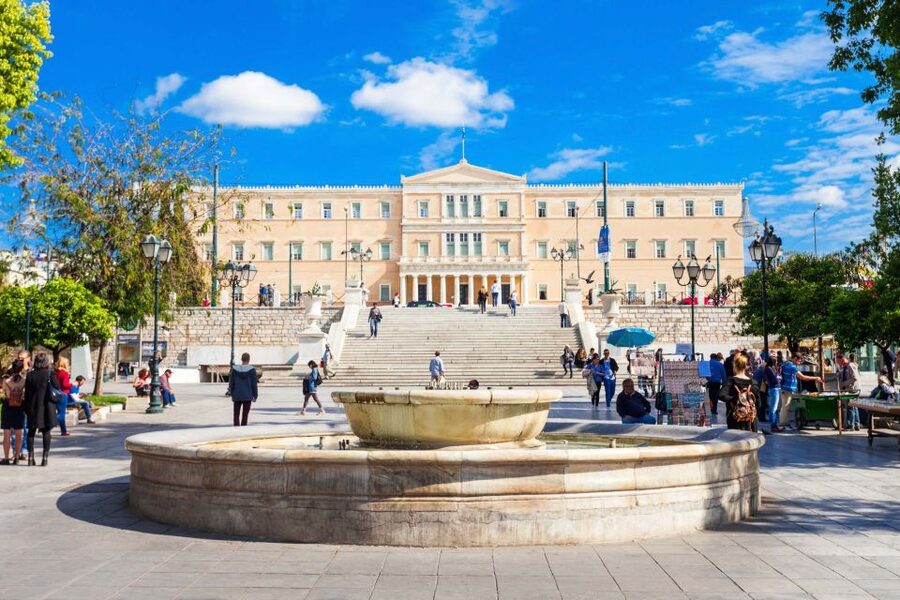
Syntagma Square is the tour’s central political stage. The name means Constitution Square, and the stop focuses on its place in modern Athens as a gathering point for demonstrations and public pressure.
You then continue toward the Hellenic Parliament and the Tomb of the Unknown Soldier. These sites carry official national symbolism, but the tour sets them beside the popular movements that have challenged authority. That contrast is important. Government buildings represent the state, while the surrounding square has repeatedly provided space for citizens to demand change.
The Tomb of the Unknown Soldier is a short stop, yet it helps you think about how nations remember sacrifice. The guide’s job here is not simply to explain military ceremony. It is to connect national memory with the political arguments that have shaped Greece in the modern period.
I find this section especially valuable early in a visit. Afterward, you may read demonstrations, memorials, public gatherings, and government buildings with a sharper eye. The tour gives you a vocabulary for understanding Athens as a city where national pride and political disagreement often share the same pavement.
Keep in mind that this portion involves open urban spaces. Athens can be hot, and there is not always shade exactly where you need it. Bring water, sunscreen, and a hat. Comfortable shoes are essential because the experience includes repeated stops, not just a gentle stroll.
More ancient sites near Athens:
- Historical Delphi One Day Tour with Arachova Stop & Expert Guide
★ 4.5 · 1,247 reviews - Historic Athens: Small Group Electric Bike Tour
★ 4.9 · 740 reviews - The History of Athens: Greek Mythology Private Tour
★ 5.0 · 138 reviews - Athens Highlights by E-Bike: Small-Group Historic Tour
★ 5.0 · 131 reviews
Kolonaki and the Academy of Athens
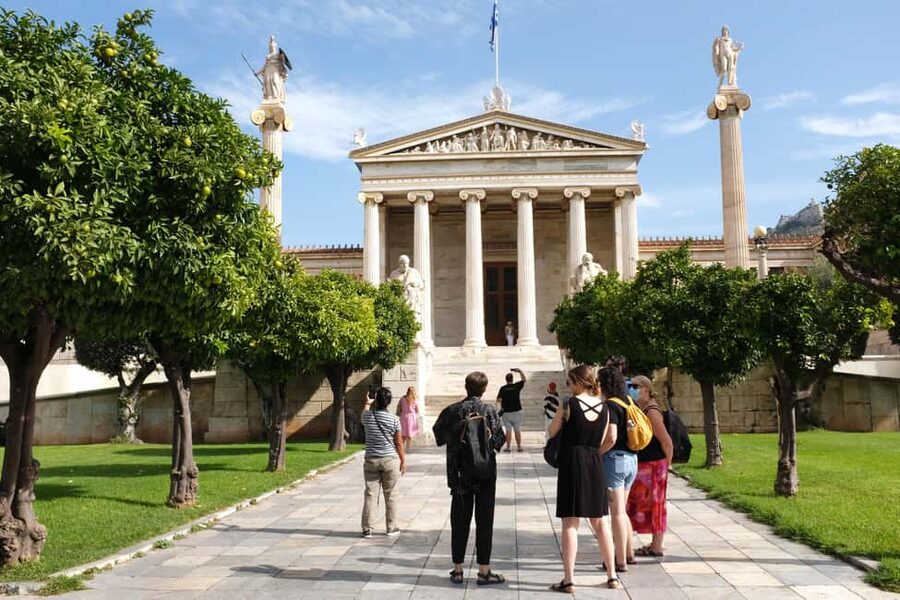
The walk passes through Kolonaki before reaching the Academy of Athens. Kolonaki offers a change in atmosphere from Monastiraki and Syntagma, while the Academy provides an impressive setting for discussing the institutions and ideals of the modern Greek state.
The stop at the Academy lasts about ten minutes. You can expect a guided explanation and time to look at the building and its surroundings, but this is not an extended architectural tour. The value lies in how the guide uses the location to connect national identity, education, power, and public life.
This is also a reminder that rebellion is not only found in obviously radical neighborhoods. Athens contains different social worlds within a short walk of one another. Moving from official institutions to Exarchia makes those contrasts easier to see.
The route is not designed as a complete sightseeing tour of every building you pass. Several locations are viewed briefly or from the outside. That keeps the tour within two and a half hours, but you should book a separate architecture or ancient history walk if detailed interiors and formal art history are your priority.
Entering Exarchia, Athens’s most political neighborhood
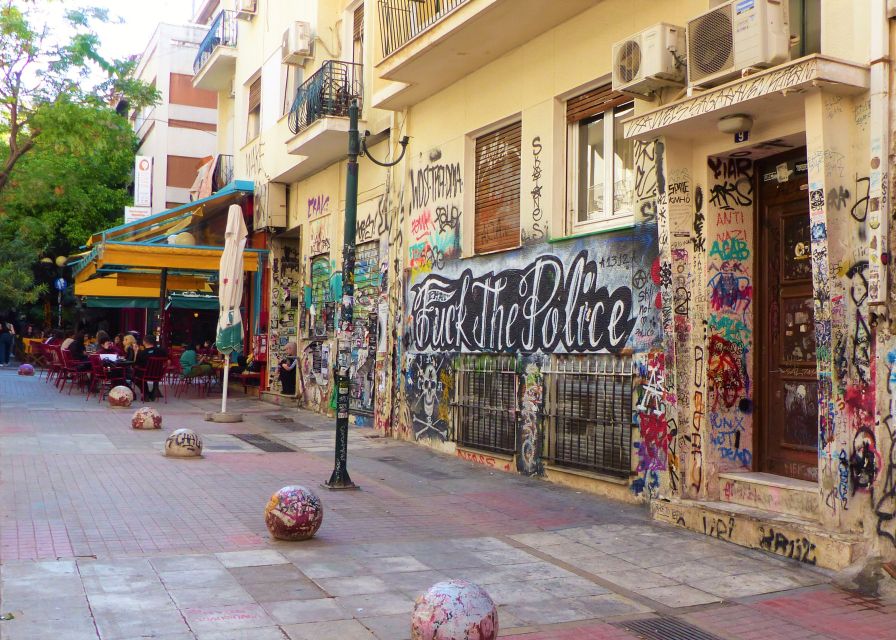
Exarchia is the section most likely to stay with you. The neighborhood is associated with anarchists, artists, refugees, LGBT+ communities, and grassroots activism. It is also connected with disputes over police power, gentrification, and the future of communal life in central Athens.
The tour includes several Exarchia stops, including an unspecified location, another lesser-known place, and Exarchion Square. The stops are short, generally five to ten minutes, but together they provide the longest look at the neighborhood’s political identity.
Do not expect Exarchia to be explained as a simple good-versus-bad story. The point is to understand why the area matters to different groups and why it remains contested. You may discuss street art, collective action, state authority, social exclusion, and the ways residents defend a sense of community.
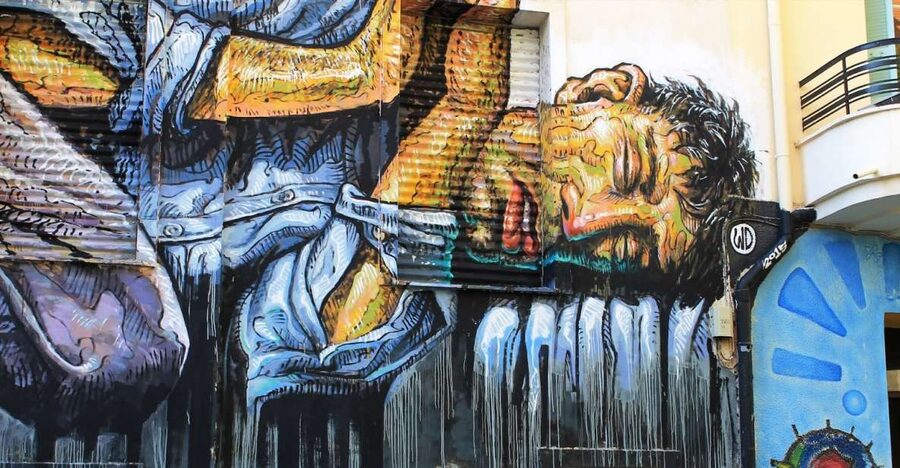
One particularly effective feature is the attention to graffiti and public art. Instead of treating walls as decoration, the guide invites you to think about who created the work, what it says, and how it functions in a neighborhood where public space carries political meaning.
You also need to behave respectfully here. This is a working neighborhood, not an open-air exhibit. Listen to the guide’s instructions, ask questions thoughtfully, and do not photograph people or private situations without permission. The experience is strongest when you treat Exarchia as a community with real lives and present concerns.
Maelle’s guiding style and the small-group advantage
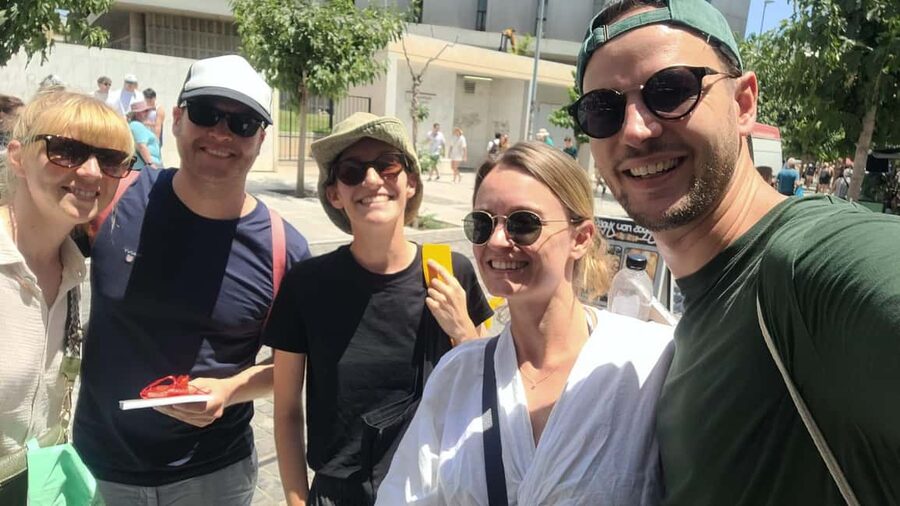
Maelle is the guide most often named in the feedback, and her role appears to be central to the experience. Her strengths include clear storytelling, enthusiasm, empathy, humor, and an ability to discuss politics without losing sight of daily life.
I like that the tour is designed for discussion. Small groups, and private bookings when available, give you more chance to ask about modern Greek history, social movements, street art, or ordinary life in Athens. The guide also appears willing to adjust the conversation to the interests of the people in front of her.
That personal approach adds value beyond the scheduled route. Maelle has offered suggestions for restaurants, shopping, sights, and places to visit in Athens and on the Greek islands. If you are taking this tour near the start of your trip, bring a short list of questions and use the final minutes to ask for local ideas.
The political viewpoint is clear. This tour is sympathetic to resistance movements, grassroots organizing, and social justice causes. That does not make the experience unsuitable for people who want to think critically, but it does mean you should not book it expecting a detached survey with equal time for every political position.
Timing, walking effort, and practical value
The tour lasts 2.5 hours, though you should be prepared to walk and stand for two to three hours. It is not suitable for people with mobility impairments according to the activity details.
At $44.04 per person, the price makes most sense when the group remains small and the discussion is active. You are not paying for admission to major attractions, transportation, or a meal. You are paying for a focused route, a live guide, and access to stories that are easy to miss when walking through Athens alone.
Compared with a general city orientation, this tour offers a narrower subject but greater depth. Compared with a private guide, the price can be attractive if you want personal conversation without paying the full cost of a one-to-one experience. Private and small-group options are available, so check the exact format and price when selecting your time.
Wear shoes that can handle uneven city pavement. Carry water, a sun hat, and sunscreen. There is no reason to bring special equipment, but a small notebook or phone can be useful if you want to record restaurant suggestions or names to research later.
The meeting information contains one detail worth checking before you go. The route is described as finishing at Plateia Exarcheion, while another note says the activity ends back at the meeting point. Confirm the final location when booking so you can plan your next stop accurately.
Who should book this Athens walking tour?
I would recommend it most strongly to you if you:
- Want modern Greek history alongside ancient Athens
- Enjoy political and social discussions
- Prefer local neighborhoods to a standard monument checklist
- Want to understand why Exarchia matters
- Like asking questions during a tour
- Are comfortable walking and standing outdoors
- Appreciate a guide who offers personal recommendations
It may be a poor match if your main goal is the Acropolis, classical mythology, museums, or architectural detail. It also may not work well for anyone who needs a route designed for limited mobility.
Taking it early in your stay is a smart move. Several people wished they had done it sooner because the background changed how they understood the rest of Athens. The walk can also pair well with an ancient-history tour, since the two experiences cover different periods and answer different questions about the city.
Should you book the History of Rebellion Walking Tour?
Book it if you want Athens to feel like a living city rather than an archaeological site with restaurants around it. The strongest parts are the clear modern timeline, the stops at Syntagma and the Parliament, and the extended look at Exarchia through the lens of community, protest, art, and social justice.
Maelle’s warm and thoughtful guiding style adds much of the tour’s appeal. Her explanations, humor, and practical advice make the $44.04 fee reasonable for a small group, especially if you value discussion more than formal sightseeing.
Skip it if you want a politically neutral overview or a route built around famous ancient monuments. For curious visitors willing to listen, question, and walk, this is one of the better ways to connect Athens’s past struggles with the city you see today.
FAQ
Where does the Athens History of Rebellion Walking Tour start?
The tour starts in Monastiraki Square, in front of Pantanassa Church, at Pl. Monastirakiou 2. The guide carries a sign that says Athens City of Rebellion.
Where does the tour finish?
The listed route finishes at Plateia Exarcheion. Another activity note says the tour ends back at the meeting point, so confirm the final location when booking.
How long does the walking tour last?
The tour lasts 2.5 hours. Starting times vary, so check availability for the date you want.
Which languages are available?
The live tour is available in English and French.
Is the tour suitable for people with mobility impairments?
No. The activity is not suitable for people with mobility impairments, and you should expect to walk and stand for two to three hours.
Can I cancel the tour or pay later?
You can cancel up to 24 hours in advance for a full refund. Reserve now and pay later is also available, so you do not have to pay at the time of booking.
Just added around Athens
- Delphi One Day Trip from Athens★ 4.0 · 98 reviews
- Private Delphi and Hosios Loukas Monastery – Great Lunch and Drinks Included★ 5.0 · 36 reviews
- Mercedes Private Tour to Delphi and Arachova★ 5.0 · 30 reviews
- Day tour to Ancient Olympia,Ancient Sparta Mycenae Including Meal★ 5.0 · 54 reviews
- Athens: Half Day Trip To Cape Sounio/Poseidon Temple Semi Private★ 5.0 · 131 reviews
- Athens Half-Day Private Tour Acropolis, Parthenon City Highlights★ 5.0 · 35 reviews
- From Athens: Day Tour to Mykonos★ 5.0 · 64 reviews
- Culinary Secrets of Downtown Athens★ 5.0 · 103 reviews
Historical Tours, compared.
Historical Delphi One Day Tour with Arachova Stop & Expert Guide
Read our review →
Historic Athens: Small Group Electric Bike Tour
Read our review →
Half-Day Guided History and Culture Sightseeing Tour
Read our review →


Throne of Helios: The History of Rhodes in 9D Experience
Read our review →
The History of Athens: Greek Mythology Private Tour
Read our review →Browse the lists this tour appears in