Reviewed · ATHENS TOURS
Big Bus Athens Hop-On Hop-Off with optional Piraeus & Riviera
See Athens before choosing your stops. This bus gives you a useful first look at the Acropolis, historic center, Piraeus, and the coastal suburbs, all from one ticket. I especially like the three-route choice and the freedom to get off whenever a site catches your eye. The main concern is traffic, which can turn a short ride into a slow wait.
The central Athens route is the most practical, with buses scheduled about every 20 minutes according to the supplied operating details. I also like the informative audio, free Wi-Fi, helpful staff at major stops, and the option of a covered upper deck in hot or rainy weather. Just confirm exactly which routes your fare includes, since some bookings may require an extra payment for Piraeus and the Riviera.
In This Review
- Key points to know before boarding
- What the Big Bus Athens ticket really gives you
- Start with the Athens city route
- Acropolis, Plaka, and the Acropolis Museum
- Panathenaic Stadium and the classical city center
- Monastiraki, Omonia, and the central loop
- Piraeus: useful for port calls and more
- The Riviera route to Vouliagmeni and Glyfada
- Audio commentary, Wi-Fi, and comfort
- Timing problems and how to avoid them
- Who will get the most value from this pass?
- Should you book Big Bus Athens?
- FAQ
- How long does the Big Bus Athens experience last?
- How long are the available passes valid?
- Which routes are available?
- Is audio commentary provided?
- Is Wi-Fi available on the bus?
- Can I cancel for a full refund?
Key points to know before boarding
- Three routes cover very different parts of Athens: the city center, Piraeus, and the southern coast.
- The Athens route is your best sightseeing tool: it links Syntagma, the Acropolis, Monastiraki, the National Archaeological Museum, and other central sights.
- The 48-hour or 72-hour pass rewards a slower plan: it gives you time to use the less frequent Piraeus and Riviera routes.
- Traffic can affect the schedule: delays, full buses, and long waits have caused real frustration at busy times.
- Audio quality varies by bus: bring patience, test your headphones early, and ask staff for help if the commentary is faint.
- The ticket is strongest as a city orientation tool: it helps you see where you want to return on foot or by another form of transport.
What the Big Bus Athens ticket really gives you
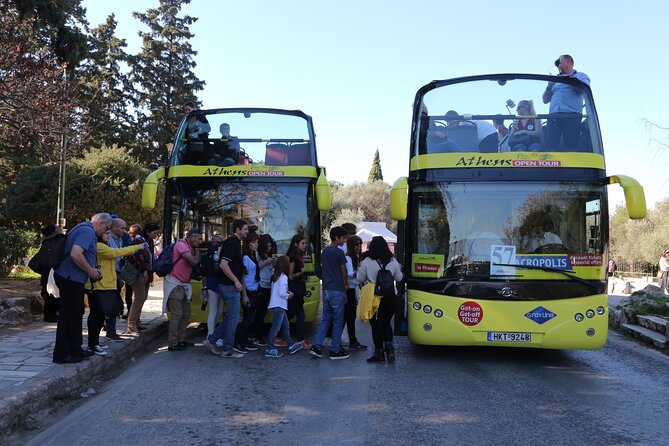
The Big Bus Athens pass is designed for flexible sightseeing rather than a guided group tour. You board a double-decker bus, listen to recorded commentary through provided headphones, and get off at the stops that interest you. Afterward, you can wait for another bus and continue.
The advertised fare is about $27.56 per person. That can be fair value if you use the bus for transportation as well as sightseeing, especially with a 48-hour pass. It becomes less attractive if you simply ride one loop and spend the rest of the day walking, since central Athens is compact enough to explore on foot.
The product information lists 48-hour and 72-hour options. It also presents three routes: Athens, Piraeus, and the Riviera. Since the optional route arrangement and the final fare can vary by booking, check your confirmation carefully. Some bookings have required an additional payment to access all three routes. That detail matters because the Piraeus and Riviera buses are a major part of the ticket’s value.
A single ride is listed at about two hours, but that is only a rough guide. Athens traffic can stretch the journey, especially near the center, the port, and the coastal road. I would not use this bus for a tight airport connection, a rushed cruise departure, or any plan that depends on exact arrival times.
A few more Athens half-days to weigh up
- Athens: Acropolis & up to 5 Archaeological Sites Combo Pass
★ 4.4 · 12,619 reviews - Athens: Acropolis Ticket with Optional Audio or Live Guide
★ 4.2 · 11,055 reviews - Athens: Acropolis, Parthenon & Acropolis Museum Guided Tour
★ 4.8 · 9,316 reviews
Start with the Athens city route
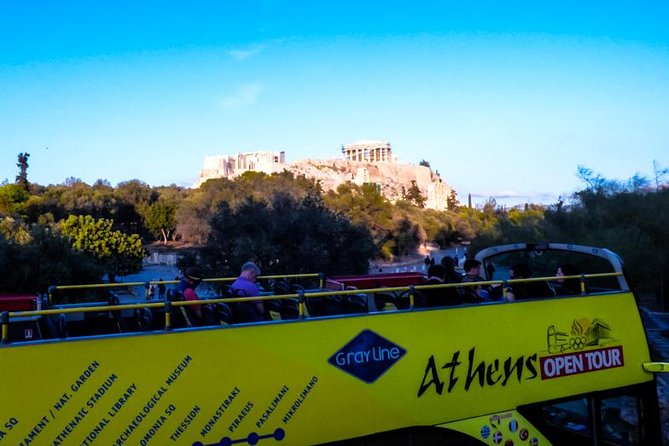
The city route is the part I would use first. It gives you a broad look at central Athens and helps you decide where to spend your limited sightseeing time. Buses are described as arriving about every 20 minutes on this route, though traffic and capacity can change that in practice.
Syntagma Square is a sensible place to begin. The stop is at 1 Ermou Street, near the center of modern Athens. From here, you are close to the Hellenic Parliament, the National Garden, Ermou shopping street, and the Plaka area. You can also use the square as a simple reference point if you are still learning the city.
The Hellenic Parliament stop sits next to the Parliament building on Vasilisis Amalias Avenue. It is useful for the National Garden and the ceremonial side of central Athens. The commentary can provide a quick introduction, but you will get more from this stop by getting off and walking around.
The Temple of Olympian Zeus stop is next to the temple entrance. This huge ruined sanctuary is one of the easiest ancient sites to pair with a bus ride. It is close to the Acropolis, the Arch of Hadrian, and the National Garden, so you can visit the temple and continue on foot rather than waiting for another bus.
Acropolis, Plaka, and the Acropolis Museum
The Acropolis stop is listed at 69 Rovertou Galli Street, next to Dionysos Restaurant. Another Acropolis stop serves Plaka and the south entrance, near Melina’s statue. These stops are useful, but do not think of the bus as a ticket or timed entry for the Acropolis itself. The bus only brings you near the monuments.
The Acropolis is Athens’ essential visit, and the bus can help you reach the area without figuring out the streets first. You will still need to walk uphill and manage your own admission arrangements. Wear shoes with a firm grip, since the approach around the archaeological area can be uneven.
The Plaka and south entrance stop is well placed for a walk through the old neighborhood below the Acropolis. I would use it for a slow wandering route rather than a quick photo stop. Plaka is also a good place to pause for food before returning to the bus.
The Acropolis Museum has its own stop. This is one of the most useful stops on the entire route because the museum gives you a structured look at the sculptures and objects connected to the Acropolis. If you have only one day, you can combine the museum, the Acropolis area, and a walk through Plaka, but allow plenty of time. The bus is not a substitute for visiting the sites.
Panathenaic Stadium and the classical city center
The Panathenaic Stadium stop is opposite the stadium. The gleaming marble structure is linked with the modern Olympic tradition and is one of the easiest major sights to visit from the street. The stop also places you near the National Garden and the broad avenues around central Athens.
The Benaki Museum stop is opposite the museum. It gives you access to one of Athens’ best-known cultural museums, though the ticket described here does not include museum admission. Check opening details separately before getting off, since a bus stop alone does not guarantee that a site is open.
The National Library stop is in front of the library, at Vallianeio Megaron. Nearby buildings connected with the city’s intellectual life make this a worthwhile passing point, even if you do not enter. The National Historical Museum, located at the Old Parliament stop, offers another chance to understand Greece beyond the ancient monuments.
The National Archaeological Museum stop is in front of the museum. This is a strong choice if you want more than the Acropolis story. The museum covers major periods of Greek archaeology, and its location farther from the Acropolis makes the bus especially helpful.
Same stretch of coastline, a completely different day out:
- Athens: Cape Sounion & Poseidon Temple Sunset Half-Day Trip
★ 4.8 · 8,241 reviews - Athens: Acropolis and Parthenon Guided Walking Tour
★ 4.6 · 5,882 reviews - All Day Cruise -3 Islands to Agistri,Moni, Aegina with lunch and drinks included
★ 5.0 · 4,958 reviews - Athens, Piraeus, and Coastline: Blue Hop-On Hop-Off Bus
★ 3.9 · 4,849 reviews
Monastiraki, Omonia, and the central loop
Monastiraki Square is opposite the Nike store. This is one of the most convenient stops for a lively central area, with easy access to the Monastiraki neighborhood and nearby historic streets. It is also a useful transfer point for exploring on foot.
Kotzia Square, opposite City Hall, gives you a different view of central Athens. Omonia Square, in front of the Hondos Center store, is another central stop. These areas are less focused on postcard monuments and more useful for seeing the city as a working capital.
Karaiskaki Square, in front of Wyndham Athens Residence, connects the route with the western side of the central area. The stop at Platia Karaiskaki can help if your accommodation is nearby, but check the direction of travel before boarding. The routes do not all serve the same stops, and it is easy to get on a bus going in a direction you did not expect.
A practical habit will save you time: ask the driver or the staff member at the stop which route the bus is following before you board. One booking does not mean every bus travels to every stop. This simple check is especially important when you are trying to return toward Syntagma, the Acropolis, or your hotel.
Piraeus: useful for port calls and more
The Piraeus route begins near the Acropolis and Plaka, then runs south through Pantios and Stavros Niarchos Park. It continues to the Municipal Theatre, the two cruise terminals, Pasalimani, Mikrolimano, and the Athens Marriott area before returning toward the center.
For cruise passengers, the cruise terminal stops are the main reason to consider this route. Cruise Terminal A, Miaoulis, is outside Gate 11, while Cruise Terminal B is outside Gate 12. Those precise locations are helpful, but allow extra time. A missed bus or traffic delay can create a serious problem if you are working around a ship departure.
The Municipal Theatre stop is next to the theatre on Korai Square. Pasalimani, opposite the statue of the Clock, gives you a look at the marina area. Mikrolimano, opposite The Alex hotel, is another waterfront stop with a different feel from central Athens.
Stavros Niarchos Park is in front of Onassio Hospital. The park is a worthwhile change from ancient ruins and busy streets, but the Piraeus route is not as frequent as the city route. The schedule is described as about four buses per day, roughly every 80 minutes. That makes planning essential. Get off only when you have checked the next departure.
The Piraeus route can be valuable with a two-day or three-day ticket. On a one-day schedule, the waiting time may eat into your Athens sightseeing. I would choose it if you have a cruise connection, a strong interest in the port, or enough time to accept a slower outing.
The Riviera route to Vouliagmeni and Glyfada
The Riviera route is the most scenic part of the package, but also the one that needs the most planning. It follows the coast from Athens toward Flisvos Marina, Alimos Marina, Glyfada, Kavouri, Astir Beach, and Lake Vouliagmeni.
The route includes Flisvos Marina, Alimos Marina, and Agios Kosmas Marina. These stops let you see Athens’ southern waterfront rather than staying among museums and ancient ruins. The bus also stops at the Phaleron War Cemetery and the Athens Memorial, Edem, and the Athens Marriott Hotel.
Further south, the route reaches the third Glyfada Marina, Divani Apollon Palace & Thalasso, Kavouri Beach, and Astir Beach. The Kavouri stop is next to the public bus stop called Litous. Astir Beach is in front of Okeanis restaurant. These details matter because coastal stops are spread out, and a vague sense of the area is not enough when you are trying to find the right return point.
Lake Vouliagmeni is the route’s most distinctive stop. The bus stops at the lake, but admission is not included. If you want to swim or spend time there, check the separate entry cost and allow enough time for the next bus.
The route continues through Voula Park, Glyfada City Center, Glyfada Beach, Hellinikon, and Edem before returning north. The listed service is about three buses per day, roughly every two hours. That makes this a poor choice for an unplanned quick stop, but a good half-day outing if you are prepared to wait.
One useful tip is to bring swimwear if you plan to use the coastal route. Just remember that the route is about seeing the shore as much as visiting a beach. You should not assume every beach stop includes free access or a long swimming break.
Audio commentary, Wi-Fi, and comfort
The audio guide is offered in 14 languages, with headphones provided. English is available, and the commentary supplies short facts about the sights and neighborhoods. I like this format for a first ride because it gives you enough context to decide where to return.
The audio system is not always reliable. Some buses have had weak headphone connections, faulty speakers, or commentary that is out of sync with the view outside. Test your headset when you board. If the sound fails, tell the staff or driver promptly rather than waiting until the end of the loop.
Free Wi-Fi is available on board. That is useful for checking maps, finding the next stop, and using live bus information while you move around the city. It should be treated as a convenience, not a guarantee that every delay or route change will be solved through the connection.
The buses may have open upper decks, covered upper decks, or different roof arrangements. The open section gives you the best views, but Athens can be very hot in summer. A covered bus is more comfortable in strong sun or rain. Seat availability is not guaranteed, and buses can fill up at busy times.
Timing problems and how to avoid them
The biggest weakness is not the route map. It is the unpredictability of urban traffic. Delays have been reported at the cruise port and on the city route, with some waits lasting much longer than the advertised interval.
I would use the city route as a flexible sightseeing aid, not as a strict timetable. Start early, keep your plan loose, and avoid scheduling a site visit around the assumption that the next bus will arrive in exactly 20 minutes.
Use live tracking through the app if it is available to you. At major stops, staff may be present to explain routes and help you find the correct boarding point. The staff support has been praised, but you should still verify the route yourself.
The commentary can also be confusing if it does not match the bus location. Watch the streets and landmarks as well as listening. If you are mainly interested in ancient ruins, the spoken information may not cover every sight you pass.
Who will get the most value from this pass?
I would recommend Big Bus Athens for a first visit, a short stay, or a trip where you want a broad orientation before choosing where to spend your time. It is also useful if walking long distances is difficult, or if you are staying outside the central sightseeing area.
Families may appreciate the simple hop-on, hop-off format, and children must be accompanied by an adult. Service animals are allowed, and the activity is near public transportation. Most people can participate, though you should consider the heat, stairs, and the possibility of standing if the bus is full.
The pass is less useful if you already know Athens well and plan to walk between central sights. It is also a poor fit for a tight cruise schedule, an exact appointment, or anyone who dislikes waiting in traffic.
For the best value, use the 48-hour ticket to combine a full Athens loop with one carefully planned coastal or Piraeus trip. The 72-hour option makes more sense if you want both outer routes and several central stops.
Free cancellation is available up to 24 hours before the start time for a full refund. Changes or cancellations inside that window are not accepted for a refund, so keep the local cut-off time in mind.
Should you book Big Bus Athens?
Book it if you want a simple introduction to Athens, appreciate narrated sightseeing, and can keep your schedule flexible. The city route, helpful staff, free Wi-Fi, and two-day access can make the price reasonable, especially for a first visit.
Think twice if you expect a perfectly timed service, flawless audio, or a detailed guided explanation at every ruin. Confirm that your fare includes Piraeus and the Riviera, then choose your route before boarding.
My practical choice would be the 48-hour pass, starting with the Athens loop and using the second day for either Piraeus or the Riviera. That plan gives you the bus’s main benefit, a broad view of Athens without forcing every hour of your trip into a seat on a slow-moving bus.
FAQ
How long does the Big Bus Athens experience last?
A single ride is listed as approximately two hours. Your total sightseeing time depends on how often you get off and which of the three routes you use.
How long are the available passes valid?
You can choose between a 48-hour pass and a 72-hour pass.
Which routes are available?
The experience includes routes covering central Athens, Piraeus, and the Athens Riviera. Check your booking details to confirm which routes are included in your fare.
Is audio commentary provided?
Yes. Audio commentary is offered in 14 languages, and headphones are provided. English is available.
Is Wi-Fi available on the bus?
Yes. Free Wi-Fi is available on board.
Can I cancel for a full refund?
Yes. You can cancel at least 24 hours before the experience start time for a full refund. Cancellations or changes made less than 24 hours before the start time are not accepted for a refund.
Just added around Athens
- Delphi One Day Trip from Athens★ 4.0 · 98 reviews
- Mercedes Private Tour to Delphi and Arachova★ 5.0 · 30 reviews
- Private Delphi and Hosios Loukas Monastery – Great Lunch and Drinks Included★ 5.0 · 36 reviews
- Day tour to Ancient Olympia,Ancient Sparta Mycenae Including Meal★ 5.0 · 54 reviews
- Athens: Half Day Trip To Cape Sounio/Poseidon Temple Semi Private★ 5.0 · 131 reviews
- Athens Half-Day Private Tour Acropolis, Parthenon City Highlights★ 5.0 · 35 reviews
- From Athens: Day Tour to Mykonos★ 5.0 · 64 reviews
- Culinary Secrets of Downtown Athens★ 5.0 · 103 reviews
Athens Tours, compared.
Acropolis & up to 5 Archaeological Sites Combo Pass
Read our review →

Acropolis, Parthenon & Acropolis Museum Guided Tour
Read our review →
Cape Sounion & Poseidon Temple Sunset Half-Day Trip
Read our review →

All Day Cruise -3 Islands to Agistri,Moni, Aegina with lunch and drinks included
Read our review →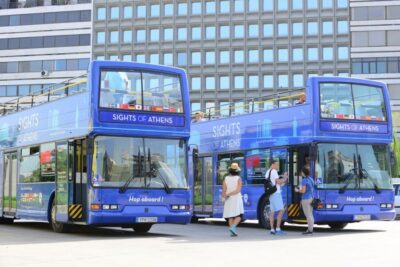
Athens, Piraeus, and Coastline: Blue Hop-On Hop-Off Bus
Read our review →