Reviewed · ATHENS TOURS
Mythology, Philosophy and Democracy Tour
Athens makes old ideas feel present. This thoughtful walking tour links mythology, philosophy, politics, and science while leading you through places many first-time visitors skip. I especially like the visit to the Pnyx, where Athenian citizens gathered for public decisions, and the final views from Philopappos Hill. The main drawback is the walking and uphill finish, which can feel tough in Athens heat.
Guide Panos is the heart of the experience. His wit, clear storytelling, and ability to connect ancient debates with modern problems turn a sightseeing walk into an active discussion. You should also know that the listed duration is about three hours, though some people describe spending closer to four hours on the route.
In This Review
- Five things to know before booking
- Why this Athens walk feels different
- Kerameikos and Pericles’ funeral speech
- The Ancient Agora and the sound of public debate
- Monastiraki, the Roman Agora, and the Tower of the Winds
- Hadrian’s Library and Plaka’s narrow streets
- Pnyx Hill and the birth of public decision-making
- Philopappos Hill and the final Athens view
- Panos’ teaching style and the small-group format
- Is $50.69 a fair price?
- What to bring and who should book
- Should you book the Mythology, Philosophy and Democracy Tour?
- FAQ
- How long does the Mythology, Philosophy and Democracy Tour last?
- What language is the tour offered in?
- How much does the tour cost?
- Where does the tour begin?
- Where does the tour end?
- Is admission included at the stops?
- How large is the group?
- Is the tour suitable for most people?
- Can I cancel for a full refund?
- What happens if bad weather cancels the tour?
Five things to know before booking
- The tour connects several big ideas: You move from myth and religion toward philosophy, mathematics, early science, and democracy.
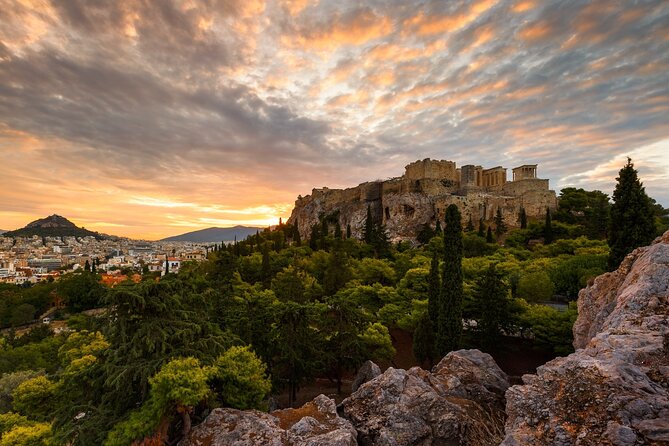
- Pnyx is the key historical stop: This rocky hill is presented as the first parliament in the world and gives you a direct link to Athenian public life.
- Panos receives exceptional praise: His humor, enthusiasm, and ability to explain complex subjects in plain language are repeated themes.
- The route includes free landmarks and viewpoints: Kerameikos, the Agora area, Plaka, Pnyx, and Philopappos Hill are visited without a separate admission charge for the tour.
- The group is capped at 12 people: That is small enough for questions and conversation, though you still need comfortable shoes and stamina for the hills.
- The $50.69 price pays for interpretation: You are not buying entry tickets. You are paying for a guided explanation that ties scattered Athenian sites into one story.
Why this Athens walk feels different
Many Athens walks concentrate on monuments. This one concentrates on ideas. You do not simply stop at an ancient stone and hear a date. Panos uses each place to ask how Athenians understood the gods, how they began testing ideas through reason, and how public debate shaped political life.
That approach suits you if you want context before or after visiting the Acropolis. One especially useful suggestion is to take this tour early in your Athens stay, before the Acropolis. The route can give you a better sense of the people, institutions, and beliefs behind the famous ruins.
Panos is repeatedly praised for being witty, thoughtful, and stimulating without turning the walk into a classroom lecture. He also connects ancient problems to present-day questions. That makes the tour useful for adults, older school-age children, university students, and anyone curious about why Greek thought still matters.
The route is not a standard mythology stroll. It covers literature, politics, religion, mathematics, astronomy, and philosophy. You should expect ideas and conversation, not only photo stops.
A few more Athens half-days to weigh up
- Athens: Acropolis & up to 5 Archaeological Sites Combo Pass
★ 4.4 · 12,619 reviews - Athens: Acropolis Ticket with Optional Audio or Live Guide
★ 4.2 · 11,055 reviews - Athens: Acropolis, Parthenon & Acropolis Museum Guided Tour
★ 4.8 · 9,316 reviews
Kerameikos and Pericles’ funeral speech
The tour begins at Kerameikos, a place many people pass without understanding. Its name refers to ceramics, since workshops once operated here. It also served as Athens’ cemetery for centuries, making it a place where everyday work and public memory met.
This is a strong opening because it moves you away from the postcard version of Athens. Here, you encounter the city through its craftsmen, its dead, and its political leaders. Prominent Athenians were buried in this area, and the setting leads naturally to the story of Pericles.
At Kerameikos, the tour recalls Pericles’ famous funeral speech, known as the Epitaph, delivered for the first casualties of the Peloponnesian War. The speech praised Athenian democracy and the way of life created by its citizens.
You spend about 25 minutes here, with no admission ticket listed for the stop. That is enough time to establish the central question of the tour: what did democracy mean in ancient Athens, and what did it ask of ordinary citizens?
The Ancient Agora and the sound of public debate
The Ancient Agora was the working heart of Athens. It was a place for walking, meeting, trading, arguing, and making decisions. The tour links this setting with figures such as Socrates, Plato, Solon, Themistocles, Pericles, Thucydides, Sophocles, and Aristophanes.
The value here comes from the human scale. The Agora was not only a collection of ruins. It was a shared civic space where major political questions and ordinary matters were discussed face to face.
The scheduled stop is about 10 minutes, with no admission ticket listed. That is brief, so you should not expect a long archaeological visit or a full museum-style explanation of every structure. Instead, Panos uses the Agora as a springboard for the larger story of how conversation, disagreement, and public life shaped Athens.
If you enjoy political thought or classical literature, this may be one of the most useful parts of the walk. The names are not presented as isolated geniuses. They are placed within the same city, amid the same arguments and pressures.
Monastiraki, the Roman Agora, and the Tower of the Winds
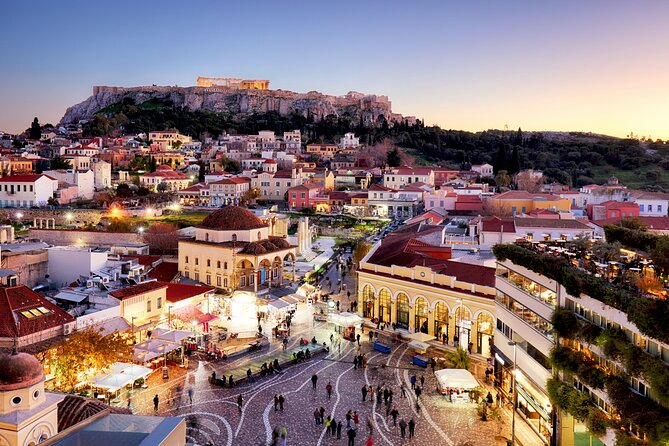
From the ancient civic center, the route moves through Monastiraki Square and its colorful flea market. You walk at an easy pace past antique and tourist shops. This short section gives you a change of mood and shows how modern Athens occupies the same central streets as the ancient city.
The stop lasts about 10 minutes. It is less about a formal monument and more about seeing present-day street life alongside the remains of earlier Athens. Keep your attention on the guide, but you may also want to glance at the shops and stalls as you pass.
The Roman Agora lies north of the Acropolis and east of the Ancient Agora. It represents a later period in the city’s development, when Roman power shaped Athens while the city retained its intellectual reputation. The scheduled visit is also about 10 minutes and carries no separate admission charge according to the tour details.
Next comes the Tower of the Winds, one of the most memorable smaller structures on the route. Built in the first century BC by the astronomer Andronicus of Kyrrhos, the octagonal building worked as a wind indicator, sundial, and water-powered clock.
The tour presents it as Athens’ ancient equivalent of a major public clock and as an early weather station. On cloudy days, its hydraulic mechanism could mark the hours with a sound. You get about 10 minutes here, but the idea is worth lingering over: this is a practical link between astronomy, engineering, and daily city life.
Same stretch of coastline, a completely different day out:
- Athens: Cape Sounion & Poseidon Temple Sunset Half-Day Trip
★ 4.8 · 8,241 reviews - Athens: Acropolis and Parthenon Guided Walking Tour
★ 4.6 · 5,882 reviews - All Day Cruise -3 Islands to Agistri,Moni, Aegina with lunch and drinks included
★ 5.0 · 4,958 reviews - Athens, Piraeus, and Coastline: Blue Hop-On Hop-Off Bus
★ 3.9 · 4,849 reviews
Hadrian’s Library and Plaka’s narrow streets

Hadrian’s Library was created by Roman Emperor Hadrian in AD 132 on the north side of the Acropolis. It was once described as the second-largest library in the world at that time.
The stop is about 10 minutes. Do not expect the same scale as the Acropolis complex. Its importance lies in what it represents: Athens remained a place of learning even after Roman rule took hold.
This stop also helps the tour shift from the political city to the intellectual one. Books, records, study, and public knowledge become part of the story. Panos’ strength, according to the many positive accounts of his guiding, is making these connections clear rather than leaving each ruin as a separate fact.
The walk then passes through Plaka, a scenic neighborhood of small houses and narrow streets. This is a pleasant change from open archaeological areas. You see a more intimate side of Athens, with a route that feels closer to ordinary neighborhood life.
Plaka is scheduled for about 10 minutes. It is not a long food or shopping stop, so do not book this expecting time to browse at length. Think of it as a short transition before the hills and the major viewpoint section.
Pnyx Hill and the birth of public decision-making

Pnyx Hill is the intellectual and political center of the experience. The tour describes it as the first parliament in the world, where citizens gathered to debate and make decisions. The open setting also gives you broad views across Athens.
This stop matters because democracy becomes physical here. You are not merely hearing about voting systems or famous statesmen. You are standing in a place associated with public speech, disagreement, and civic participation.
The scheduled visit lasts about 25 minutes. Pnyx is free, and the hill is also a good place for sunset. If your tour is timed for late afternoon or evening, the light can add a memorable finish to the political portion of the walk.
You should bring water and wear shoes with a secure sole. One person found the heat difficult but appreciated water and ice cream breaks arranged by Panos. That is useful practical information: Athens can make a moderate walk feel much harder in summer, especially when the route reaches open hills.
The Pnyx also suits the tour’s questioning style. Panos does not only explain what happened there. He encourages you to think about the limits of ancient democracy, the problems citizens faced, and the ways old political questions still appear today.
Philopappos Hill and the final Athens view
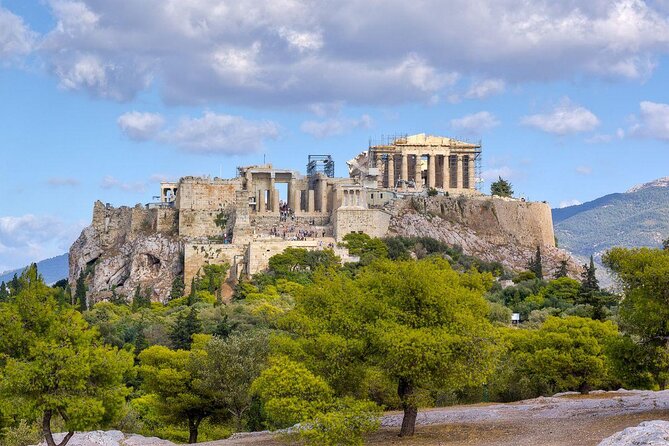
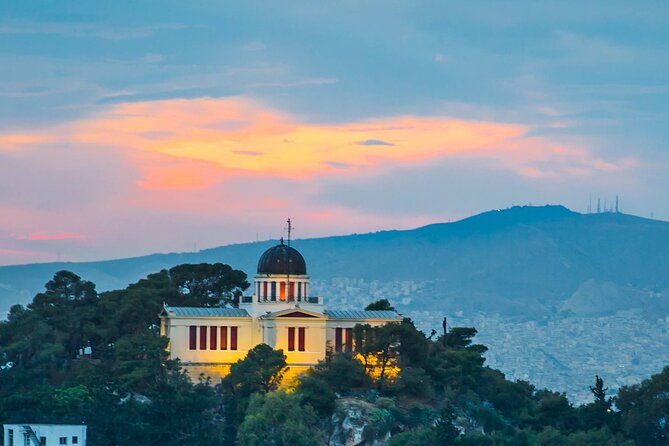
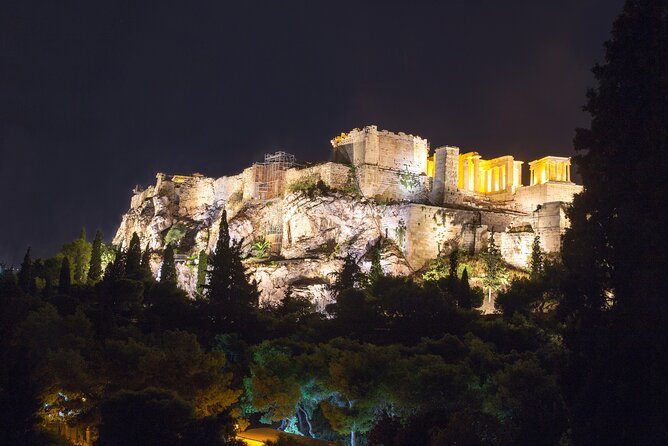
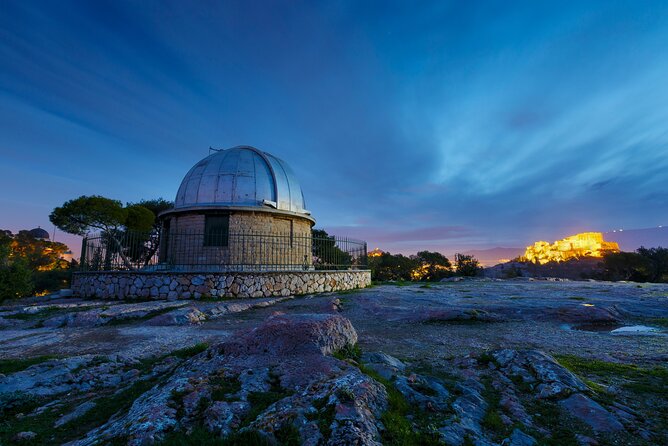
The final stop is Philopappos Hill, also called the Hill of the Muses. You spend about 45 minutes here, making it the longest scheduled stop. The hill offers especially strong views toward the Acropolis and Athens by night.
Ending here is a smart choice. The walk begins with the cemetery at Kerameikos and moves through civic spaces, scientific ideas, Roman institutions, and democracy. It finishes above the city, where you can look back at the places you have just discussed.
The hill is also the part most likely to test your energy. The route ends uphill, and the experience includes several walking sections across central Athens. If you have limited mobility or dislike uneven ground and climbs, ask yourself if the final viewpoint is worth the effort.
For most people interested in the subject, it is. The closing view gives the ideas a physical shape. You see the Acropolis, the surrounding city, and the layered remains of different periods all at once.
Panos’ teaching style and the small-group format

Panos is praised for three qualities above all: strong command of Greek history and culture, enthusiasm for his subject, and a warm sense of humor. He is also described as someone who adapts the conversation to the interests of the group.
That matters on a subject that can easily become dry. Ancient philosophy is not always easy to follow during a hot afternoon walk. Panos reportedly explains difficult points through stories, comparisons, and questions, helping you see why philosophy and mathematics changed how people understood the world.
The maximum group size is 12. That is a useful limit for this kind of tour because the experience depends on conversation. You can ask about mythology, political systems, famous thinkers, or the modern city without being lost in a large crowd.
The English-language format makes the content accessible to visitors who want more than a basic sightseeing script. It is especially suitable for people who enjoy learning while walking, including families with older children and teenagers. One family found the material educational for children, while other accounts describe the tour as especially worthwhile for high school age and up.
Is $50.69 a fair price?
At $50.69 per person, this is not the cheapest walking tour in Athens. But the price needs to be judged against what you are buying. The listed stops do not add separate admission costs, so the main expense is Panos’ time, interpretation, and the structure of the route.
That can be good value if you would otherwise visit these sites without understanding how they connect. Kerameikos, the Agora area, the Tower of the Winds, Pnyx, and Philopappos Hill can feel like scattered pieces when seen alone. A strong guide turns them into a single argument about how a city moved from myth toward reason and public debate.
The value is lower if you only want quick photographs or a short introduction to the Acropolis. This is a thinking tour. You need to listen, walk, and engage with the subject.
The average booking time is 37 days ahead, which suggests you should reserve early if your Athens dates are fixed. Group discounts are available, and the tour is offered with a mobile ticket in English.
Free cancellation is available up to 24 hours before the start time for a full refund. Changes made within 24 hours are not accepted, and late cancellations are not refunded. The tour requires good weather and a minimum number of participants. If poor weather or insufficient bookings cancel it, you are offered another date, another experience, or a full refund.
What to bring and who should book
Bring water, comfortable walking shoes, sun protection, and a little patience for the hills. The heat can affect the experience, so an evening departure may be more pleasant than a midday walk. The exact schedule should guide your choice, especially if sunset at Pnyx or nighttime views from Philopappos Hill are important to you.
I would choose this tour if you:
- Want to understand the connection between Greek mythology, philosophy, science, and democracy
- Prefer a guide who explains ideas rather than reciting dates
- Are visiting Athens for the first time and want context before the Acropolis
- Enjoy thoughtful conversation and historical debate
- Are traveling with older children, teenagers, or university-age family members
- Want viewpoints and lesser-known places alongside central Athens landmarks
I would skip it if you want a short, gentle route with little discussion. The walk may also be a poor match if hot weather or uphill terrain is a serious concern.
Should you book the Mythology, Philosophy and Democracy Tour?
Yes, if you want Athens to make more sense. The strongest part is not any single ruin. It is the way Panos links the cemetery at Kerameikos, the public life of the Agora, the Tower of the Winds, the Pnyx, and the final view from Philopappos Hill.
Book it early in your stay if possible, then use what you learn when you visit the Acropolis and other major sites. At $50.69, the tour is a fair purchase for an English-speaking visitor who values explanation, discussion, and a small group more than admission-ticket attractions.
FAQ
How long does the Mythology, Philosophy and Democracy Tour last?
The advertised duration is approximately three hours. Some descriptions of the experience refer to closer to four hours, so you should allow extra time in your schedule.
What language is the tour offered in?
The tour is offered in English.
How much does the tour cost?
The listed price is $50.69 per person. Group discounts are available.
Where does the tour begin?
The meeting point is the Statue of Theseus in Athens, Greece.
Where does the tour end?
The tour ends at Philopappos Hill.
Is admission included at the stops?
The listed itinerary identifies the stops as having free admission tickets. The price is mainly for the guided walking experience.
How large is the group?
The tour has a maximum of 12 participants.
Is the tour suitable for most people?
Most people can participate, and service animals are allowed. The route includes walking and hills, especially near Pnyx and Philopappos Hill.
Can I cancel for a full refund?
Yes. You can cancel at least 24 hours before the start time for a full refund. Cancellations made less than 24 hours before the start time are not refunded.
What happens if bad weather cancels the tour?
If poor weather causes a cancellation, you are offered a different date or a full refund. The same options apply if the minimum number of participants is not met.
Just added around Athens
- Traditional Greek Show in Plaka with Dinner★ 3.6 · 178 reviews
- Santorini Wine Roads Tour with Wine Tastings Morning & Sunset★ 5.0 · 106 reviews
- Insightful Pistachio Orchard and Factory Tour★ 4.5 · 27 reviews
- Private Sunset Wine Tour with 3 Wineries and Tapas★ 5.0 · 34 reviews
- Traditional Villages Full day Tour in Santorini★ 4.0 · 84 reviews
- Half Day Tour★ 5.0 · 63 reviews
- Half-Day Shared Fishing Experience in Hydra★ 5.0 · 35 reviews
- Athens Old City Private Photoshoot Tour / 2 hrs★ 5.0 · 109 reviews
Athens Tours, compared.
Acropolis & up to 5 Archaeological Sites Combo Pass
Read our review →
Acropolis, Parthenon & Acropolis Museum Guided Tour
Read our review →
Cape Sounion & Poseidon Temple Sunset Half-Day Trip
Read our review →

All Day Cruise -3 Islands to Agistri,Moni, Aegina with lunch and drinks included
Read our review →
Athens, Piraeus, and Coastline: Blue Hop-On Hop-Off Bus
Read our review →