
Reviewed · OLYMPIA TOURS
Olympia: Tour with Virtual Reality and Audio
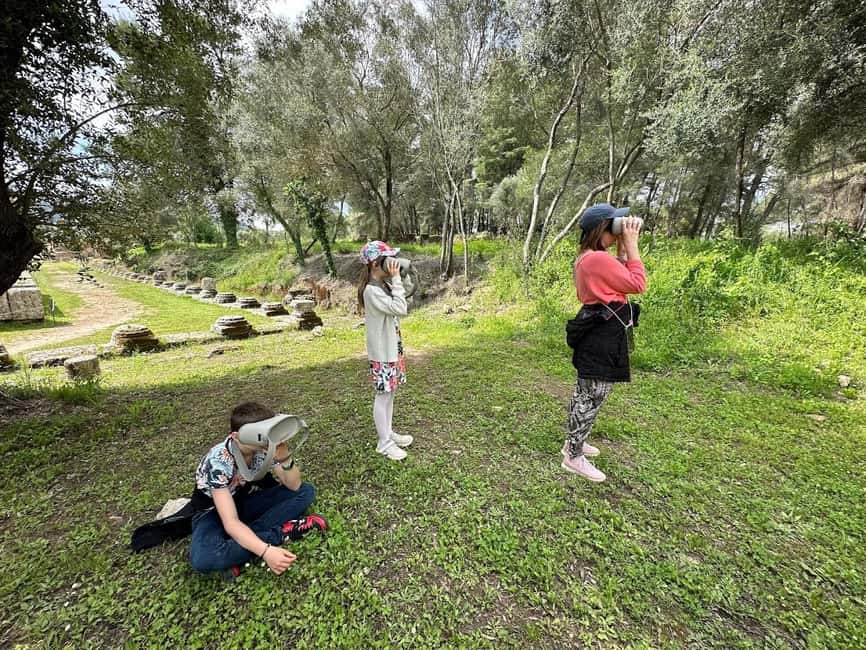
Ancient Olympia makes more sense in 3D. This two-hour self-guided tour uses virtual reality glasses, audio commentary, and a map to show you how the sanctuary may have looked before earthquakes, time, and stone reuse reduced it to ruins. I especially like the freedom to move at your own pace and the way the images explain the scale of the temples, training grounds, and stadium.
The tour is also a good choice if you want more than a guidebook description. The audio begins as you approach each site, and the VR scenes show athletes training, competing, and taking part in the ancient Olympic Flame ceremony. The main drawback is that the office is across town from the archaeological entrance, and the GPS guidance can occasionally need reorienting.
In This Review
- Key points to know before you go
- Why virtual reality helps at Ancient Olympia
- Picking up the glasses in Olympia
- The Ancient Gymnasium and Palestra
- The Phidias Workshop and the Statue of Zeus
- The Ancient Stadium and the Olympic competition
- The Nymphaeum of Herodes of Atticus
- The Olympic Flame ceremony
- The map, audio, and GPS: what works and what does not
- Timing, crowds, and how to plan your visit
- Is $28.23 good value?
- Who should book this experience?
- Should you book Olympia Back In Time?
- FAQ
- How long does the Olympia VR tour take?
- Where do I meet the host?
- Is admission to the archaeological site included?
- Which languages are available for the audio guide?
- Which languages are available for the live introduction?
- What do I need to leave as a deposit?
- Is the activity wheelchair accessible?
- Can I cancel the booking?
Key points to know before you go
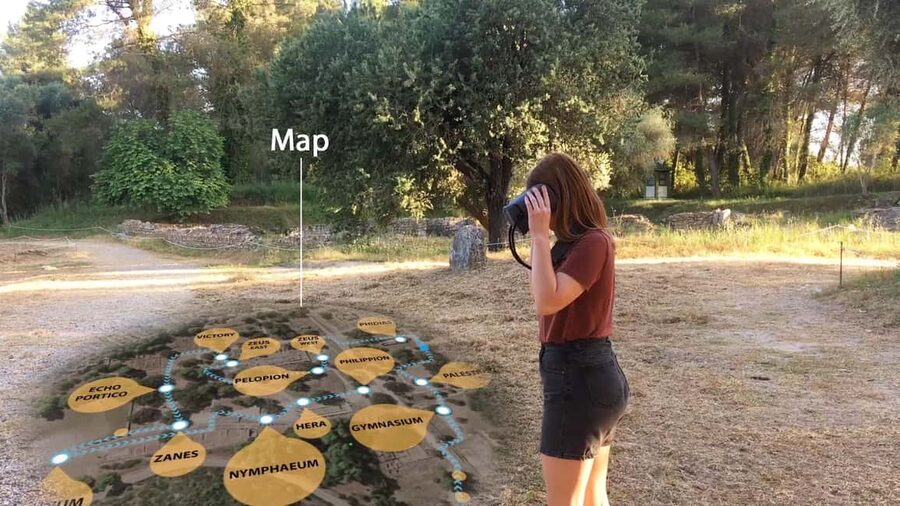
- Fifteen monuments in one route: The program covers major sites including the Ancient Gymnasium, Palestra, Phidias Workshop, Temple of Zeus, Stadium, and Nymphaeum.
- Ruins become full buildings: The glasses reconstruct temples and facilities in 3D, helping you understand what the scattered columns and foundations once meant.
- Self-guided, not group-led: You follow the virtual map and move at your own speed, with no large tour group setting the pace.
- Audio in seven languages: Commentary is available in Greek, English, French, German, Spanish, Italian, and Dutch.
- Allow extra walking time: The partner office is on Olympia’s main street, across from the church, and can take about 20 minutes to reach from some transport drop-off points.
- Useful for families: The moving athletes and game scenes give children a clear reason to look closely at the ancient site.
Why virtual reality helps at Ancient Olympia
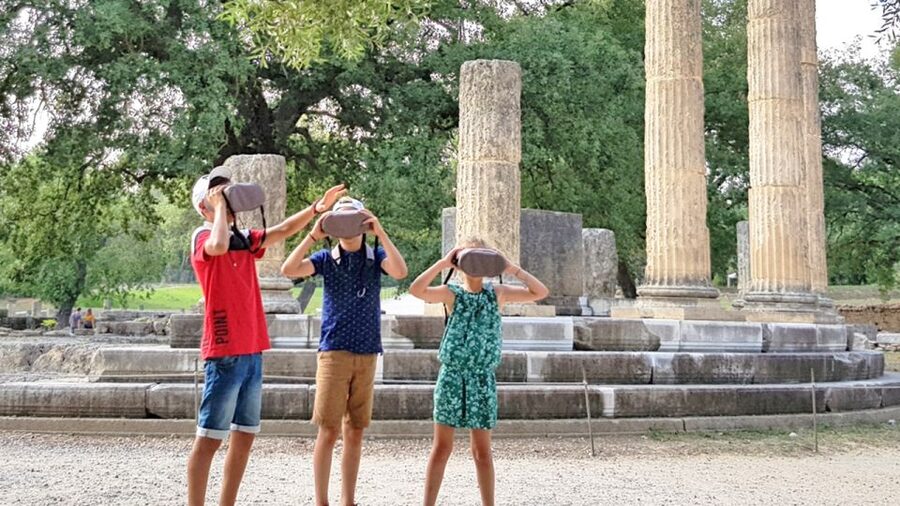
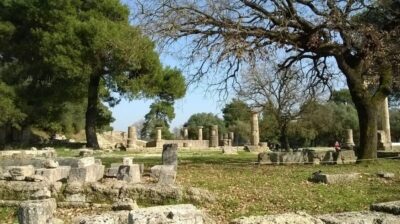
Ancient Olympia is important, but it can be hard to read. You see foundations, fallen blocks, partial columns, and open ground. Without context, the site can blur into a long walk among stones.
The VR glasses solve much of that problem. As you reach each monument, you can look through the device and see a computer-generated version of the buildings in their former setting. The images are not photographs. One useful description is to think of them as video-game-style reconstructions, but that does not make them less helpful.
I like this approach because it answers the questions you naturally ask while walking: How tall was this building? Where did the athletes train? What could spectators see from the stadium? How did the Temple of Zeus dominate the sanctuary?
The audio adds another layer. It gives short facts and stories as you approach the monuments, so you do not need to keep stopping to read signs or search through a guidebook. You can listen, look around, and continue when ready.
The experience has earned a 4.8 rating from 505 reviews, and the strongest praise focuses on one thing: the technology makes the ruins understandable. That is the real value here. You are not simply adding a gadget to a site visit. You are gaining visual context that the remaining stones cannot provide on their own.
A few more Greece half-days to weigh up
- Athens: Acropolis Ticket with Optional Audio or Live Guide
★ 4.2 · 11,055 reviews - Athens: Cape Sounio & Poseidon Temple Trip with Audio Guide
★ 4.4 · 4,521 reviews - Athens: Acropolis Ticket with Audio Guide
★ 4.0 · 3,575 reviews
Picking up the glasses in Olympia
You begin at the local partner’s office, identified as Olympia Back In Time. The office is on the main street, across from the church. You can also search for Olympia Back in Time on Google Maps.
The staff gives you a short demonstration before you enter the archaeological site. Pay attention during this briefing, especially to the map and the blue arrow. The arrow shows the direction to walk, and it may take a few seconds to adjust to the way you are facing.
You need to leave a passport, driving licence, or identity card as a deposit. Bring comfortable shoes, since the activity involves walking over an open archaeological site. Admission to the archaeological site is not included, so you must buy that separately.
The office is not directly beside the ruins. Several visitors have found it useful to allow about 20 minutes to walk from a coach drop-off point, and another 20 minutes at the end to return the equipment before continuing to transport. This matters if you are visiting Olympia on a cruise excursion or working around a strict departure time.
The Ancient Gymnasium and Palestra
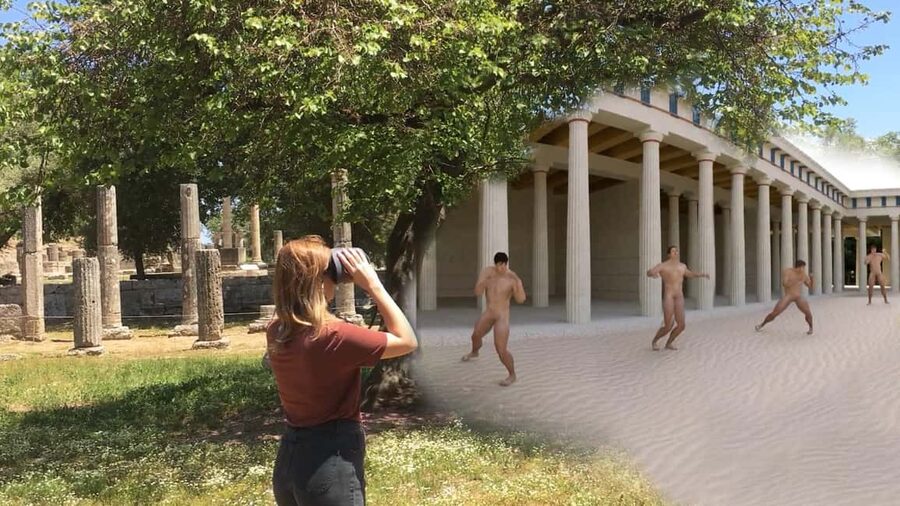
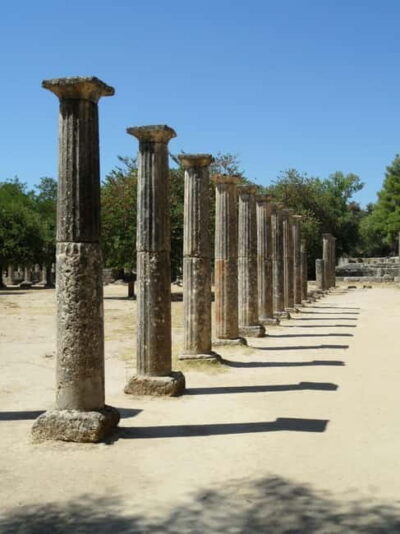
The route begins with the Ancient Gymnasium. This was where athletes trained for the Olympic Games, and the VR reconstruction gives you a better sense of its size and purpose than the remaining structures can manage alone.
You then reach the Palestra, the training area associated with boxers and wrestlers. The difference between these two sites becomes clearer with the glasses. Instead of seeing two sets of ruins, you can picture the athletic spaces as working parts of a larger training complex.
This section should appeal to anyone interested in the human side of the games. Ancient Olympia was not only a stadium and a ceremony. Athletes trained, prepared, and spent time in facilities designed for physical competition.
The route is self-guided, so you can pause near the ruins and listen again if a point catches your attention. That freedom is useful, but it also means you must keep an eye on the route and your available time.
The Phidias Workshop and the Statue of Zeus
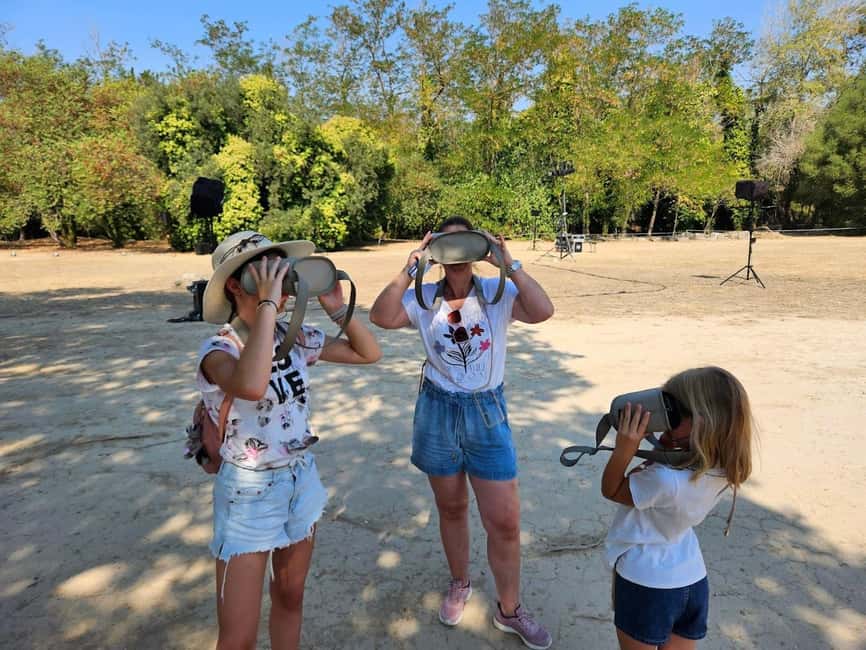
The next major stop is the Phidias Workshop. According to the tour material, Phidias created one of the seven wonders of the ancient world here. The VR display helps connect this plain archaeological space with the enormous artistic work once produced inside it.
The workshop is a good example of why the tour works best at the actual site. A reconstruction viewed on a phone would not give you the same connection between the surviving remains and the building that once occupied them.
From there, you head east to the Temple of Zeus. This is one of the key moments of the route. Through the glasses, you can enter a restored version of the temple and see the magnificent Statue of Zeus in its original setting.
The scale is difficult to grasp when you look only at the temple ruins. The virtual view gives you a stronger sense of the building’s height and presence, while the audio explains why this monument mattered. If you have limited time, give yourself enough space here rather than rushing through for photographs.
Same stretch of coastline, a completely different day out:
- Athens: Acropolis & up to 5 Archaeological Sites Combo Pass
★ 4.4 · 12,619 reviews - Athens: Acropolis, Parthenon & Acropolis Museum Guided Tour
★ 4.8 · 9,316 reviews - Athens: Cape Sounion & Poseidon Temple Sunset Half-Day Trip
★ 4.8 · 8,241 reviews - From Kissamos Port: Boat Cruise to Balos Lagoon & Gramvousa
★ 4.2 · 6,755 reviews
The Ancient Stadium and the Olympic competition
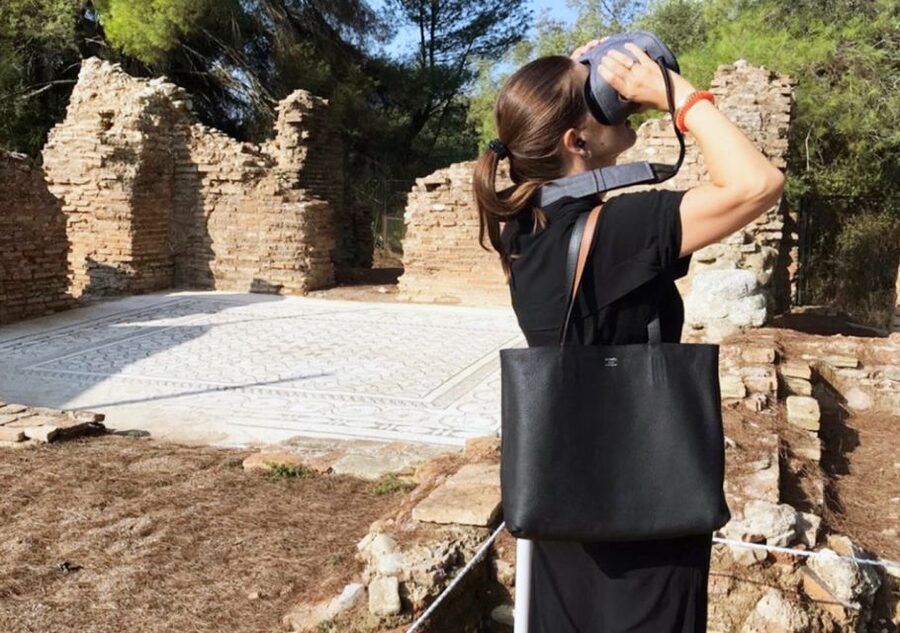
The Ancient Stadium is likely to be the most memorable stop for many people. This is where the tour shifts from architecture to action.
Through the VR glasses, you watch athletes train and compete in an ancient Olympic event. The viewpoint near the finishing line helps you picture the race from the same part of the stadium where the result mattered most.
This is where the technology becomes especially effective for families. Children may not care much about a foundation wall, but they can understand a race, a finish, and a crowd gathered for a contest. Adults get a useful reminder that the Olympics began as a religious and athletic festival in this place, not as the modern international event we know today.
The stadium is also one place where you should be aware of your surroundings. The device occupies your attention, and one visitor found it disconcerting when people moved around nearby. If the site is crowded, walk slowly and pause in a safe position before focusing on the virtual scene.
The Nymphaeum of Herodes of Atticus
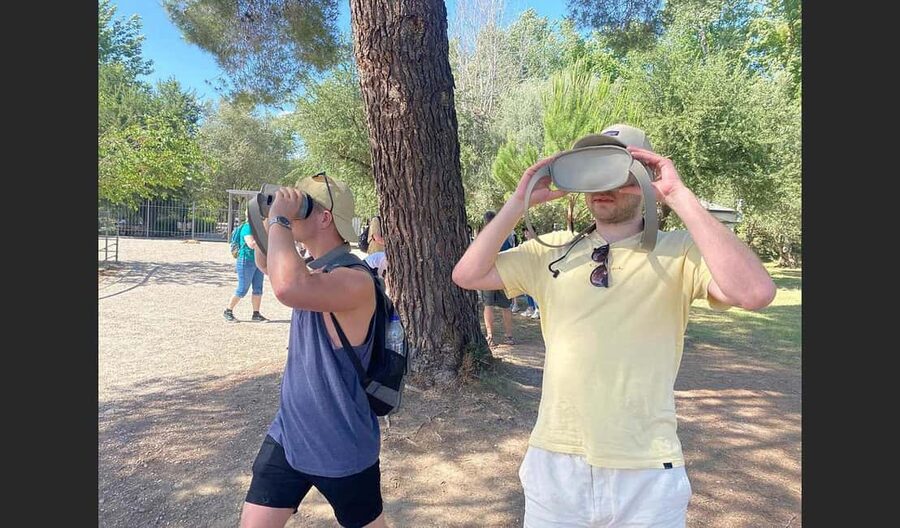
The route continues to the ruins of the Nymphaeum of Herodes of Atticus. Today, you see the remains of a water monument. With the glasses, you can view the structure in its full form and get a better idea of its original grandeur.
This stop adds variety to the tour. You have already seen training grounds, a workshop, a temple, and a stadium. The Nymphaeum shows another part of the sanctuary’s life, one connected with water, display, and monumental design.
The value here is not just visual decoration. The reconstruction helps you see how separate buildings fitted into a larger sacred complex. You begin to understand Ancient Olympia as a functioning place with many purposes, rather than a collection of isolated ruins.
The Olympic Flame ceremony

Near the end of the route, the program shows the lighting of the Olympic Flame in ancient times. This links an ancient tradition with the ceremony still associated with the modern Olympic Games.
The scene gives the visit a clear ending. You have followed athletes through training and competition, seen the buildings that supported the games, and then returned to the ritual side of Olympia.
The connection should not be taken to mean that every modern Olympic custom is unchanged. The tour presents the lighting tradition as an example of continuity, and it gives you a memorable way to think about how ancient and modern Olympic culture relate.
The map, audio, and GPS: what works and what does not
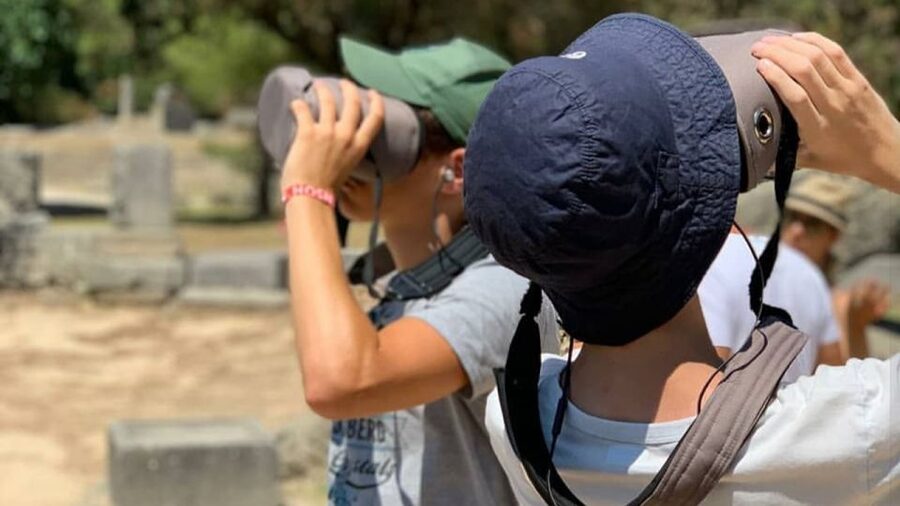
The virtual map is one of the tour’s most useful tools. It helps you find the next monument and keeps the route manageable across the archaeological site. You are not required to follow a guide holding a flag, and you can take a little longer at the places that interest you most.
The audio starts as you approach each monument. It is available in seven languages: Greek, English, French, German, Spanish, Italian, and Dutch. The live introduction and technical help are provided in English, French, and Greek.
The GPS is helpful, but it is not perfect. At times, the device may fail to recognize your position or point you in a confusing direction. The practical fix is to pause, reorient yourself, and use the physical site signs as a check. If the audio begins at the wrong moment, you can still match it to the monument in front of you.
The blue arrow deserves special attention. Follow the direction it indicates, even if it does not seem to match the way you are currently facing. The system may take a few seconds to adjust.
Some visitors also encountered a device that shut down briefly. The instructions and staff support made these problems manageable, but you should not expect flawless modern navigation every second of the route.
Timing, crowds, and how to plan your visit
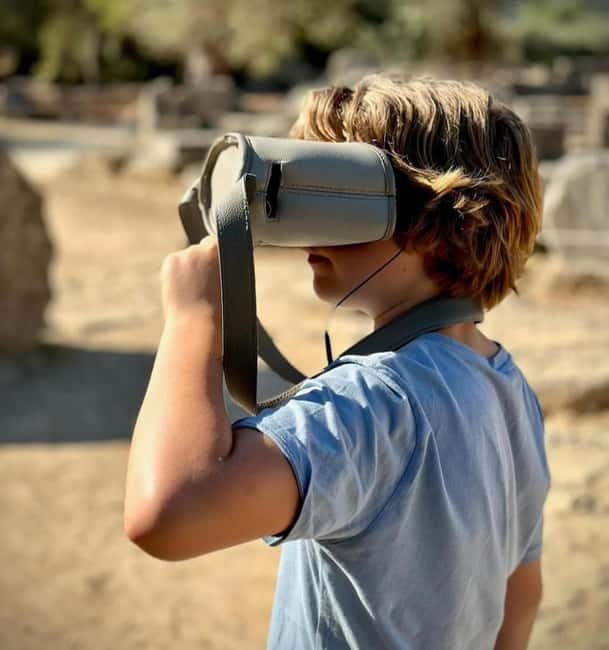
The advertised duration is two hours, but your total time should include the walk to and from the office, the equipment briefing, and the separate admission process for the archaeological site.
One useful strategy is to collect the glasses before entering the ruins. The VR route is designed for the outdoor archaeological site, and beginning there gives you the best chance of completing the full experience without a time squeeze.
If you also want to visit the museum, plan carefully. One visitor went to the museum first and felt rushed afterward while trying to complete the VR route. The museum and archaeological site are different parts of the visit, so do not assume that two hours covers both.
The office does not offer returns between 1:30 pm and 3:00 pm because of its working schedule. Check the available start times before booking, especially if you have a coach, ferry, or cruise departure.
Late arrival can cause a serious problem. Arrivals more than 45 minutes late without contacting the provider may be canceled without a refund.
Is $28.23 good value?
At $28.23 per person, this is not the cheapest way to add information to a ruin visit. You still pay the archaeological-site admission separately, and the equipment is rented rather than included as part of the entry ticket.
I think the price makes sense if you are not already arranging a private guide. The glasses provide visual reconstruction, an audio guide, navigation, and technical support in one package. You also avoid being tied to the pace of a large group.
The value is strongest for first-time visitors who want to understand the site rather than simply photograph it. It is also useful if your group has different interests. One person can pause at the Temple of Zeus while another moves ahead, within the limits of the route and return time.
A traditional guide may offer more conversation and the ability to answer personal questions. The VR tour gives you more independence, but less direct human explanation once you leave the office. Choose based on how you prefer to learn.
Who should book this experience?
I would recommend it to families, first-time visitors, and anyone who has trouble picturing ancient buildings from foundations alone. The athletic scenes are lively enough to hold children’s attention, while the audio gives adults the historical context needed to understand the sanctuary.
It is also a strong option for independent visitors who dislike large groups. You can walk at your own pace and avoid following a crowd from monument to monument.
You should think twice if you dislike wearing electronic equipment, want a fully personal guide, or have a very tight schedule. The GPS can occasionally lose its position, and the walk to the office takes planning.
The activity is wheelchair accessible, but the information provided does not describe every surface or route condition within the archaeological site. If you need precise access details, contact the provider before booking.
Should you book Olympia Back In Time?
Book it if the ruins need explaining. Ancient Olympia has enormous historical importance, but the physical remains do not always communicate their original size or purpose. The VR scenes of the Temple of Zeus, the stadium, the training grounds, and the Olympic Flame ceremony fill in those missing pieces.
For $28.23, plus site admission, you get a flexible two-hour experience with 15 monuments, seven audio languages, a map, and staff support. Allow extra time for the office walk, collect the equipment before visiting the museum, and treat the GPS as a helpful guide rather than a perfect one.
If you want the clearest picture of how Olympia once worked, this is a smart addition to your visit.
FAQ
How long does the Olympia VR tour take?
The activity lasts two hours. Check availability for the starting times offered on your chosen date.
Where do I meet the host?
Meet at the Olympia Back In Time office on Olympia’s main street, across from the church. You can search for Olympia Back in Time on Google Maps.
Is admission to the archaeological site included?
No. Admission to the archaeological site is not included in the tour price.
Which languages are available for the audio guide?
The audio guide is available in Greek, English, French, German, Spanish, Italian, and Dutch.
Which languages are available for the live introduction?
The live demonstration and information are provided in English, French, and Greek.
What do I need to leave as a deposit?
A passport, driving licence, or identity card deposit is required for the VR equipment.
Is the activity wheelchair accessible?
Yes, the activity is listed as wheelchair accessible.
Can I cancel the booking?
You can cancel up to 24 hours in advance for a full refund. The reserve-now-and-pay-later option lets you book without paying immediately.
Just added around Greece
- Delphi One Day Trip from Athens★ 4.0 · 98 reviews
- Mercedes Private Tour to Delphi and Arachova★ 5.0 · 30 reviews
- Private Delphi and Hosios Loukas Monastery – Great Lunch and Drinks Included★ 5.0 · 36 reviews
- Day tour to Ancient Olympia,Ancient Sparta Mycenae Including Meal★ 5.0 · 54 reviews
- Athens: Half Day Trip To Cape Sounio/Poseidon Temple Semi Private★ 5.0 · 131 reviews
- Athens Half-Day Private Tour Acropolis, Parthenon City Highlights★ 5.0 · 35 reviews
- From Athens: Day Tour to Mykonos★ 5.0 · 64 reviews
- Culinary Secrets of Downtown Athens★ 5.0 · 103 reviews
Olympia Tours, compared.
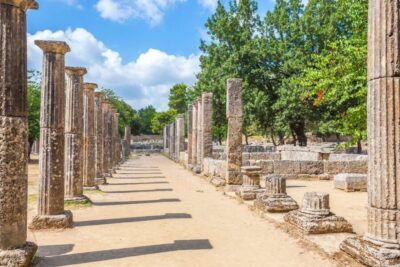
Katakolo Port: Transfer to Ancient Olympia and VR Audio Tour
Read our review →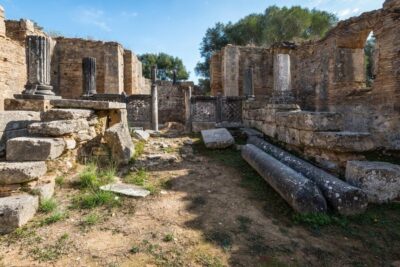
Archaeological Site & Museum E-Ticket & Audio Guide
Read our review →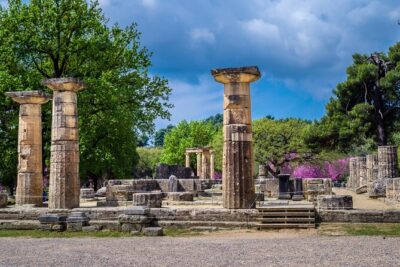
Ancient Olympia Half-Day Tour from Katakolo Cruise Port
Read our review →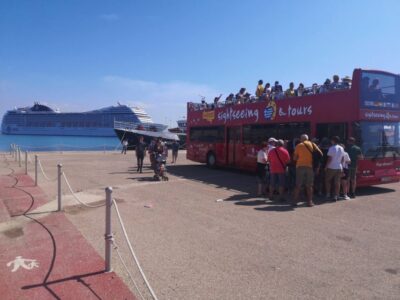
Browse the lists this tour appears in