Reviewed · ATHENS TOURS
Philosophical Tour in Athens
Think Athens, then think beyond ruins. This private walking tour links ancient sites with questions about happiness, identity, democracy, psychology, and even artificial intelligence. I like the thoughtful route through places tied to Socrates and Plato, and I like the way guide Lampros uses short videos and conversation instead of giving a nonstop lecture. The main consideration is that this is a serious philosophy experience, not a standard sightseeing walk, so it may feel demanding if you want only quick facts and photographs.
You pay $90.11 per person for about two and a half hours, with a private group of up to six people. That can be good value for families or friends who want personal attention, though you should check how the total price is calculated for your group before booking. The walk includes hills, outdoor stops, and Athens heat, but Lampros is praised for choosing shady places to sit and talk.
In This Review
- Key points to know before you book
- Why this Athens walk feels different
- Theater of Dionysus: tragedy as a cure for easy judgment
- Herod Atticus Odeon and the masks of personality
- The Prison of Socrates and Plato’s Cave
- Agios Dimitrios Loumbardiaris and the idea of democracy
- Philopappos Monument and the ancient recipe for happiness
- Pnyx, Eudaimonia, and the secret place of Socrates
- Keramikos and Epicurus’s garden
- Roman Agora and the practical side of Stoicism
- Lysikratous Square and Nietzsche’s two sides of Athens
- Anafiotika: a Cycladic finish below the Acropolis
- What the $90.11 price really buys you
- Who will enjoy this private Athens tour?
- FAQ
- Where does the Philosophical Tour in Athens start?
- Where does the tour end?
- How long does the tour last?
- Is this a private tour?
- What language is the tour offered in?
- Is admission included?
- Can I cancel for a full refund?
- Should you book it?
Key points to know before you book
- Philosophy happens on location: You discuss tragedy outside the Theater of Dionysus, Plato near the Prison of Socrates, and Stoicism around the Roman Agora.
- Private groups stay small: The tour is for your party only, with up to six people covered by the group arrangement.
- Lampros shapes the discussion: He adjusts explanations to the group and welcomes questions about psychology, happiness, free thought, and AI.
- The route has strong views: Philopappos Monument and Pnyx offer memorable views toward the Acropolis and across Athens.
- Multimedia adds variety: Short videos and presentations help explain ideas that can be hard to grasp from spoken commentary alone.
- The walk ends in Anafiotika: The final stretch feels more like a Cycladic village than central Athens, a pleasant change after the ancient sites.
Why this Athens walk feels different
Most Athens walking tours help you understand what you are seeing. This one asks you to consider what the sites mean. The ancient stones are still important, but they serve as prompts for discussion about how people think, suffer, choose, and live well.
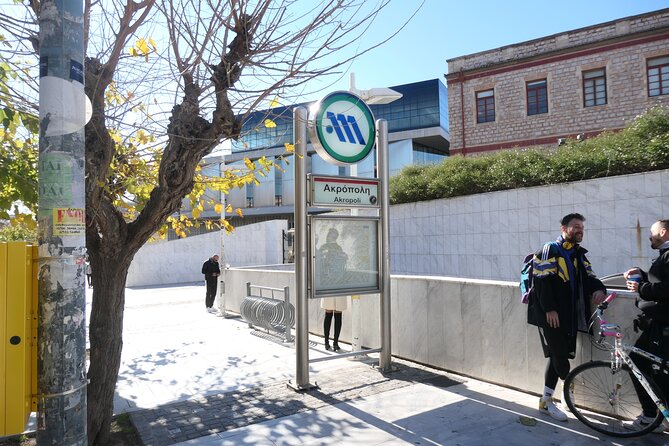
The route begins near AcropoliAthens at 11 a.m. and returns to the same meeting point. Over roughly two hours and thirty minutes, you move through theaters, sacred ground, civic spaces, monuments, old streets, and neighborhoods near the Acropolis. The pace is broken into short talks at each location, so you are not expected to listen while walking every minute.
I like that structure. A philosophical idea can be slippery when explained in a crowded city street. Sitting in a shaded spot, watching a brief video, and then discussing the idea gives it room to settle. Lampros also connects ancient thought with modern psychology, which helps make the experience useful beyond the holiday.
This is not a tour built around ticking off famous monuments. You will see important places, but the focus is the development of ideas. That makes it a good first activity in Athens if you want later visits to the Acropolis, Agora, and surrounding streets to carry more meaning.
A few more Athens half-days to weigh up
- Athens: Acropolis & up to 5 Archaeological Sites Combo Pass
★ 4.4 · 12,619 reviews - Athens: Acropolis Ticket with Optional Audio or Live Guide
★ 4.2 · 11,055 reviews - Athens: Acropolis, Parthenon & Acropolis Museum Guided Tour
★ 4.8 · 9,316 reviews
Theater of Dionysus: tragedy as a cure for easy judgment
The first stop is outside the Theater of Dionysus Eleuthereus, often linked with the birth of Greek tragedy. The discussion asks why citizens were expected to watch tragic plays and how tragedy might challenge quick moral judgments.
That is a strong opening because theater is not treated as mere entertainment. The conversation connects tragic storytelling with Carl Jung, Buddhist ideas, and evolutionary psychology. The supplied itinerary contains a wording error around one term, but the intended subject is clearly the way tragedy can expose parts of the self that are easy to ignore.
You can expect about fifteen minutes here. Admission is free because the tour stops outside the theater. The benefit is context and interpretation, not entry into the performance space.
This is also a useful test of the tour’s style. If you enjoy questions about emotion, human behavior, and self-awareness, you will likely settle into the experience quickly. If you prefer dates, battles, and architectural details, the opening may feel abstract.
Herod Atticus Odeon and the masks of personality
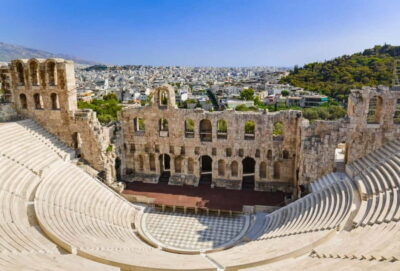
The next stop is the Herod Atticus Odeon, the striking open-air theater below the Acropolis. The talk turns to the idea of persona, along with the animus and anima in Jungian psychology.
You spend about ten minutes here. The setting helps because a theater naturally raises questions about roles. What do you show other people? What do you hide? How much of personality is performance, and how much is genuine?
The Odeon is one of the most photogenic points on the route, but the tour does not linger only for a picture. Lampros uses the theater as a symbol, then moves the group toward psychology and personal reflection. That shift is typical of the whole walk.
The Prison of Socrates and Plato’s Cave
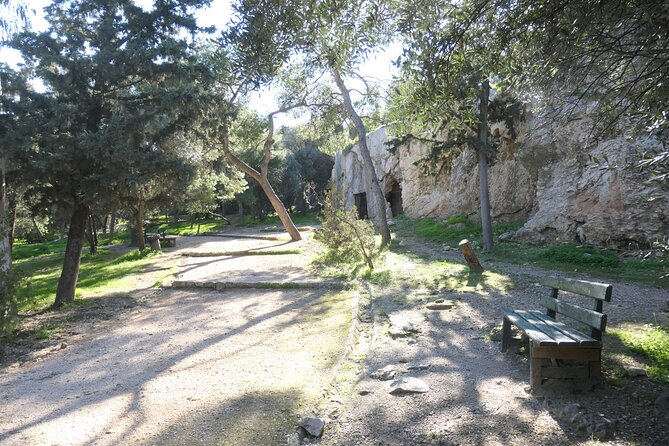
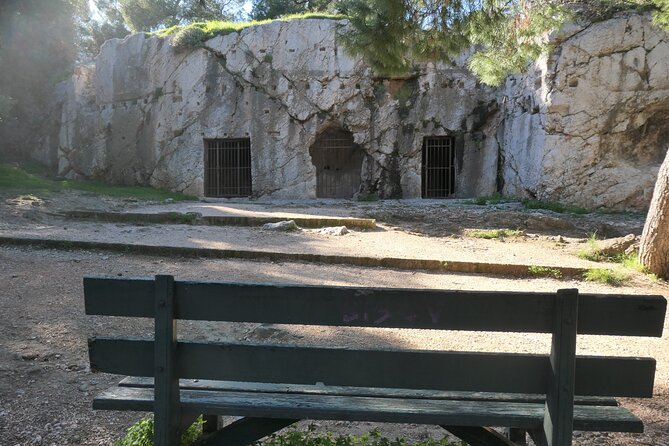
At the Prison of Socrates, the focus turns to Plato’s allegory of the cave. This is one of the longer talks, about twenty minutes, and one of the clearest chances to see how the tour blends place with philosophy.
The cave allegory asks how people distinguish appearance from reality. It also raises an uncomfortable question: if someone has been shown a wider truth, should that person return to help others, even when the message is unwelcome?
You will not need a university background to follow the discussion. Lampros is repeatedly praised for meeting people at different levels, explaining difficult concepts for beginners while still giving experienced students something to consider. That matters on a private tour where a family or group of friends may not share the same interest in philosophy.
The location itself should be treated with care. The stop is presented as the Prison of Socrates, but the real value here is the conversation and its connection to Plato. Do not expect a large formal museum presentation. This is an outdoor pause with interpretation.
Same stretch of coastline, a completely different day out:
- Athens: Cape Sounion & Poseidon Temple Sunset Half-Day Trip
★ 4.8 · 8,241 reviews - Athens: Acropolis and Parthenon Guided Walking Tour
★ 4.6 · 5,882 reviews - All Day Cruise -3 Islands to Agistri,Moni, Aegina with lunch and drinks included
★ 5.0 · 4,958 reviews - Athens, Piraeus, and Coastline: Blue Hop-On Hop-Off Bus
★ 3.9 · 4,849 reviews
Agios Dimitrios Loumbardiaris and the idea of democracy
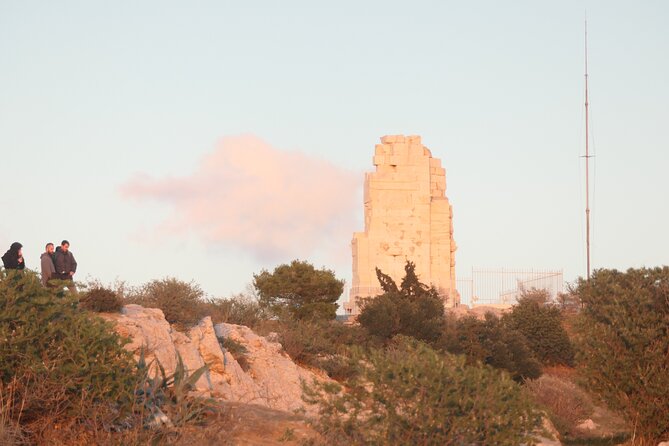
The route continues to the church of Agios Dimitrios Loumbardiaris, where the discussion turns to the birth of democracy. You spend roughly twenty minutes here.
The strength of this stop is that democracy is treated as an idea that needs examination, not just as a proud label attached to ancient Athens. You can expect discussion about civic life, participation, judgment, and the responsibilities that come with freedom.
This part may appeal especially to students, families with older children, and anyone interested in how political thought began to take shape. One teenager reportedly enjoyed the tour enormously, which suggests that Lampros can make the material accessible without reducing it to a school lesson.
The walk also gives you a break from the most crowded Acropolis viewpoints. You are still close to major sights, but the conversation takes place in a quieter setting than a conventional monument stop.
Philopappos Monument and the ancient recipe for happiness
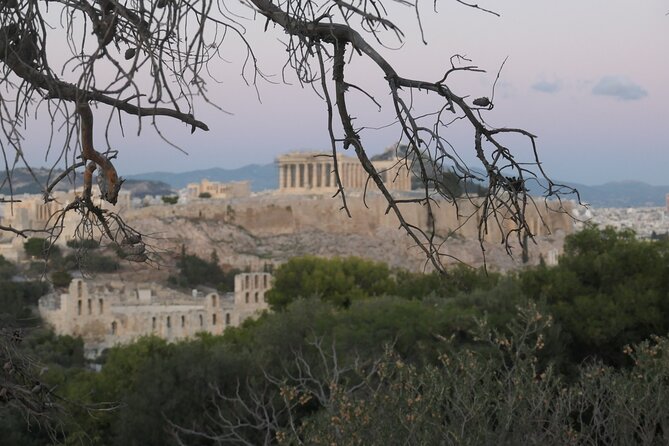
At the Philopappos Monument, the tour reaches one of its best viewpoints. You look toward the Parthenon and Acropolis from a position that gives the monuments a wider setting rather than the close-up view you get inside the Acropolis complex.
The stop lasts about fifteen minutes. Here the subject is happiness according to Plato and Socrates, along with the claim that this is one of the most energetic points in Athens.
The word energetic is subjective, of course, but the setting does have a strong sense of openness. The view gives you a natural pause, and the happiness discussion fits the moment. Ancient philosophy often treats happiness as something more serious than pleasure or comfort. The question becomes how to live well, act wisely, and shape a worthwhile life.
If you are taking photographs, this is one of the places to have your camera ready. Still, do not expect a long photo session. The viewpoint supports the talk, rather than replacing it.
Pnyx, Eudaimonia, and the secret place of Socrates
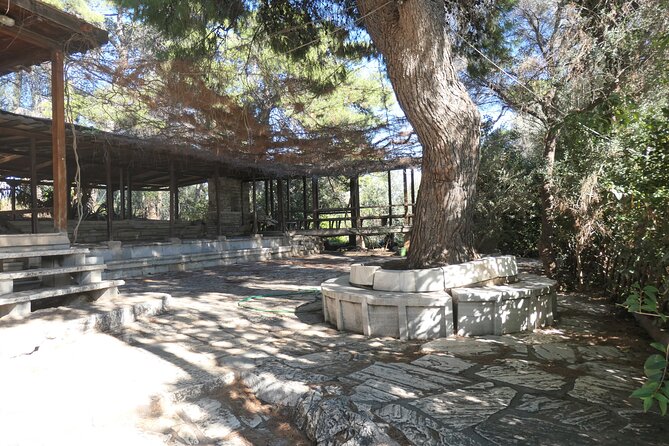
Pnyx was the assembly area of Athenian citizens, and the tour uses it to discuss Aristotle’s idea of eudaimonia, often translated as flourishing or blissful living. This is another fifteen-minute stop, and admission is listed as included.
The connection between Pnyx and eudaimonia is useful. Here, happiness is linked to how a person lives and participates in the community, not only to private feelings. The setting gives the political side of philosophy a physical place.
The view across Athens is another major reward. The itinerary calls Pnyx the best view in the city, which is a matter of taste, but it is certainly one of the route’s strongest outlooks. You also hear about a place associated with Socrates, adding a more personal layer to the civic setting.
Expect uneven walking and outdoor conditions. The tour is manageable for most people, and one account describes Lampros helping children in wheelchairs, but the route is not presented as a fully step-free path. If mobility is a concern, ask about the exact route before booking.
Keramikos and Epicurus’s garden
Keramikos Archaeological Site brings a different mood. This was the ancient cemetery of Athens, and the discussion moves to Epicurean ideas about happiness and the image of Epicurus’s garden.
The stop lasts about fifteen minutes. A cemetery is a fitting place to discuss pleasure, fear, mortality, and the search for a calm life. Epicurean thought is often misunderstood as a call to constant indulgence. The tour gives you a chance to consider a more measured view of happiness and contentment.
Admission is listed as free at this stop. Since the itinerary also includes a separate admission note for Pnyx, it is wise to confirm exactly which access fees are covered when you book. The important point is that the tour’s cost is not built around a long series of museum entries. You are paying mainly for the private guide, route, discussion, and interpretation.
The route also passes places connected with the beginnings of philosophy, theater, and democracy. Those claims are broad, but they reflect the tour’s central idea: Athens is not only a collection of ancient remains. It is a city where public life, performance, argument, and reflection crossed paths.
Roman Agora and the practical side of Stoicism
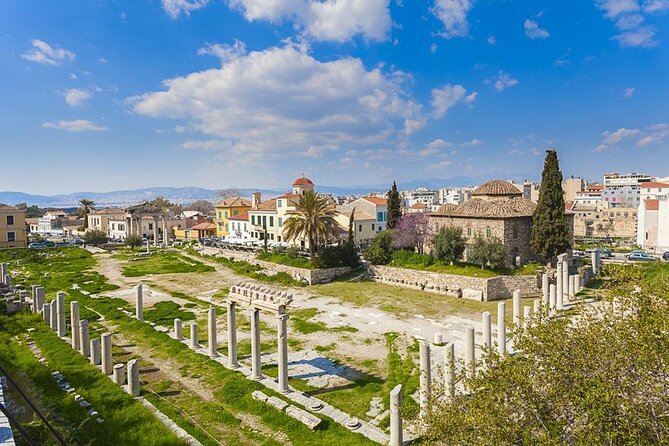
At the Roman Agora, the conversation turns to Stoicism as a philosophy of life. You spend around fifteen minutes here.
This section should appeal to anyone who has encountered Stoic ideas through modern books or podcasts. Instead of treating Stoicism as a set of slogans, Lampros links it to daily choices and personal discipline. The goal is to ask what you can control, how you respond to hardship, and how your values guide action.
The Roman Agora is also connected with the first meteorological station in the world. That detail gives the stop a useful change of pace after the more personal discussion of happiness and self-control.
The tour then moves toward the Mnisikleous stair area, described as a meeting place for philosophers and a good spot for lunch. The itinerary does not assign a formal time to every passing point, so you should not assume lunch is included. Instead, think of this as a useful local tip. Lampros has also suggested rooftop bars, open-air cinema, and places to eat, including a restaurant known for meatballs.
Lysikratous Square and Nietzsche’s two sides of Athens
At Lysikratous Square, the tour discusses Friedrich Nietzsche’s idea of the Apollonian and Dionysian sides of Athens. The stop lasts about fifteen minutes.
This is a clever place to bring together the tour’s earlier themes. Apollo suggests order, balance, and form. Dionysus points toward emotion, theater, instinct, and release. The city’s ancient theaters and civic spaces make those contrasts easier to picture.
The square also gives you another chance to see how the tour moves between ancient Greece and later thinkers. You are not hearing only about Socrates, Plato, and Aristotle. The route includes Jung, Nietzsche, Buddhism, evolutionary psychology, and modern questions about technology.
One unusual feature is the link some participants make between these old questions and artificial intelligence. Lampros has used the walk to discuss the future of human reasoning and whether machines change the way people understand thought. That will not suit everyone, but it gives the tour a modern edge.
Anafiotika: a Cycladic finish below the Acropolis
The final stop is Anafiotika, a small area near the Acropolis that feels more like a Cycladic island than central Athens. You spend about ten minutes here before returning to the starting point.
After theaters, tombs, political meeting grounds, and philosophical schools, Anafiotika offers a visual change. Whitewashed walls, narrow lanes, and the village-like feel make the ending light and memorable.
The stop is not presented as a major philosophy lesson. It works more as a final atmospheric note, reminding you that Athens is layered in unexpected ways. Ancient monuments, modern city streets, local food, and island-style architecture can all appear within a short walk.
What the $90.11 price really buys you
The listed price is $90.11 per person, and the experience is private for groups of up to six. For one or two people, that may feel high beside a large group walking tour. For six friends or family members, the personal format can make the price more reasonable, especially if you value questions and flexible discussion.
The guide’s role is the main value. You are not simply walking between free sights. You are receiving a themed route, explanations, multimedia material, and a conversation that can shift toward your interests. Lampros has been praised for being warm, attentive, and able to explain ideas to both beginners and people with university study in philosophy.
There are also practical savings in the route. Most stops list no admission charge, and the tour ends where it begins. Still, the listed price is described per person while the tour also says one price covers a group of up to six, so confirm the final booking total before paying.
Who will enjoy this private Athens tour?
I would choose this tour for you if you enjoy asking why, not only what. It suits people interested in philosophy, psychology, personal growth, political thought, theater, and the way old ideas still shape modern life.
It can also work well for families with teenagers. The private format lets Lampros adjust the pace and explain concepts without forcing everyone into a fixed group script. Couples and small groups of friends may appreciate the freedom to ask personal questions.
You may want another type of Athens tour if your main goal is to enter major monuments, hear a detailed chronology, or cover the Acropolis in a traditional art-history format. This walk visits many important places, but it does not replace a full Acropolis tour or an archaeological guide.
Wear comfortable shoes, bring water, and plan for sun. The heat can affect the experience, although Lampros has been praised for using shade and choosing comfortable places for discussion. The tour needs good weather. If poor conditions cancel it, you can take another date or receive a full refund. Free cancellation is available up to 24 hours before the start time.
FAQ
Where does the Philosophical Tour in Athens start?
It starts at AcropoliAthens, 117 42, Greece, at 11 a.m.
Where does the tour end?
The activity ends back at the meeting point.
How long does the tour last?
It lasts approximately two hours and thirty minutes.
Is this a private tour?
Yes. Only your group participates, with a group arrangement for up to six people.
What language is the tour offered in?
The tour is offered in English.
Is admission included?
The itinerary lists admission as free at most stops and shows admission included for Pnyx. Confirm the exact access details when booking.
Can I cancel for a full refund?
Yes, if you cancel at least 24 hours before the experience start time. Cancellations or changes made less than 24 hours before the start are not refunded, and poor weather may lead to a new date or full refund.
Should you book it?
Book this tour if you want Athens to become a place for thought as well as sightseeing. The strongest reasons are the small private group, Lampros’s personal style, the use of videos, and the chance to discuss happiness, tragedy, democracy, Stoicism, and human reasoning in the actual places tied to those subjects.
I would book it early in your stay, since the walk can give later visits more context and Lampros offers useful suggestions for food and evening activities. Skip it if you want a fast monument checklist or a traditional chronological history tour. For curious minds, though, this is an unusually personal way to walk through Athens.
Just added around Athens
- Traditional Greek Show in Plaka with Dinner★ 3.6 · 178 reviews
- Santorini Wine Roads Tour with Wine Tastings Morning & Sunset★ 5.0 · 106 reviews
- Private Sunset Wine Tour with 3 Wineries and Tapas★ 5.0 · 34 reviews
- Insightful Pistachio Orchard and Factory Tour★ 4.5 · 27 reviews
- Traditional Villages Full day Tour in Santorini★ 4.0 · 84 reviews
- Half Day Tour★ 5.0 · 63 reviews
- Half-Day Shared Fishing Experience in Hydra★ 5.0 · 35 reviews
- Athens Old City Private Photoshoot Tour / 2 hrs★ 5.0 · 109 reviews
Athens Tours, compared.
Acropolis & up to 5 Archaeological Sites Combo Pass
Read our review →
Acropolis, Parthenon & Acropolis Museum Guided Tour
Read our review →
Cape Sounion & Poseidon Temple Sunset Half-Day Trip
Read our review →

All Day Cruise -3 Islands to Agistri,Moni, Aegina with lunch and drinks included
Read our review →
Athens, Piraeus, and Coastline: Blue Hop-On Hop-Off Bus
Read our review →