
Reviewed · HISTORICAL TOURS
Small-Group Women History in Ancient Greece Walking Tour
Athens had more women’s stories than most tours reveal. This two-hour walk shifts attention from famous male statesmen to Athena, Sappho, Aspasia, and Agnodice, while still using major ancient sites to explain how women lived, worked, married, worshipped, and influenced public life. I especially like the fresh subject and the way mythology is tied to real places. I also like the small group, capped at 12 people, which gives you a better chance to hear and ask questions.
The main drawback is the walk itself. You finish on Philopappos Hill, and the tour is not recommended if you have mobility issues. Most stops are outside, and the Ancient Agora is viewed from outside rather than entered, so this is a storytelling walk, not an archaeological-site tour.
In This Review
- Key points at a glance
- Why this Athens walk feels different
- Monastiraki begins the story
- Hadrian’s Library and the question of education
- Marriage, Sparta, and Eros near the Taxiarchs church
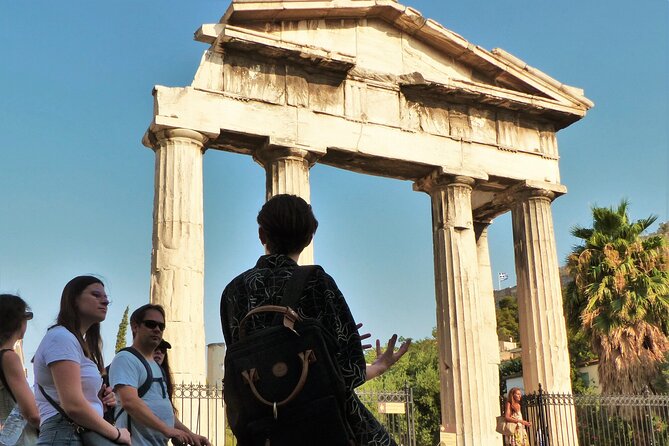
- Athena at the Gate of Athena Archegetis
- The women-only festival at Dioskouron
- The Agora from the outside
- Areopagus and the cost of changing women’s rights
- The Pnyx and the limits of democracy
- Philopappos Hill closes with the Muses
- What the tour costs and what you receive
- Who will get the most from this walk
- Should you book the Women’s History in Ancient Greece tour?
- FAQ
- How long is the Women’s History in Ancient Greece Walking Tour?
- Where does the tour begin?
- Where does the tour end?
- How large is the tour group?
- Does the tour enter the Ancient Agora?
- What people and figures are discussed?
- Is the tour suitable for people with mobility issues?
- Is public transportation available near the tour?
- What is the cancellation policy?
Key points at a glance

- A women-centered view of Athens: Learn about daily life, marriage, education, slavery, politics, religion, and love.
- Stories tied to real places: Hadrian’s Library, the Agora, Areopagus, Pnyx, and Philopappos Hill give the discussion a clear setting.
- Myth and documented lives together: Athena, Penelope, and Pandora appear alongside Sappho, Aspasia, and Agnodice.
- A genuinely small group: The maximum of 12 people makes the walk more personal and easier to follow.
- A strong final view: The tour ends on Philopappos Hill, with an Acropolis panorama.
- A good value at $44.71: You receive two hours of guided interpretation, with no separate admission charge listed for the stops.
Why this Athens walk feels different
Many first visits to Athens center on temples, generals, philosophers, and democratic institutions. Those subjects matter, but they can leave out the people who were barred from voting, restricted in public spaces, or expected to remain inside the household.
This tour asks a sharper question: What did these famous places mean to women? At the Agora, you consider the limits placed on wives, female slaves, and courtesans. At the Pnyx, you stand where democracy was practiced, while hearing that only male citizens could vote. At the Gate of Athena Archegetis, the goddess becomes a route into stories about marriage, identity, and women’s place in Athens and Sparta.
I like this approach because it does not treat women’s history as a small side topic. It uses women’s lives to explain the whole city. You still hear about politics, religion, festivals, mythology, and public space, but the questions are different.
Maelle is the guide named most often in the feedback, and the descriptions of her approach are consistent: kind, prepared, funny, inclusive, and able to answer questions. One comment specifically praised the professional research behind the women’s profiles. That matters here, since ancient women are often known through myths, male writers, or scattered evidence.
More Walking Tours in Athens
- Athens: Acropolis and Parthenon Guided Walking Tour
★ 4.6 · 5,882 reviews - Greek Food Walking Tour in Athens
★ 5.0 · 4,740 reviews - Acropolis: Acropolis and Parthenon Guided Walking Tour
★ 4.7 · 3,442 reviews
Monastiraki begins the story
The meeting point is Monastiraki Square, at Pl. Monastirakiou 2. This is a useful starting place because it is easy to reach by public transport and gives you a familiar central reference point before the walk heads into older Athens.
The opening lasts about 10 minutes. You meet your guide, settle into the group, and begin looking at the city through the theme of women in ancient Greece. This is not a long orientation, so arrive ready to walk and listen rather than expecting a general introduction to every period of Athens.
Monastiraki is also a practical place to begin if you are arranging the tour around another central Athens visit. The route eventually finishes near the center on foot, with access to the metro if you need it.
Hadrian’s Library and the question of education

The next stop is Hadrian’s Library, seen from outside, with about 10 minutes devoted to the education of girls and women in ancient Athens.
This is one of the tour’s useful corrections to the familiar image of ancient Greece as a place where learning was equally open to all. The discussion asks you to consider who had access to education and how women’s opportunities differed from those of men.
The setting works well because a library naturally raises questions about reading, writing, philosophy, and access to ideas. You are not simply looking at old walls. You are thinking about who was allowed to enter intellectual life and whose work was preserved.
Do not expect an interior visit here. The attraction is the guide’s explanation, not a ticketed exploration of the library itself.
Marriage, Sparta, and Eros near the Taxiarchs church
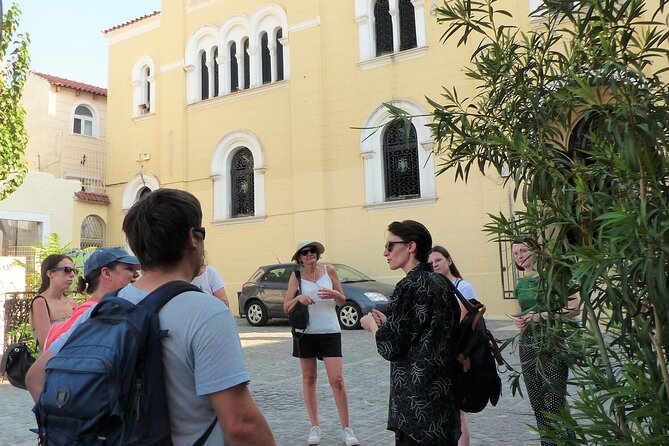
At the Holy Church of the All-Great Taxiarchs and the Virgin Mary Gregorousa, the tour spends about 15 minutes discussing marriage in ancient Athens and ancient Sparta.
The subject is broader than a simple comparison of wedding customs. You hear about what marriage meant for women in each society and how expectations could differ between Athens and Sparta. The stop also introduces Eros, the passionate form of love, adding an emotional and mythological layer to the social rules.
This is where the tour’s balance of serious history and story becomes clear. Ancient marriage was not presented only as a private romance. It was connected to family, duty, social expectations, and the position of women.
The church itself is a modern setting compared with the ancient material being discussed. That may feel less direct than standing beside a classical ruin, but it also keeps the walk moving through the living city rather than turning into a series of museum stops.
More ancient sites near Athens:
- Historical Delphi One Day Tour with Arachova Stop & Expert Guide
★ 4.5 · 1,247 reviews - Historic Athens: Small Group Electric Bike Tour
★ 4.9 · 740 reviews - The History of Athens: Greek Mythology Private Tour
★ 5.0 · 138 reviews - Athens Highlights by E-Bike: Small-Group Historic Tour
★ 5.0 · 131 reviews
Athena at the Gate of Athena Archegetis
The Gate of Athena Archegetis receives about 15 minutes. Here, you learn more about married life for women in Athens and Sparta, along with myths linked to Athena.
Athena is an especially fitting figure for this tour. She is one of the most powerful figures in Greek mythology, yet her stories also expose the assumptions and contradictions surrounding women. The guide uses her myths as a way to ask how ancient Greeks imagined female strength, wisdom, authority, and independence.
This stop should appeal to you if you enjoy mythology but want more than a list of gods and legends. Athena, Penelope, and Pandora are not included simply as entertaining names. They help show the different ways women were represented: as clever, loyal, dangerous, gifted, powerful, or controlled.
The site is viewed as part of the public street. You will not be entering a separate attraction, so the quality of the stop depends heavily on the guide’s storytelling and your ability to focus in an open urban setting.
The women-only festival at Dioskouron
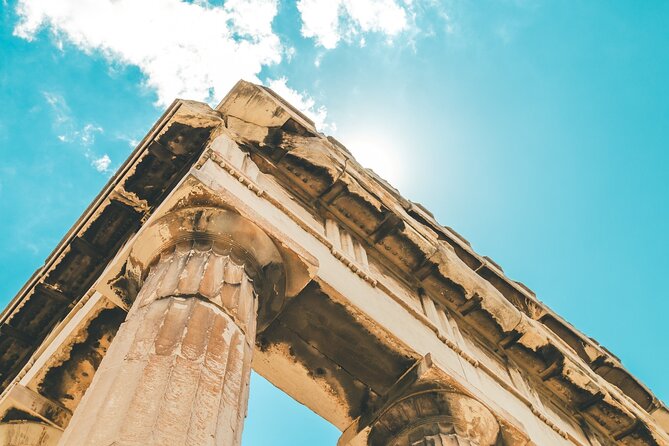
At Dioskouron, the tour spends 10 minutes on a mysterious ancient festival dedicated exclusively to women.
This is one of the more unusual subjects on the route. It gives you a glimpse of women gathering in a setting that was not simply defined by the household or by male public institutions.
The festival also helps prevent the story from becoming too bleak. The restrictions placed on women are a major part of the tour, but women were not without social, religious, or cultural roles. A women-only festival shows that ancient society could create spaces with a different balance of power, even within a system that sharply limited women in other areas.
Because the stop is short, expect a focused story rather than a long lecture. It is the sort of detail you might miss while walking alone, especially if you were concentrating only on monuments.
The Agora from the outside
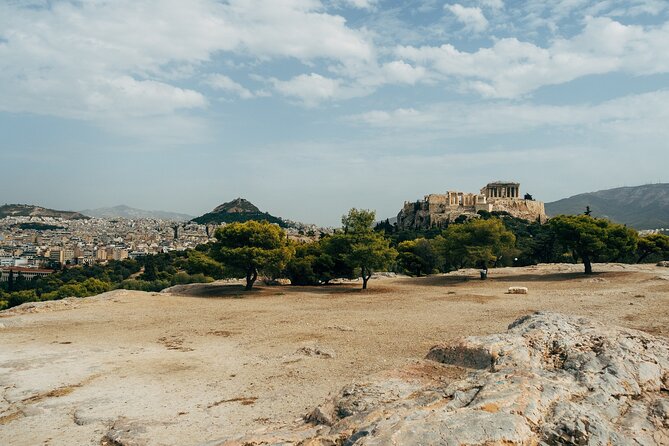
The Ancient Agora is the tour’s clearest look at public life. About 15 minutes are devoted to the marketplace and civic center, but the archaeological site is not entered. You view it from outside.
That limitation is important. If you want to walk through the Agora’s excavated remains, see its buildings up close, and spend time inside the site, you will need a separate visit. This tour does not replace an Agora ticket.
Still, the outside viewpoint has real value. The guide explains the role of women in public space, including the lives of female slaves and courtesans. You also consider the striking fact that Athenian wives were forbidden from going to the market, while the Agora was central to the city’s public life.
This is one of the strongest stops for understanding how democracy could exist alongside severe limits on women. The city’s public world was not open to everyone. The tour makes that contradiction hard to overlook.
I would especially recommend paying attention here if you have already taken a standard ancient Athens tour. The Agora may be familiar, but the questions about access, work, status, and visibility can make it feel newly important.
Areopagus and the cost of changing women’s rights

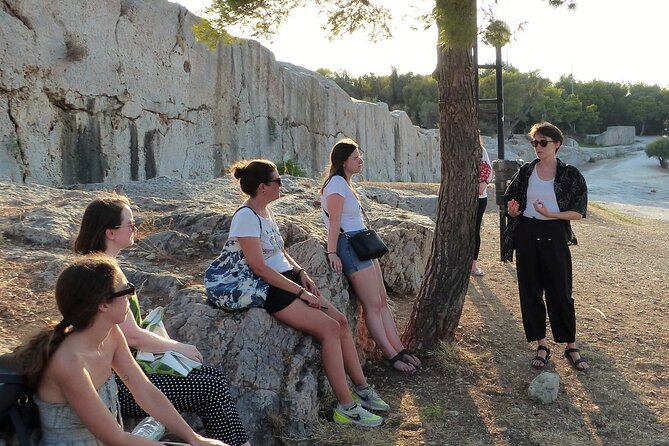
The route continues to Areopagus for about 10 minutes. This rocky site is linked with trials of serious sinners in ancient times, and the discussion turns to a woman who risked a death sentence to change women’s rights.
The subject brings the tour’s central theme into sharp focus. Ancient women did not simply live under rules as passive figures. Some challenged those rules, sometimes at enormous personal risk.
Areopagus is also one of the tour’s more physically demanding locations. The walk across uneven stone and uphill ground can be difficult if you have mobility limitations. Wear practical shoes and take care on the rock.
The setting adds drama, but the guide’s presentation is still the main event. You are not visiting a courtroom interior or a museum exhibit. You are standing in a historic place while hearing how law and social control affected women.
The Pnyx and the limits of democracy
At the Pnyx, the tour spends about 15 minutes discussing the birthplace of Athenian democracy. The key point is uncomfortable and useful: only male citizens could vote.
This stop connects women’s history to one of Athens’ most celebrated achievements. Instead of treating democracy as an automatic good for the whole population, you examine who counted as a citizen and who was excluded.
The story then turns to a woman who influenced Athenian politics during the Golden Age. Aspasia is a major figure here. She was a philosopher and the companion of the statesman Pericles, and her presence opens questions about women’s intellectual and political influence even when formal voting rights were closed to them.
This is the kind of distinction I value in a history tour. A person can lack a legal vote and still shape public debate, relationships, culture, or political decisions. The tour does not let the word democracy end the conversation.
The Pnyx also offers a strong physical sense of civic space. You can connect the terrain to the discussion about public speaking and political participation, while keeping in mind that the formal assembly was not open to women in the same way.
Philopappos Hill closes with the Muses
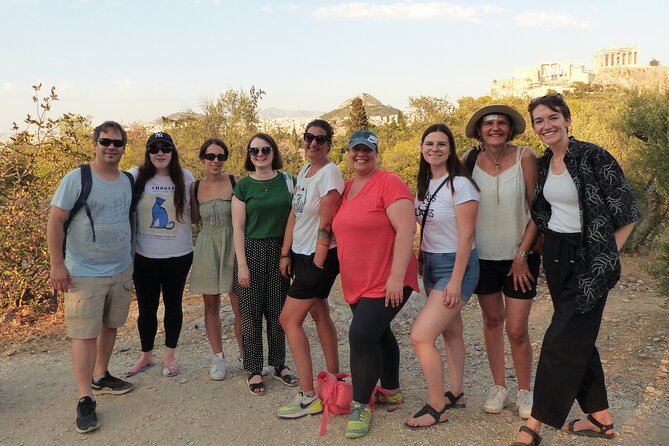
The final stop is Philopappos Hill, with about 10 minutes among the Hill of the Muses. The walk ends with a view toward the Acropolis, described as one of the best viewpoints close to central Athens.
This is a smart ending. After two hours of social history, mythology, legal restrictions, and public life, you get space to look back across the city. The Acropolis view gives the stories a clear geographic frame.
The hill is also a reminder that this is a walking tour, not a flat city stroll. The ending may be the most rewarding part for you, but it is not the easiest part for every body. If steep or uneven paths are a concern, the mobility warning should guide your decision.
The final setting under the trees, with the Acropolis in view, was praised as a pleasant close to the experience. It also makes the tour useful early in an Athens visit: you finish with a better sense of the city’s layout and a few ideas for what to explore next.
What the tour costs and what you receive
The price is $44.71 per person. For two hours with a group limited to 12, I consider that a fair price, particularly if you want interpretation rather than a quick set of monument facts.
The value comes from the focus. You are paying for a carefully shaped subject that is rarely the main theme of a general Athens walk. The guide connects nine locations and a wide range of topics, including education, marriage, Eros, mythology, festivals, slavery, courtesans, law, democracy, politics, poetry, philosophy, and medicine.
You should not think of the price as covering entry to Athens’ archaeological sites. The stops are listed with no admission charge, and the Ancient Agora is specifically viewed from outside. If you want interior access to the Agora or other monuments, budget separately.
The tour is often booked about 37 days in advance. That suggests planning ahead is sensible, especially if your Athens dates are fixed or you want a particular start time. Group discounts are available, and the ticket is mobile, which keeps the practical side simple.
Who will get the most from this walk
I would choose this experience if you want a different angle on Athens but still want to see major historical locations. It suits anyone interested in women’s history, mythology, ancient society, feminism, politics, or the gap between democratic ideals and daily life.
It also works well for families with older children. A 15-year-old with a strong interest in women’s rights was reported to have loved the experience, and the subjects give younger visitors something to question rather than merely memorize.
The tour is a good fit for a first Athens day if you want context before visiting more monuments. It also works later in your stay if you have already seen the Acropolis and want to fill in the human stories that standard sightseeing can miss.
I would be more cautious if your main goal is extensive archaeological access. You will not enter the Agora, and several stops rely on the guide’s words rather than on close examination of preserved structures.
The route is not recommended for people with mobility issues. Most travelers can participate, service animals are allowed, and the tour is near public transportation, but the walk includes Areopagus and Philopappos Hill. Good weather is required, so a cancellation caused by poor conditions can lead to another date or a full refund.
Should you book the Women’s History in Ancient Greece tour?
Book it if you want Athens explained through the lives and limits of women. The strongest reasons are the rare subject, the small group, Maelle’s praised presentation, and the way the route links mythology with real civic spaces.
Skip it if you want a conventional monument tour with site entry and long archaeological stops. For everyone else, $44.71 buys a thoughtful two-hour walk that can change how you understand the Agora, the Pnyx, Athena, and even the idea of Athenian freedom.
The best time to book is before your Athens plans fill up. Finish on Philopappos Hill, take in the Acropolis view, and let the city’s famous old story become a little less one-sided.
FAQ
How long is the Women’s History in Ancient Greece Walking Tour?
The tour lasts approximately two hours.
Where does the tour begin?
It begins at Pl. Monastirakiou 2 in Athens, Greece, in Monastiraki Square.
Where does the tour end?
It ends at Philopappos Hill, at the listed address Φυλής 215, Athens 117 41, Greece.
How large is the tour group?
The tour has a maximum of 12 travelers.
Does the tour enter the Ancient Agora?
No. The Ancient Agora is viewed from outside, and the tour does not enter the archaeological site.
What people and figures are discussed?
The tour includes mythological figures such as Athena, Penelope, and Pandora, along with historical women including Sappho, Aspasia, and Agnodice.
Is the tour suitable for people with mobility issues?
It is not recommended for travelers with mobility issues. The route includes Areopagus and Philopappos Hill.
Is public transportation available near the tour?
Yes. The experience is near public transportation, and the end point has easy access to the metro if needed.
What is the cancellation policy?
You can cancel at least 24 hours before the start time for a full refund. Changes or cancellations made less than 24 hours before the start time are not accepted for a refund. If poor weather causes the tour to be canceled, you will be offered another date or a full refund.
Just added around Athens
- Traditional Greek Show in Plaka with Dinner★ 3.6 · 178 reviews
- Santorini Wine Roads Tour with Wine Tastings Morning & Sunset★ 5.0 · 106 reviews
- Private Sunset Wine Tour with 3 Wineries and Tapas★ 5.0 · 34 reviews
- Insightful Pistachio Orchard and Factory Tour★ 4.5 · 27 reviews
- Traditional Villages Full day Tour in Santorini★ 4.0 · 84 reviews
- Half Day Tour★ 5.0 · 63 reviews
- Half-Day Shared Fishing Experience in Hydra★ 5.0 · 35 reviews
- Athens Old City Private Photoshoot Tour / 2 hrs★ 5.0 · 109 reviews
Historical Tours, compared.
Historical Delphi One Day Tour with Arachova Stop & Expert Guide
Read our review →
Historic Athens: Small Group Electric Bike Tour
Read our review →
Half-Day Guided History and Culture Sightseeing Tour
Read our review →


Throne of Helios: The History of Rhodes in 9D Experience
Read our review →
The History of Athens: Greek Mythology Private Tour
Read our review →Browse the lists this tour appears in