Reviewed · ATHENS TOURS
4-Day Classical Greece Tour: Epidaurus, Mycenae, Olympia, Delphi, Meteora
Ancient Greece comes at you fast on this tour. From Athens, you reach five UNESCO World Heritage Sites, travel more than 2,500 kilometers, and see the ancient theaters, temples, stadiums, tombs, and monasteries that define mainland Greece. I especially like the efficient route and the strong guides, including Sophia, Xenia, Joy, Maria, and Foteini, who have earned praise for making complicated mythology and archaeology easy to follow. The main drawback is the pace: long bus days, limited free time, and hotel standards that may not match what North American visitors expect from a 4-star upgrade.
The tour also does a good job removing practical headaches. Your guide handles entrance tickets, your driver manages the winding roads, and three breakfasts and three dinners are included. You should still expect to pay for lunch, cover a €30 environmental room fee, and accept that group size and the bus can change during the trip.
In This Review
- Key points to know before booking
- What the four-day route really covers
- Day one: Epidaurus, Mycenae, and the Corinth Canal
- The Theatre of Epidaurus
- Mycenae and the age of Agamemnon
- The Corinth Canal
- Day two: Olympia and the journey west
- Ancient Olympia
- Crossing the spectacular bridge
- Day three: Delphi, Apollo, and the Oracle
- The Temple of Apollo and the sanctuary
- The Delphi Archaeological Museum
- The Tholos of Athena Pronaia
- Day four: Meteora and Thermopylae
- Meteora monasteries above Kalambaka
- Thermopylae and the Leonidas Monument
- Hotels, meals, and the 4-star question
- Guide quality, buses, and the pace of the days
- Is $766.70 a good value?
- What to pack for this Greek archaeology route
- Who should book this tour?
- Should you book the Classical Greece tour?
- FAQ
- Where does the tour begin and end?
- Is hotel pickup available from the airport or port?
- Which meals are included?
- Which entrance fees are included?
- Is the tour available in French?
- How many people can join the tour?
- What is the cancellation policy?
Key points to know before booking
- Five major UNESCO sites in four days: Epidaurus, Mycenae, Olympia, Delphi, and Meteora form an impressive survey of Greek culture.
- The guides are a major strength: Guides such as Joy, Xenia, Maria, Jordan, and Foteini have been praised for clear English, warm group management, and strong subject knowledge.
- Expect long road days: You leave around 8:30 a.m. and return to Athens around 7 p.m. on the fourth day, with regular comfort stops.
- Hotel quality can vary: The Amalia properties are generally clean and comfortable, but some rooms and meals feel closer to 2 or 3-star standards than 4-star standards.
- Lunch is not included: You choose and pay for lunch each day, often at scheduled stops used by several touring groups.
- The physical demands are moderate: Ancient sites involve uneven stones, cobbles, marble, steps, sun, and plenty of walking.
What the four-day route really covers
This is not a leisurely village tour. It is a concentrated classical Greece route built around the mainland’s biggest archaeological names. You spend much of each day on the road, but that is also what lets you connect the Peloponnese, western Greece, central Greece, and Meteora without arranging several separate excursions.
The tour begins at 8:30 a.m. from Leof. Vasilisis Amalias 10 in central Athens. Hotel pickup runs from about 7:30 to 8:15 a.m. at selected hotels. Airport, port, Airbnb, and private apartment pickup are not offered, so plan to reach the meeting point or an eligible hotel.
The vehicle is air-conditioned, and group size can reach 40 people. Some departures are far smaller, with reports of groups of 9, 12, 14, 17, and 26. That makes a big difference at archaeological sites. A small group can move quickly and hear the guide more easily, but you cannot assume every departure will operate that way.
A few more Athens half-days to weigh up
- 4-Day Tour of Mycenae, Epidaurus, Olympia, Delphi & Meteora
★ 4.8 · 168 reviews - 4-Day Greece Highlights Tour: Epidaurus, Mycenae, Olympia, Delphi and Meteora
★ 5.0 · 79 reviews - From Athens: Explore Ancient Greece 4-Day Tour
★ 4.7 · 73 reviews
Day one: Epidaurus, Mycenae, and the Corinth Canal
The first day brings the ancient world to life through theater, myth, and military power. It is a full day, so you should eat breakfast before pickup and carry water, sun protection, and comfortable shoes.
The Theatre of Epidaurus
The Theatre of Epidaurus is one of the tour’s most memorable stops. You have about an hour here, with admission included, and the setting gives you a chance to appreciate how ancient Greek theater used natural acoustics and a carefully shaped performance space.
This is more than a quick photo stop. Your guide explains the theater’s place in Greek culture, and the site gives you a physical sense of how drama, music, and public life worked in the ancient world. The stone seating and open setting also make this a good place to pause after the morning drive.
The nearby Epidaurus Archaeological Museum is allotted about 15 minutes. That is enough for a quick look at selected remains, but not enough for a slow museum visit. If museums are your main interest, the short timing may feel rushed.
Mycenae and the age of Agamemnon
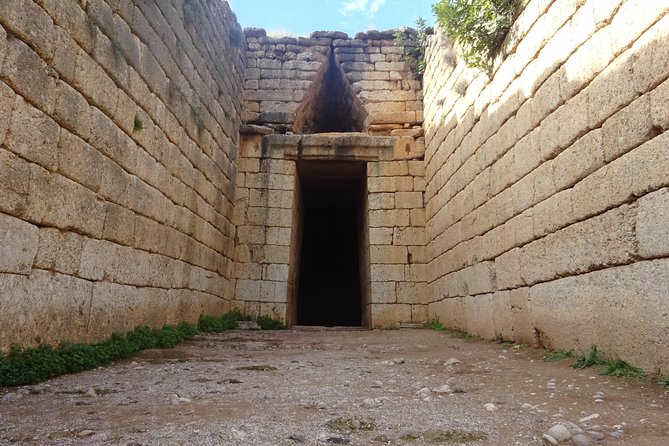
At Mycenae, you spend about 90 minutes exploring the fortified citadel associated with Agamemnon, the legendary king connected with Homer’s Trojan War stories. The archaeological setting gives you a useful contrast with Epidaurus. Here the mood is older, more defensive, and more tied to royal power and burial customs.
The famous tomb of Agamemnon is part of the appeal, even though the connection between the legendary ruler and the archaeological remains belongs partly to myth and tradition. A good guide helps separate what archaeology can show from what later storytelling added.
Mycenae is also one of the more physically demanding stops. Expect uneven paths, stone surfaces, and sun exposure. At one departure, visitors experienced thunderstorms and rain, so a light waterproof layer is sensible even in a warm season.
Same stretch of coastline, a completely different day out:
- Athens: Acropolis & up to 5 Archaeological Sites Combo Pass
★ 4.4 · 12,619 reviews - Athens: Acropolis Ticket with Optional Audio or Live Guide
★ 4.2 · 11,055 reviews - Athens: Acropolis, Parthenon & Acropolis Museum Guided Tour
★ 4.8 · 9,316 reviews - Athens: Cape Sounion & Poseidon Temple Sunset Half-Day Trip
★ 4.8 · 8,241 reviews
The Corinth Canal
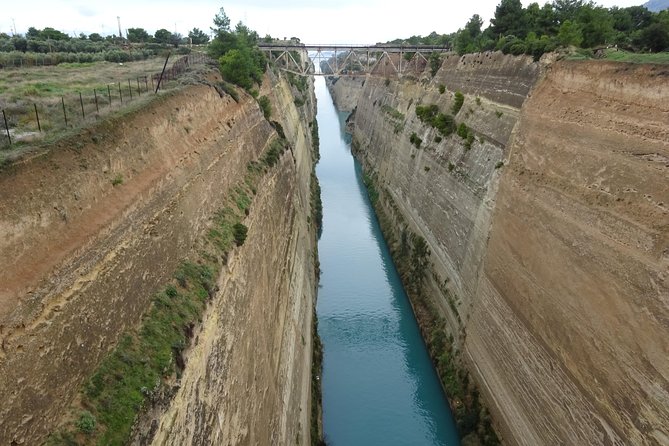
The Corinth Canal gets about 20 minutes. It is a short stop, but it breaks up the long drive and gives you a striking view of the narrow waterway connecting the Gulf of Corinth with the Saronic Gulf.
The canal is modern compared with the ancient sites, yet it fits the route because it explains the geography of the Peloponnese. Your bus is crossing between regions that feel distinct, and the canal makes that separation clear.
Dinner is included at the hotel. Lunch is not included, and the lunch stops are usually practical rather than intimate. Some meals may feel expensive for what you receive, so keep expectations sensible and carry snacks.
Your first overnight may be in Nafplio or Olympia, depending on the departure arrangements. This variation matters if you are expecting a specific evening in Nafplio. Check your confirmation before you build extra plans around the first night.
Day two: Olympia and the journey west
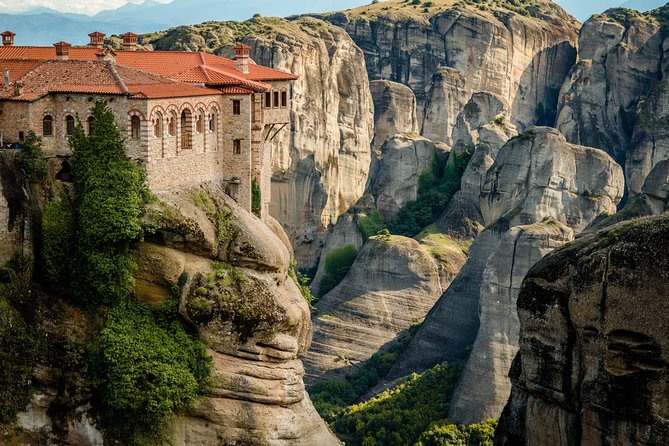
Day two centers on Olympia, the birthplace of the ancient Olympic Games. After breakfast, you visit both the archaeological site and its museum before continuing across the Rio-Antirrio Bridge area toward your hotel.
Ancient Olympia
You have about 90 minutes at the archaeological site. Olympia was not simply an athletic venue. It was a major religious center dedicated to Zeus, and the remains help explain how sport, worship, politics, and regional identity were tied together.
The site is broad and open, so shade can be limited. Wear a hat and bring water. The heat can be intense, and the combination of walking and sun makes this one of the places where a moderate fitness level becomes important.
The archaeological museum receives about an hour. This is one of the stronger museum visits on the route because it gives you sculptures and objects that add detail to the foundations and columns outside. Seeing the museum after the site is the right order: you first understand the place, then see the surviving art in a more meaningful setting.
Lunch is again at your own expense. The scheduled restaurants are convenient, but several large tour buses may use the same places. You gain speed and predictability, not a quiet, local dining experience.
Crossing the spectacular bridge
The crossing toward the mainland is a scenic part of the day. The bridge is a memorable engineering feature, and the route provides a welcome change from ruins and museums.
Dinner and overnight accommodation follow at the hotel. The included hotel meals are buffet-style, with breakfast and dinner generally offering a broad range of choices. Food quality can vary by property, and some meals are repetitive across the three nights, but the arrangement is convenient after a long day.
Day three: Delphi, Apollo, and the Oracle
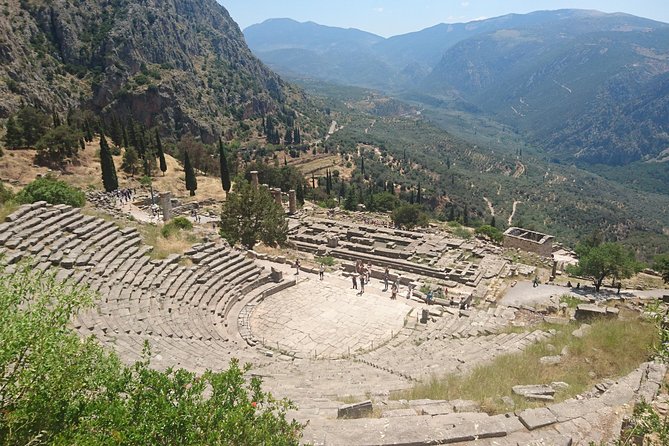
Delphi is the intellectual center of the trip. The mountain setting, the sanctuary of Apollo, and the stories of the Oracle give the guide plenty to explain. This is also one of the days when the quality of the guide matters most.
The Temple of Apollo and the sanctuary
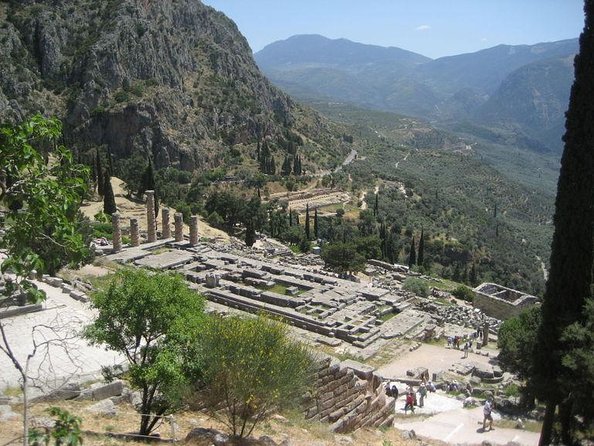
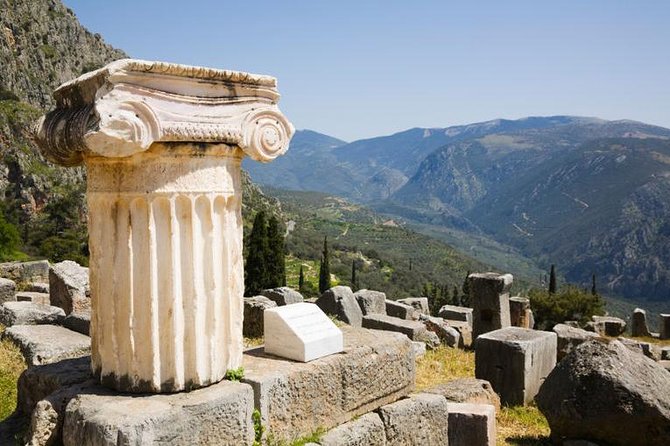
The archaeological site receives about 90 minutes. You follow the mountainside remains of the sanctuary, where ancient Greeks came to consult Apollo’s Oracle. The subject can become confusing quickly, since myth, ritual, politics, and prophecy overlap. A strong guide turns the stones into a clear story.
Guides such as Xenia, Jordan, Emilia, Dimitra, and Joy have been praised for making the material understandable and engaging. English ability is generally strong, but individual guide quality can vary. On Mondays, French may be added, creating a bilingual tour, and in winter the operation is English only.
The Delphi Archaeological Museum
The museum visit lasts about an hour. Look for the bronze Charioteer of Delphi, sometimes rendered as Iniochos in tour descriptions, along with the dancers and other important pieces.
This museum is not filler between bus rides. It supplies the artistic detail that the outdoor sanctuary cannot. The bronze figure, in particular, gives you a close look at the restraint and precision of classical Greek sculpture.
The Tholos of Athena Pronaia
The Tholos receives about 30 minutes. Its round design and mountain setting make it one of the most photographed parts of Delphi, even though it is separate from the main sanctuary.
The stop is brief, and you may want more time for photographs. The schedule favors coverage over lingering. That is the basic bargain of this tour: you see the essential places, but you rarely get an hour to wander without checking the clock.
Depending on the departure, the group may change at Delphi for the onward trip to Meteora. This is an important point for anyone expecting one small group and one guide for all four days. Some departures have shifted from a small vehicle to a much larger bus, with less personal attention and commentary in both English and French. The change is operational, but it can affect the feel of the second half.
Day four: Meteora and Thermopylae
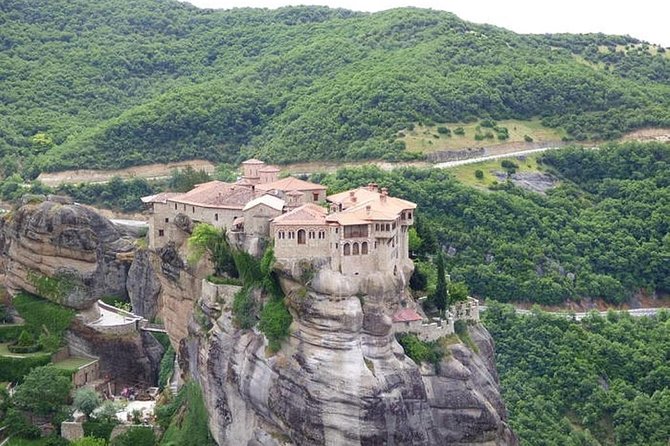
The final day is the most visually dramatic. After breakfast, you travel toward Kalambaka and Meteora, then begin the long return to Athens. The scheduled return is about 7 p.m., depending on traffic.
Meteora monasteries above Kalambaka
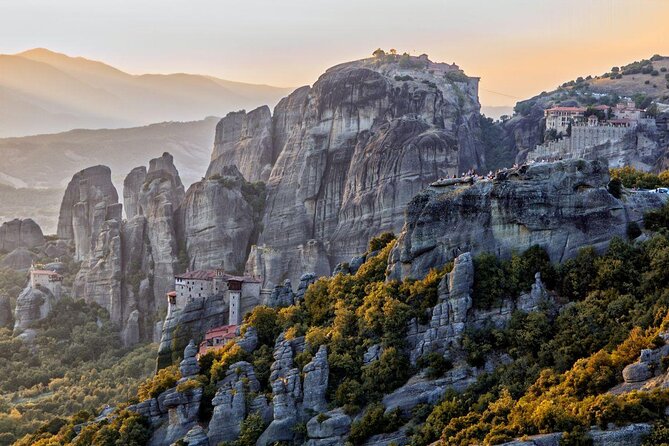
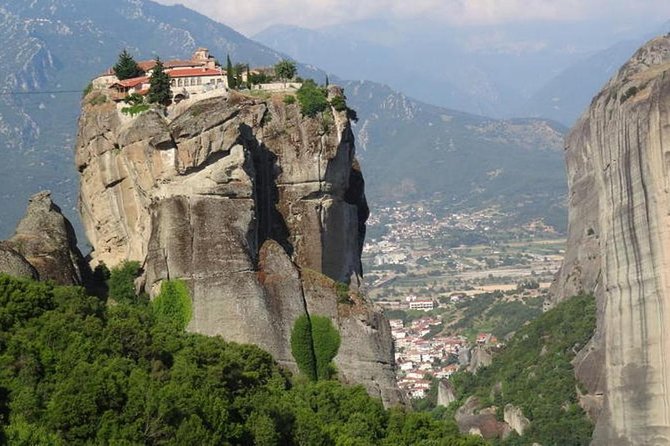
Meteora is famous for monasteries perched on towering rock pillars. The site is very different from the classical ruins: instead of temples spread across open ground, you see religious buildings set high above the plain.
The tour includes entrance tickets to two Meteora monasteries, although the listed stop itself is described as free admission. Your guide will provide the site and museum tickets included in the package. The visit is allotted about an hour, so do not expect to explore every monastery or spend a full day in the area.
Dress carefully. Places of worship and selected museums require covered knees and shoulders for both men and women. Shorts and sleeveless tops can lead to refused entry. Pack a scarf or light cover-up rather than hoping a rule will be overlooked.
Meteora also involves steps and uneven surfaces. If you have limited mobility, ask the operator for current details before booking, since the general requirement is a moderate fitness level and the provided information does not promise step-free access.
Thermopylae and the Leonidas Monument
The Leonidas Monument at Thermopylae is a 15-minute stop. It recalls the Spartan defense against the Persian army, a story made famous by later history and popular culture.
This is a quick roadside-style historical pause, not a large archaeological visit. Its value comes from the story and the chance to connect the ancient places you have visited with one of Greece’s best-known military legends.
Hotels, meals, and the 4-star question
Accommodation is included for all three nights, with a choice between tourist-class and 4-star hotels. Room arrangements depend on the booking: two adults share a double or twin room, three adults share a triple room, and four or five adults are placed in two rooms. A single supplement applies when needed.
The hotels are often from the Amalia chain. The practical strengths are cleanliness, comfortable beds, pools at some properties, balconies or patios at some hotels, and buffet breakfasts and dinners. One Delphi hotel is especially appreciated for its views.
The weak point is the meaning of 4-star. Some departures receive hotels that feel clean and serviceable but dated, with basic rooms, uneven air conditioning, and food that does not match a higher-end standard. One hotel in Nafplio has been described as badly in need of renovation. Other departures have found the hotels comfortable and the meals very good, so the experience is not uniform.
I would choose the 4-star option for location, room category, and the best available property, but I would not book this tour expecting polished luxury. Think practical touring hotels with character, not boutique interiors or white-glove service.
Breakfast and dinner are included for three days. Dinners are generally buffets, which is useful when everyone returns tired and at different times. Lunch is excluded, giving you some control over spending, but the fixed stops can feel tourist-oriented and prices may be higher than in town.
Budget another €10 per room per night for the environmental fee, or €30 per booking for the three-night stay. This is paid at the hotel reception.
Guide quality, buses, and the pace of the days
The strongest part of the experience is often the guide and driver team. Several guides, including Joy, Xenia, Maria, Foteini, Sophia, Emilia, and Jordan, have been praised for clear explanations, warmth, organization, and strong command of Greek mythology and archaeology. Drivers such as Socrates, Peter, Costa, Spiro, Fanasis, and Yannis have also received praise for safe handling of narrow roads and tight parking areas.
That matters here. You are not just being driven to ruins. You are being asked to understand why each place matters, and the commentary on the bus helps connect the stops.
The schedule is demanding. You usually leave around 8 a.m. and spend much of the day visiting sites or riding between them. Comfort stops are timed along the route, but long driving stretches can still feel tedious.
The tour is a good fit if you prefer seeing a lot rather than lingering. It is less suitable if you want slow meals, independent exploration, or a guaranteed small group. Ask about the expected group size and possible vehicle changes before paying, especially if personal guiding is a priority.
Is $766.70 a good value?
At $766.70 per person, the package includes transportation from Athens, a professional guide, three nights of accommodation, three breakfasts, three dinners, and entry to Mycenae, Epidaurus, Olympia, Delphi, and two Meteora monasteries.
That is a strong amount of coverage for four days. Buying transport, hotels, and entrance tickets separately would take time and would make the route harder to arrange. The tour also lets you see distant sites such as Olympia and Meteora without renting a car or managing Greek mountain roads.
The price is best for someone who values access and efficiency over luxury. You are paying for a broad education in mainland Greece, not premium lodging or carefully chosen independent restaurants. Group discounts may improve the value for families or larger parties, but check the room rules and single supplement before booking.
Children aged 5 to 12 need a passport or identity card to receive the discounted price. Without the required document, they may have to pay the normal archaeological site or museum entrance fee.
What to pack for this Greek archaeology route
Bring walking shoes with firm soles. Marble, rock, cobbles, and uneven ground appear at several sites, and sandals with little support will make the days harder.
A hat, sunscreen, refillable water bottle, and small umbrella are useful in hot weather. The umbrella can provide shade at open sites, not just shelter from rain.
Pack a light rain jacket because weather can change quickly, even during warm months. Include clothing that covers your shoulders and knees for Meteora monasteries and other religious locations.
Keep a small amount of cash available for the environmental hotel fee, drinks, snacks, and lunches. Your guide gives you the included entrance tickets, so you do not need to buy those separately at each site.
Who should book this tour?
I would recommend it to first-time visitors who want the main mainland archaeological sites in one organized trip. It is especially good for adults interested in mythology, ancient architecture, military history, and sculpture.
Families can enjoy it if children already like Greek myths. Younger children who are not interested in ancient sites may struggle with the long drives and repeated walking.
Solo visitors also benefit from the organized transport and group setting. The guide and driver teams have been praised for making solo participants feel comfortable.
I would hesitate if your priority is luxury lodging, quiet meals, small villages, or generous free time. You should also think twice if a last-minute change from a small coach to a large bus would spoil the experience.
Should you book the Classical Greece tour?
Book it if you want a high-value survey of ancient Greece and accept a quick pace. Epidaurus, Mycenae, Olympia, Delphi, and Meteora are a powerful set of sights, and having a strong guide can turn a pile of ruins into a connected story.
Before booking, confirm the hotel category, expected group size, language arrangement, and possibility of a group change at Delphi. Go with realistic expectations about the hotels and lunch stops, wear sensible shoes, and keep your schedule clear until about 7 p.m. on the fourth day.
For most history-focused visitors, the route is worth the price. For luxury seekers, it is better viewed as an efficient educational tour with comfortable basics rather than a premium holiday.
FAQ
Where does the tour begin and end?
The tour begins at Leof. Vasilisis Amalias 10 in Athens and ends back at the same meeting point. Selected hotel pickup is available before the 8:30 a.m. departure.
Is hotel pickup available from the airport or port?
No. Pickup is not available from airports, ports, private apartments, or Airbnb properties. Pickup is offered from selected hotels only.
Which meals are included?
Three breakfasts and three dinners are included at the hotels. Lunch is not included and must be paid for separately.
Which entrance fees are included?
Entrance tickets to Mycenae, Epidaurus, Olympia, Delphi, and two Meteora monasteries are included. Your guide gives you the entry tickets.
Is the tour available in French?
French-speaking service is available only on Mondays. During the winter season, tours operate in English only.
How many people can join the tour?
The tour can have a maximum of 40 people. Some departures may be much smaller, but a small group is not guaranteed.
What is the cancellation policy?
You can cancel at least 24 hours before the start time for a full refund. Cancellations or changes made less than 24 hours before departure are not accepted for a refund.
Just added around Athens
- Delphi One Day Trip from Athens★ 4.0 · 98 reviews
- Mercedes Private Tour to Delphi and Arachova★ 5.0 · 30 reviews
- Private Delphi and Hosios Loukas Monastery – Great Lunch and Drinks Included★ 5.0 · 36 reviews
- Day tour to Ancient Olympia,Ancient Sparta Mycenae Including Meal★ 5.0 · 54 reviews
- Athens: Half Day Trip To Cape Sounio/Poseidon Temple Semi Private★ 5.0 · 131 reviews
- Athens Half-Day Private Tour Acropolis, Parthenon City Highlights★ 5.0 · 35 reviews
- From Athens: Day Tour to Mykonos★ 5.0 · 64 reviews
- Culinary Secrets of Downtown Athens★ 5.0 · 103 reviews
Athens Tours, compared.
Acropolis & up to 5 Archaeological Sites Combo Pass
Read our review →
Acropolis, Parthenon & Acropolis Museum Guided Tour
Read our review →
Cape Sounion & Poseidon Temple Sunset Half-Day Trip
Read our review →

All Day Cruise -3 Islands to Agistri,Moni, Aegina with lunch and drinks included
Read our review →
Athens, Piraeus, and Coastline: Blue Hop-On Hop-Off Bus
Read our review →