
Reviewed · ANCIENT CORINTH TOURS
Ancient Sparta Ancient Corinth Private Tour from Athens/ Nafplio
Sparta rewards curiosity, not spectacle. This long private drive from Athens reaches the Corinth Canal, the scattered remains of Sparta, King Leonidas, and Ancient Corinth in one packed day, with a dedicated English-speaking driver to keep the day flexible. I like the door-to-door transport and the chance to adjust the pace or trade one stop for another. I also like the personal touch provided by drivers such as Christos, Nikolaos, Takis, and Philippe, who have added local food stops, country-road breaks, and useful historical commentary.
The main consideration is the distance. Ten hours is a lot of road time, and Sparta is not a grand, intact city like Athens. Its remains are modest and spread around modern Sparta. If you expect towering temples at every turn, you may feel disappointed. If you want to connect the famous Spartan story with its actual setting, this private trip offers a practical way to do it.
In This Review
- Key points to know before booking
- Why this private day trip works
- The Corinth Canal: a 15-minute engineering stop
- Sparta in context: power without grand monuments
- The Archaeological Museum of Sparta
- The Acropolis and Roman theater of Sparta
- Leonidas and the meaning of Molon labe
- The Olive and Greek Olive Oil Museum
- Ancient Corinth: the day’s strongest archaeological stop
- The drive, vehicles, and driver service
- Who should book this tour?
- FAQ
- How long is the Ancient Sparta and Ancient Corinth tour?
- Is hotel pickup included in Athens?
- Can I be picked up at Piraeus Port?
- Can the tour start from Nafplio?
- Is an archaeologist guide included?
- What is included in the tour price?
- Which admission fees cost extra?
- Are the museums open on Tuesdays?
- Can I cancel for a full refund?
- Should you book it?
Key points to know before booking

- The Corinth Canal is a quick but striking first stop: You can walk across a pedestrian bridge and look down from about 80 meters.
- Sparta is an archaeological setting, not a preserved city: The Acropolis and Roman theater reward imagination more than quick sightseeing.
- King Leonidas gets his own brief stop: The monument and possible tomb connect the modern town with the famous Thermopylae story.
- Ancient Corinth deserves serious attention: The site and museum together can easily feel rushed in the time allowed.
- Your driver is not an archaeologist guide: You receive books, audio material, and spoken information in the vehicle, but guided walks require advance arrangement and an extra fee.
- Tuesday needs special care: The Archaeological Museum of Sparta and the Olive and Greek Olive Oil Museum are closed every Tuesday. Ancient Corinth Museum is closed on Tuesdays in winter.
Why this private day trip works
The great strength here is efficiency. From Athens, you can reach two major Peloponnese sites without renting a car, studying Greek road signs, or arranging several separate transfers. Fuel, toll roads, parking, pickup, and return transport are included, which matters on a day covering a large distance.
A private vehicle also changes the mood. You are not tied to a large group’s bathroom schedule or forced to spend equal time at every stop. The driver can adjust the pace within the agreed ten hours. One group exchanged a planned stop for another, while others added a country-road fruit stand or a visit to Mystras when time allowed.
That flexibility has limits. The published schedule is already full, and Sparta is a long way from Athens. Adding extra places can make the return late or reduce time at Ancient Corinth. Ask your driver early which stops matter most to you.
The listed price is $265.50 per person, though the final cost varies by group size and vehicle. The available choices include a sedan for up to three adults, a minivan for one to seven people, and a minibus for up to fourteen. Two children up to age twelve can travel free in the stated family arrangements. For a couple, the per-person cost is high, but the private transport and full-day reach make more sense for a family or small group sharing the vehicle.
Admission fees are extra. Depending on season, the listed charges include €5 or €10 for Sparta’s Archaeological Museum, €8 in winter or €15 in summer for Ancient Corinth and its museum, and €5 for the Olive and Greek Olive Oil Museum. Check the exact seasonal prices when booking, since the supplied information gives different winter and summer amounts for some sites.
More Ancient Corinth and canal trips:
- From Athens: Ancient Corinth Day Trip with Canal & VR Guide
★ 4.6 · 1,073 reviews - Private Biblical Tour Ancient Corinth & Isthmus Canal from Athens
★ 5.0 · 762 reviews - Athens: Ancient Corinth & Nafplio Full Day Trip with Swim
★ 4.8 · 523 reviews
The Corinth Canal: a 15-minute engineering stop
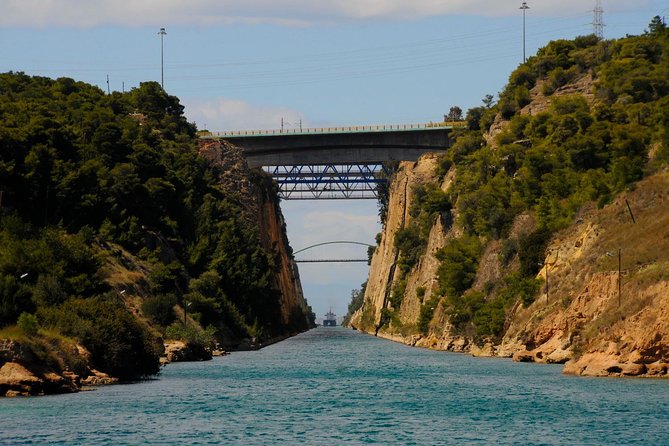
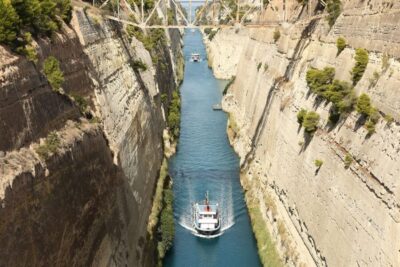
The first stop is brief, but it gives the day an immediate visual reward. The Corinth Canal cuts through the Isthmus of Corinth, linking the Aegean and Ionian seas and separating the Peloponnese from central Greece.
More than 2,500 workers dug the 6,400-meter channel between 1881 and 1893. From the pedestrian bridge, you can look straight down into the narrow waterway and take photographs from around 80 meters above it. The stop has no admission fee.
Do not expect a long walk or a full canal cruise. This is a photo and orientation stop, usually about fifteen minutes. It works well early in the day because you can stretch your legs, see a major piece of Greek engineering, and continue without spending precious archaeological time.
Sparta in context: power without grand monuments
Sparta’s reputation can create the wrong expectation. Ancient Sparta was famous for its military society and strict social order, but the physical remains are not as monumental as those at Athens, Olympia, or Corinth.
The city’s social system was shaped around military skill and physical training. Full Spartan citizens were called Spartiates. Other groups included mothakes, free men raised as Spartans; perioikoi, free residents involved in trade; and helots, a state-controlled, enslaved local population. This structure explains both Sparta’s military strength and the severe inequalities on which that strength rested.
You receive about thirty minutes in the modern Sparta area before moving through the archaeological remains. That is enough to understand the setting, but not enough for a slow archaeological study. The town itself also makes the history more tangible. You are not looking at an isolated ruin in the countryside. Ancient and modern Sparta occupy the same broad area, so the famous name is tied to an ordinary living city rather than a polished open-air museum.
I would approach this stop with curiosity rather than a checklist. Sparta is valuable because it challenges the movie version of the Spartans. The city’s power came from its people, institutions, and military system. The stones left behind are only part of the story.
The Archaeological Museum of Sparta
The Archaeological Museum of Sparta occupies a neoclassical building dating from 1874 to 1876. It is described as the oldest provincial archaeological museum in Greece, and the building itself has architectural and historical interest.
The museum adds objects and context that the outdoor site cannot provide. A thirty-minute visit is planned, so you will need to keep moving. The general admission is listed as €10, though the information also gives a winter figure of €5 in the admission details. Confirm the current seasonal rate before you go.
The museum closes every Tuesday. This is not a minor detail. If your visit falls on Tuesday, you should expect to miss this indoor collection and plan the day around the outdoor remains, Leonidas, and Corinth instead. The Olive and Greek Olive Oil Museum is also closed that day.
A few more Athens half-days to weigh up
- Athens: Acropolis & up to 5 Archaeological Sites Combo Pass
★ 4.4 · 12,619 reviews - Athens: Acropolis Ticket with Optional Audio or Live Guide
★ 4.2 · 11,055 reviews - Athens: Acropolis, Parthenon & Acropolis Museum Guided Tour
★ 4.8 · 9,316 reviews - Athens: Cape Sounion & Poseidon Temple Sunset Half-Day Trip
★ 4.8 · 8,241 reviews
The Acropolis and Roman theater of Sparta

The Acropolis and Ancient Theater are the heart of the Sparta portion. The theater was built from local white marble during the Roman period, in the late first century BC, and may once have held about 16,000 people. It had a mobile stage and was considered a destination even in ancient times.
Today, the site is fragmentary. Byzantine damage removed much of the seating, and the surviving marble and limestone have weathered over time. You will not find a complete arena ready for a dramatic reconstruction. What you get is a quieter place where the size of the original theater emerges gradually from the surviving curves and blocks.
The planned visit lasts about an hour and has no admission fee listed. Wear shoes suitable for uneven ground, though the supplied information does not specify any formal accessibility limits. Ask your driver about the walking surface if anyone in your group has mobility concerns.
This is where the driver’s role matters. You can walk the ruins independently with the books and audio documentary provided for the drive, but the driver is not an archaeologist guide accompanying you through the site. If you want detailed explanations beside the stones, arrange a licensed archaeologist guide in advance. Availability is not guaranteed at the last minute, and the additional service costs extra.
Leonidas and the meaning of Molon labe
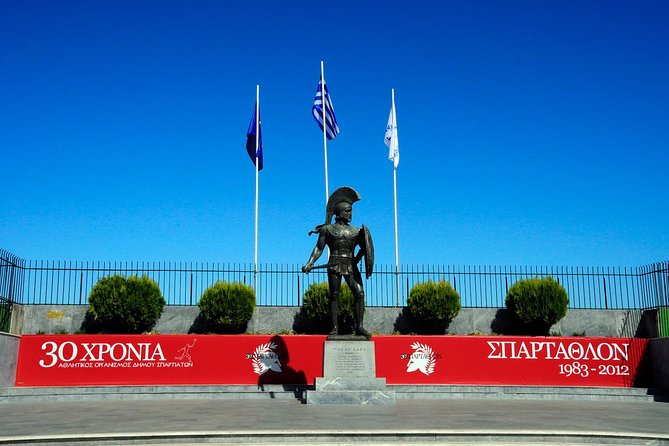
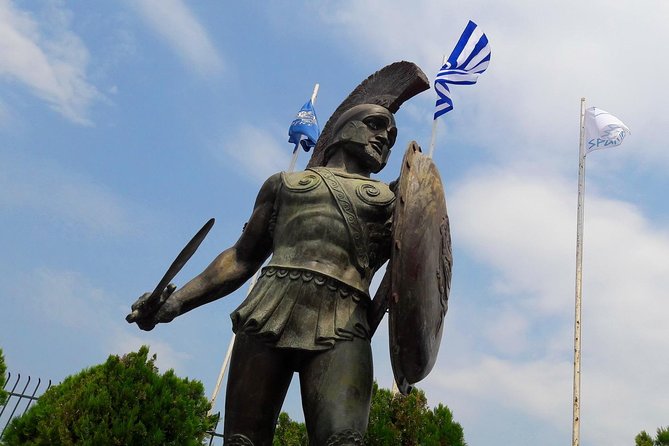
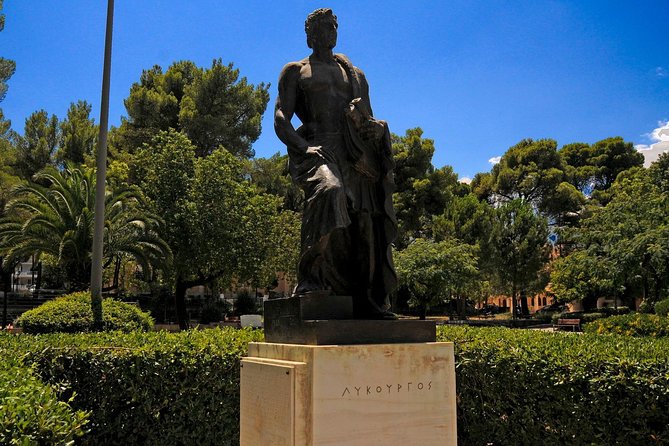
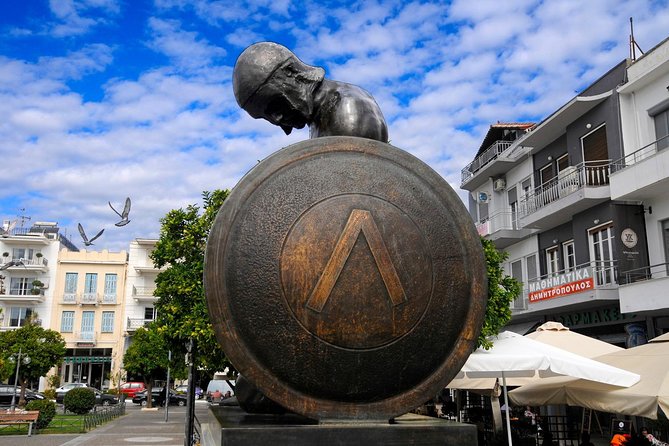
The Leonidas Monument takes only about fifteen minutes, but it gives Sparta an emotional center. The statue faces a stadium, recalling the Spartan king who commanded the defense at Thermopylae.
The famous response to the Persian demand that the Spartans surrender their weapons is written beneath the statue: Molon labe, commonly translated as come and get them. The stop is short, yet it helps connect the legendary military image with a physical place in modern Sparta.
Nearby excavations revealed a fifth-century BC limestone structure. Archaeologists first thought it was a small temple, but it is now believed by some to be the tomb of Leonidas. Its use is not verified, and the tradition says his remains were transferred there after Thermopylae. It is the only preserved monument of the Ancient Agora.
That uncertainty is worth remembering. Ancient sites often carry later stories, and a good visit leaves room for both tradition and evidence. Here, the power comes less from a grand building than from the way the monument links myth, memory, and archaeology.
The Olive and Greek Olive Oil Museum
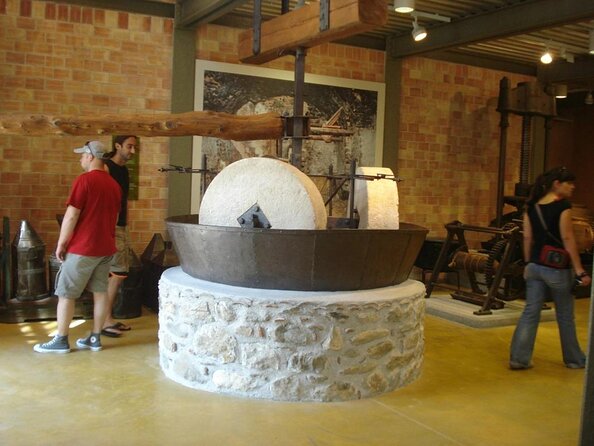
The olive oil museum is an optional stop in Sparta and takes about twenty minutes if time allows. It traces the olive and olive oil in Greek life from prehistoric times through the early twentieth century, including food, trade, religious use, art, and technology.
Some of its unusual material includes fossilized olive leaves from Santorini dated to roughly 50,000 to 60,000 years ago. Replicas of fourteenth-century BC Linear B tablets show some of the earliest written references to olives and olive oil in Greece.
The museum costs €5, and it closes every Tuesday. Since the overall day is already tight, the stop may be dropped if the drive runs late or your group chooses more time at Corinth. Clarify the plan at the start of the morning. One group expected to visit but found the museum closed, while another received an olive oil tasting and met a local host named Marianna. That contrast shows why opening days and available time should be checked rather than assumed.
Ancient Corinth: the day’s strongest archaeological stop
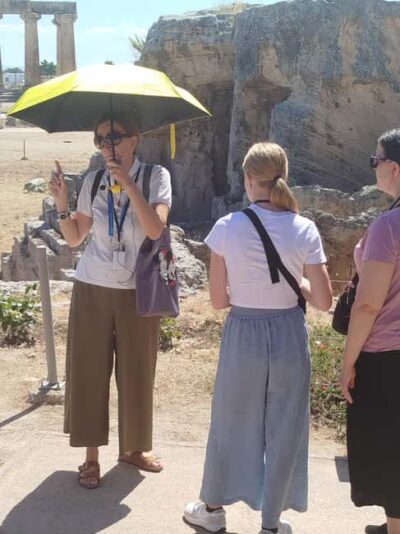
Ancient Corinth is often the surprise of this trip. The remains belong to one of the largest cities of ancient Greece, and the site gives you a broad sense of urban life, commerce, religion, and travel through the Peloponnese.
The connection with Saint Paul adds another layer. Corinth appears in the Acts of the Apostles and is associated with the First and Second Corinthians in the New Testament. You are not only visiting a classical city. You are also standing in a place tied to early Christian history.
The outdoor site and Archaeological Museum are treated together. The combined ticket is listed at €15 in summer or €8 in winter, with the museum included. The planned time is about one hour and ten minutes at the archaeological site, followed by about thirty minutes in the museum. In practice, that can feel short. If you have any say in the schedule, I would protect time here rather than adding too many small stops earlier.
The museum helps make sense of the scattered remains. It also gives you a break from the sun and uneven ground. Ancient Corinth is a place where a little preparation pays off, so listen carefully to the historical material during the drive or arrange an archaeologist guide ahead of time.
Lunch is flexible rather than fixed. Drivers have recommended local gyro places and small cafes, including a cafe with a view toward the Temple of Apollo. A flexible meal stop is useful, but it also consumes archaeological time. Tell the driver if food, Corinth, or Sparta is your priority.
The drive, vehicles, and driver service
The tour uses air-conditioned sedans, minivans, or minibuses described as clean and well maintained. Pickup and drop-off are offered at hotels or apartments in central Athens within seven kilometers, as well as from Piraeus and other agreed locations.
Pickup beyond seven kilometers from central Athens costs an extra €15 per way. Piraeus Port and the cruise terminal are specifically listed as longer-distance pickups. Airport and Lavrio Port transfers require prior agreement and are not covered by the stated extra charge.
The usual recommended start is 8:00 am or earlier in winter. You can adjust the departure time to suit your group, but an early start is sensible. The day covers Athens, Corinth, Sparta, and the return journey, so sleeping late cuts into site time.
The drivers are the most praised part of the experience. Christos is described as helpful with stops and historical information. Nikolaos was praised for safe driving and for finding a good gyro lunch. Takis added discussions about Greek culture, land, and modern life, along with an unplanned stop at a fruit stand selling fresh cherries. Philippe was praised for his patience, broad subject knowledge, comfort stops, and encouragement to take time at Mystras.
These personal details show what the service can offer at its best. You are not hiring a formal museum lecturer, but you may get a warm local escort who explains the country while handling a demanding road day. The quality depends partly on the individual driver, so request an archaeologist guide if site interpretation is important to you.
Who should book this tour?
I would recommend it to a small group that wants to cover a lot of ground without driving. Families benefit from the private vehicle, adjustable breaks, and the ability to choose a sedan, minivan, or minibus. The arrangement also suits people staying in Athens for a short time who want one Peloponnese day instead of several hotel changes.
It is less suitable if you want a relaxed archaeological day with long walks and detailed guided interpretation. Sparta and Corinth both deserve more time than this schedule can give. The drive is scenic and comfortable according to the available comments, but it remains a long road day.
The tour can also begin or end in Nafplio, with a different price because Sparta, Acropolis, and Corinth are closer from there. This may be the smarter choice if Nafplio is already part of your trip.
Free cancellation is available up to 24 hours before the local start time. Changes or cancellations inside that window are not refunded.
FAQ
How long is the Ancient Sparta and Ancient Corinth tour?
The tour lasts approximately 10 hours, including transportation from Athens or the agreed pickup location to the Peloponnese and back.
Is hotel pickup included in Athens?
Pickup and drop-off are offered from hotels or apartments in central Athens within seven kilometers. Longer pickup locations may carry an additional €15 charge per way.
Can I be picked up at Piraeus Port?
Yes. Piraeus Port and the Piraeus cruise terminal are listed as pickup locations with an additional charge. Airport and Lavrio Port pickup require prior agreement.
Can the tour start from Nafplio?
Yes. Pickup and drop-off are offered from hotels, apartments, or the port in Nafplio. The price changes because Sparta, Acropolis, and Corinth are closer to Nafplio.
Is an archaeologist guide included?
No. The driver provides historical information, books, and an audio documentary during the drive, but does not accompany you as an archaeologist guide inside the sites. A licensed archaeologist guide must be arranged separately and in advance.
What is included in the tour price?
Air-conditioned private transportation, fuel, toll roads, parking, hotel or apartment pickup and drop-off, and an English-speaking professional driver are included.
Which admission fees cost extra?
The listed extra fees include the Olive and Greek Olive Oil Museum at €5, Sparta’s Archaeological Museum at €5 in winter or €10 in summer, and Ancient Corinth at €8 in winter or €15 in summer. Ancient Corinth’s ticket includes its museum.
Are the museums open on Tuesdays?
The Archaeological Museum of Sparta and the Olive and Greek Olive Oil Museum are closed every Tuesday. The Archaeological Museum of Ancient Corinth is closed on Tuesdays during winter.
Can I cancel for a full refund?
You can cancel at least 24 hours before the experience begins for a full refund. Cancellations or changes made less than 24 hours before the start time are not accepted for a refund.
Should you book it?
Book this tour if you want private transport, flexible stops, and a serious look at the Peloponnese in one demanding day. It is especially good for families, small groups, and anyone who prefers a driver to a bus tour or rental car.
Before paying, confirm the Tuesday museum closures, the admission budget, your pickup surcharge, and whether you want a licensed archaeologist guide. If Ancient Corinth matters most, protect your time there. If Sparta’s story matters more than monumental ruins, accept its modest remains and let the setting, Leonidas monument, museum, and driver’s commentary fill in the gaps. Done with realistic expectations, this is a useful and memorable way to reach places that are awkward to combine independently.
Just added around Athens
- Delphi One Day Trip from Athens★ 4.0 · 98 reviews
- Private Delphi and Hosios Loukas Monastery – Great Lunch and Drinks Included★ 5.0 · 36 reviews
- Mercedes Private Tour to Delphi and Arachova★ 5.0 · 30 reviews
- Day tour to Ancient Olympia,Ancient Sparta Mycenae Including Meal★ 5.0 · 54 reviews
- Athens: Half Day Trip To Cape Sounio/Poseidon Temple Semi Private★ 5.0 · 131 reviews
- Athens Half-Day Private Tour Acropolis, Parthenon City Highlights★ 5.0 · 35 reviews
- From Athens: Day Tour to Mykonos★ 5.0 · 64 reviews
- Culinary Secrets of Downtown Athens★ 5.0 · 103 reviews
Ancient Corinth Tours, compared.
Ancient Corinth Day Trip with Canal & VR Guide
Read our review →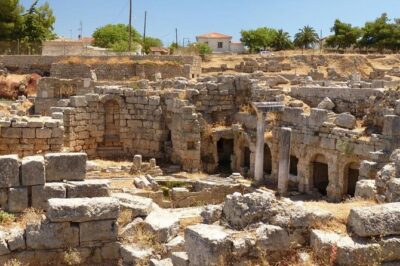
Private Biblical Tour Ancient Corinth & Isthmus Canal from Athens
Read our review →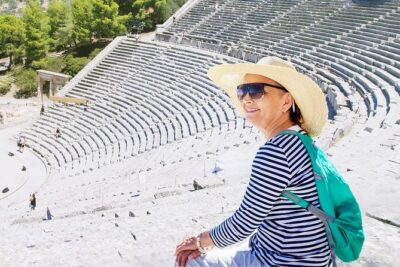
Ancient Corinth & Nafplio Full Day Trip with Swim
Read our review →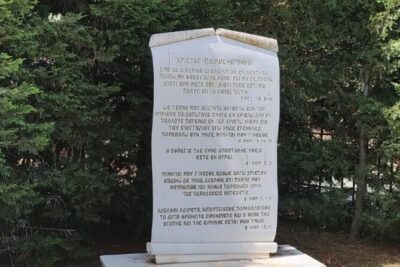
Private Tour of Apostle Paul’s Footsteps in Ancient Corinth
Read our review →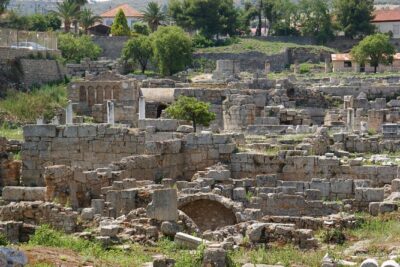
Corinth Half-Day Trip from Athens with Entrance Tickets
Read our review →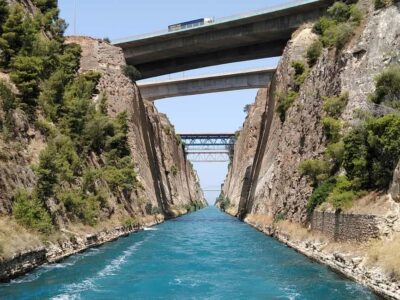
Browse the lists this tour appears in