
Reviewed · ANCIENT CORINTH TOURS
Biblical Ancient Corinth Canal Epidaurus Nafplio Private Tour
Ancient Greece in one long day. This private excursion packs the Corinth Canal, Ancient Corinth, Epidaurus, Nafplio, and several major monuments into about eight and a half hours from Athens. I like the door-to-door pickup and the freedom to adjust the schedule, especially since guides such as Chris, Giannis, Themos, and Yiannis have been praised for safe driving, useful commentary, and flexibility.
I also like the practical comfort: air-conditioning, bottled water, WiFi, and a private car or minivan make a hot Peloponnese day far easier. The main drawback is simple: the pace is demanding, and entrance fees, lunch, tips, and a licensed guide inside the sites cost extra.
In This Review
- Five details that shape the day
- Why this private Peloponnese trip works
- The Corinth Canal and a 2,000-year-old idea
- Ancient Corinth, Saint Paul, and the Roman city
- The Archaeological Museum of Ancient Corinth
- The Temple of Apollo
- Acrocorinth and the climb question
- Epidaurus and the best theatre acoustics in Greece
- The Epidaurus theatre
- The museum and Sanctuary of Asklepios
- Nafplio provides a welcome change of rhythm
- Palamidi, Akronafplia, and Bourtzi
- Transport, timing, and what the day feels like
- What the $240.93 price really buys
- Should you book this tour?
- FAQ
- How long is the private tour?
- Where can pickup and drop-off take place?
- Is airport pickup available?
- Is this a private group tour?
- What type of vehicle is used?
- Is transportation air-conditioned?
- Are entrance fees included?
- Is lunch included?
- Is a licensed guide included at the archaeological sites?
- Can the itinerary be changed?
- What happens if the weather is poor?
- Can I cancel for a full refund?
Five details that shape the day
- The Corinth Canal is a quick but memorable first stop, with about 20 minutes for views and photos.
- Ancient Corinth combines archaeology and biblical connections, including the places linked with Saint Paul.
- Epidaurus has the day’s finest single monument, its famous theatre and remarkable acoustics.
- Nafplio supplies a needed change of pace, with lunch, coffee, shopping, harbor views, and time in town.
- The private format lets you make changes, add a stop, or spend longer at a place that matters to you.
- The price covers transport and service, not admissions, so budget separately for the archaeological sites and museums.
Why this private Peloponnese trip works
At $240.93 per person, this is not a low-cost sightseeing bus. It makes more sense when you value privacy, hotel pickup, and a schedule built around your own group. Groups of one to three ride in a sedan, while groups of four to seven use a minivan.
That price includes fuel, tolls, bottled water, WiFi, air-conditioning, and an English-speaking driver with historical knowledge. Pickup and drop-off are available from an Athens hotel, apartment, or port. Airport pickup can also be arranged for an extra charge.
For a group of several people, the cost can compare well with arranging separate transport, especially when you consider the long distances and the convenience of returning to Athens in the same vehicle. For one person, or for two people who prefer a slow archaeological visit, it may feel expensive.
The private setup is the strongest feature. Your pickup time can be adjusted, and the driver can return you to your starting point or another preferred location. A family group once altered the planned route, and the driver adapted without making the day feel rigid. Another group of seven, ranging from teenagers to people in their seventies, found enough variety and rest opportunities to keep everyone involved.
The important distinction is that this is a driver-led tour, not automatically a guided archaeological tour. A licensed guide to accompany you inside the sites is not included. Your driver can explain the places and their background, but if you want detailed interpretation among the ruins, you need to arrange and pay for a guide separately.
More Ancient Corinth and canal trips:
- From Athens: Ancient Corinth Day Trip with Canal & VR Guide
★ 4.6 · 1,073 reviews - Private Biblical Tour Ancient Corinth & Isthmus Canal from Athens
★ 5.0 · 762 reviews - Athens: Ancient Corinth & Nafplio Full Day Trip with Swim
★ 4.8 · 523 reviews
The Corinth Canal and a 2,000-year-old idea
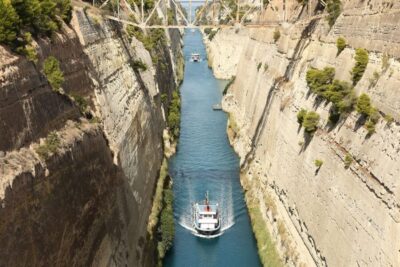
The Corinth Canal is usually your first stop after leaving Athens. You get about 20 minutes here, which is enough to look over the narrow cut, take photos, and understand why this strip of water matters.
The canal links the Gulf of Corinth with the Saronic Gulf. It cuts through the Isthmus of Corinth and separates mainland Greece from the Peloponnese in practical geographic terms. The walls are steep, and the waterway looks surprisingly narrow when viewed from above.
The modern canal was completed in the late 19th century, but the idea reaches back much further. Ships once had to sail around the Peloponnese, adding about 185 nautical miles to their route. Periander, the ruler of Corinth in the 7th century BC, is said to have considered digging a canal, but ancient engineering could not manage the task.
Instead, the Greeks built the diolkos, a stone route that allowed ships to be moved overland on wheeled platforms. That detail helps turn a short photo stop into a useful lesson in ancient engineering and trade.
The stop is brief, so do not expect a long walk or a boat ride. You are there for the view and the setting. The canal gives you a clear sense of the narrow land bridge that made Corinth such an important commercial center.
Ancient Corinth, Saint Paul, and the Roman city
Ancient Corinth receives about an hour and a half, followed by time at its archaeological museum and the Temple of Apollo. This is the most historically layered part of the Corinth section.
Corinth occupied the isthmus between mainland Greece and the Peloponnese, roughly between Athens and Sparta. Its location brought trade, political power, and contact with the wider Greek world. In 400 BC, the city is estimated to have had around 90,000 people, a remarkable number for the ancient world.
The site also matters to Christian history. Saint Paul visited Corinth during his missionary work, and the New Testament letters First Corinthians and Second Corinthians are associated with the city. You can look at the ruins with both classical Greek and early Christian history in mind.
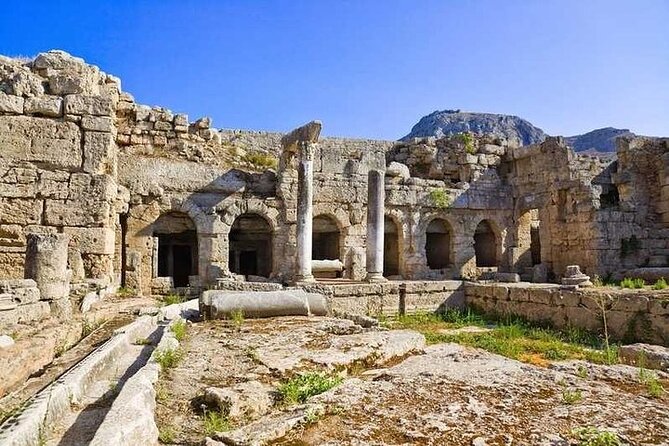
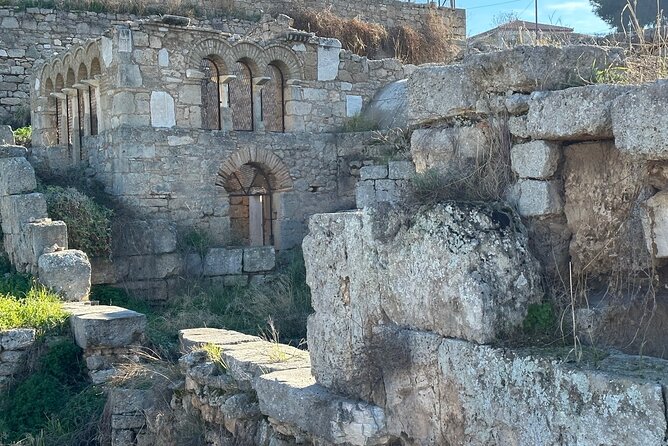
The surviving area includes the agora, the Lechaion Road, the Fountain of Peirene, a basilica, a stoa, a theatre, an odeon, and other temples. The ruins do not form one neat, preserved street scene. You will need to use the remains, the open spaces, and the museum displays to picture the ancient city.
Corinth was destroyed by the Romans in 146 BC. A new Roman city was founded in 44 BC, and Corinth later became the provincial capital of Greece. That change is one reason the site feels different from a purely classical Greek ruin. Greek, Roman, commercial, religious, and Christian threads all meet here.
The Archaeological Museum of Ancient Corinth
The museum sits within the archaeological site and was built in 1931 and 1932 to display finds from excavations. Allow about 40 minutes.
This is not an optional add-on if you want the ruins to make sense. Objects and architectural pieces help fill in what is missing outdoors. The museum also gives you a break from the sun, which matters during a warm day.
Admission is not included. The stated entry fee for Ancient Corinth is €15 per person, while museum admission is listed separately without a price. Check the current combined or separate fees before departure.
A few more Athens half-days to weigh up
- Athens: Acropolis & up to 5 Archaeological Sites Combo Pass
★ 4.4 · 12,619 reviews - Athens: Acropolis Ticket with Optional Audio or Live Guide
★ 4.2 · 11,055 reviews - Athens: Acropolis, Parthenon & Acropolis Museum Guided Tour
★ 4.8 · 9,316 reviews - Athens: Cape Sounion & Poseidon Temple Sunset Half-Day Trip
★ 4.8 · 8,241 reviews
The Temple of Apollo
The Temple of Apollo is one of the visual anchors of Ancient Corinth. The temple was built around the 6th century BC and is noted as one of the earliest Doric temples in the Peloponnese and on the Greek mainland.
Its monolithic columns are especially striking. Only part of the temple survives, but the remaining columns show the weight and simplicity of early Doric design. The scheduled visit is about 10 minutes, so this is mainly a focused look and photo stop rather than a long exploration.
Acrocorinth and the climb question
Acrocorinth, or Upper Corinth, is a huge rock above the ancient city. Its fortress controlled the isthmus and served as a defensive stronghold for southern Greece.
You get about 30 minutes here. That is enough for a brief visit and broad views, but not for a serious exploration of the entire fortress. The terrain and elevation can make this stop more strenuous than the schedule suggests. If you have limited mobility or dislike uneven ground, tell the driver early and ask how much of the site is practical for you.
The water supply helped Acrocorinth remain useful as a last line of defense. Even a short stop gives you a feel for why the position mattered. From above, the connection between the rock, the ancient city, and the isthmus becomes easy to understand.
Epidaurus and the best theatre acoustics in Greece
Epidaurus is the artistic high point of the route. The visit lasts about an hour, followed by 30 minutes at the archaeological museum, 15 minutes at the Sanctuary of Asklepios, and 45 minutes at the theatre.
The sanctuary was dedicated to Asklepios, the ancient Greek god of medicine. It functioned as a major healing center and competed with important religious sites at Olympia and Delphi.
The site gives you more than broken stones. It shows how religion, medicine, architecture, and performance came together in ancient Greece. The Temple of Asklepios was built in the early 4th century BC. The sanctuary later fell out of use when Christian emperors restricted pagan worship in the late Roman period.
The Epidaurus theatre
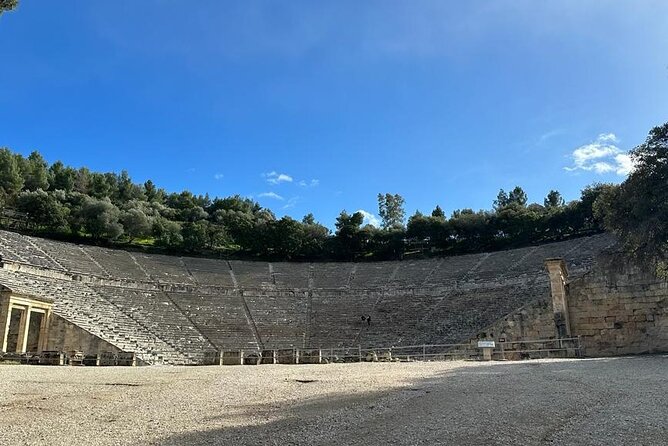
The Ancient Theatre of Epidaurus is the main reason to come. Its three-part design includes the seating area, orchestra, and stage building. The setting on the west side of Cynortion Mountain adds to the sense of order and calm.
The acoustics are famous for good reason. A small sound made at the center of the orchestra can carry to the upper seats. The familiar test is to drop a coin or pin on the stage and listen from farther up, though the site rules and conditions may affect what you can do.
The theatre is considered one of the finest surviving ancient Greek theatres in both appearance and sound. The 45-minute stop gives you time to sit, look across the seating, and understand how performances worked. It is not just a photo backdrop.
The stone seats, open orchestra, and careful geometry make the theatre especially rewarding even if you are not deeply interested in classical drama. Plays by Euripides, Sophocles, Aristophanes, and Aeschylus are part of the cultural story connected with the space.
The museum and Sanctuary of Asklepios
The Epidaurus Archaeological Museum opened in 1909 after being established in the early 20th century. It is known for temple reconstructions, columns, and inscriptions recovered from the surrounding site.
Thirty minutes is enough for a focused look. If you spend a long time outdoors studying every structure, the museum may feel rushed. Still, it helps explain the sanctuary’s buildings and medical purpose.
The Temple of Asklepios gets about 15 minutes. The visit is short, but it gives you a direct look at the core religious site. The archaeological site admission is listed at €20 per person and is not included in the tour cost.
Nafplio provides a welcome change of rhythm
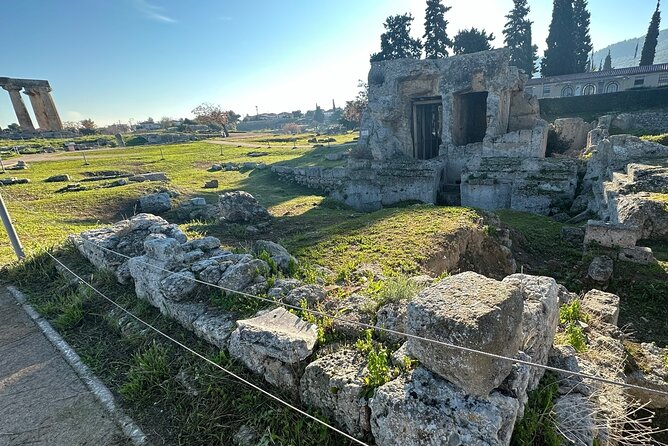
After the archaeological stops, Nafplio feels refreshingly human. The schedule includes about an hour for lunch, coffee, and shopping, though the meal itself is not included.
Nafplio was an important port and later served as the capital of the First Hellenic Republic and the Kingdom of Greece during the early period of the modern Greek state. Its position on the Argolic Gulf gives the town a strong connection to the sea, while the fortresses remind you that this was also a strategic place.
I would use this hour for a proper break rather than trying to race through every street. One driver, Giannis, was praised for taking a family to a particularly good lunch spot. Ask your driver for a recommendation, but remember that food and drinks are extra.
The Lion of the Bavarians is another unusual stop. The large sleeping lion was carved into the rock above Michael Iatrou Street by German sculptor Christian Ziegel. It honors Bavarian soldiers from the dynasty of King Otto who died in Nafplio during a typhoid epidemic in 1833.
The monument has a small park below it and takes about an hour in the stated program, although the exact amount of time can be adjusted. It is a reminder that modern Greek statehood involved foreign rulers, soldiers, and complicated political ties, not only ancient temples.
Palamidi, Akronafplia, and Bourtzi
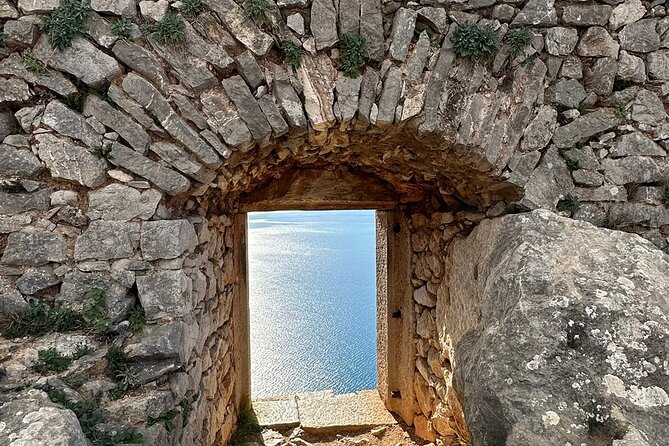
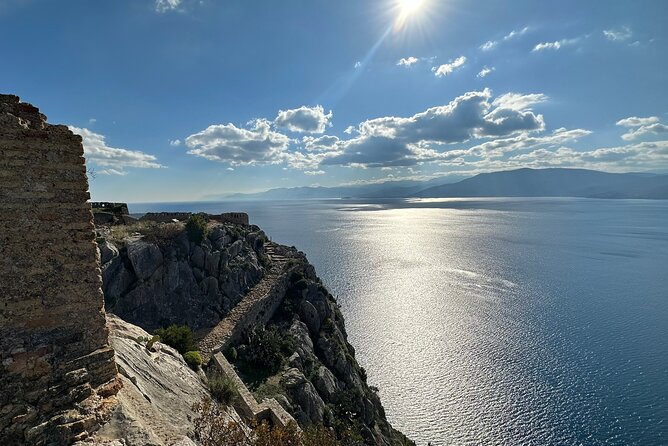
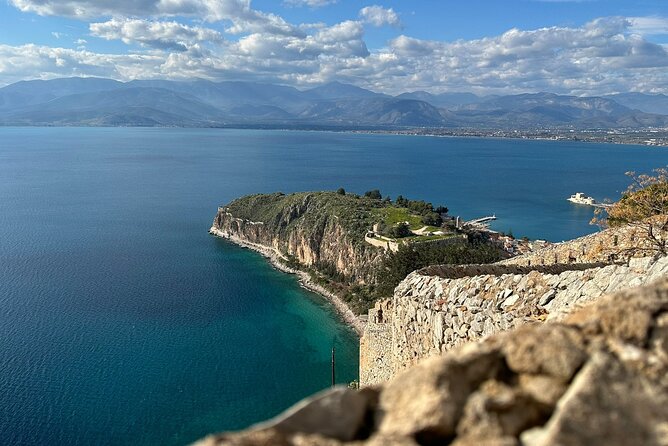
Palamidi Castle sits on a 216-meter-high hill above Nafplio. The Venetians built the fortress during their second period of control, from 1686 to 1715.
The castle offers broad views over Nafplio, the Argolic Gulf, and the surrounding countryside. The route from town is famous for its 913 steps, though local tradition often rounds the number to 999. Even after reaching the fortress, more steps lead through the complex.
The scheduled visit is about 30 minutes, which is enough for a quick look and viewpoints if you arrive by vehicle. It is not enough for a slow examination of every bastion and passage. Admission is listed at €20 per person and is not included.
The fortress includes the prison connected with Theodoros Kolokotronis, a key figure in the Greek War of Independence. That detail adds political weight to the visit, while the views make it one of the most memorable places around Nafplio.
Akronafplia is the oldest part of the city. It was once a separate settlement and later became part of Nafplio’s defenses under Frankish and Venetian control. Some of the area was later used as a prison.
Bourtzi is the final photo stop, a Venetian water castle in the middle of Nafplio harbor. You view it from the harbor side rather than treating it as a separate boat excursion. Ten minutes is enough for photographs and a final look across the water.
Transport, timing, and what the day feels like
The vehicle is one of the tour’s practical strengths. Air-conditioning, WiFi, and bottled water matter when you are moving between exposed archaeological sites in summer. The private sedan or minivan also gives your group space to talk, rest, and control the music or conversation.
The day includes a lot of driving and several short visits. You will see more than you could manage easily with public transport, but you will not experience every site at a slow museum pace. The schedule works best when you decide in advance which places matter most.
The drivers have received strong praise for careful driving and personal attention. Themos was specifically praised for safe driving, explanations at each stop, and making an additional stop beyond the planned route. Chris was praised for flexibility, historical information during the drives, and giving a group extra time rather than rushing them out.
That flexibility is valuable, but you should speak clearly about priorities. If Epidaurus matters most, ask for enough time there. If your group wants a relaxed lunch in Nafplio, accept that one smaller Corinth stop may need to be brief.
Car seats are available if requested in advance. Most people can participate, but Acrocorinth and Palamidi involve slopes, steps, or uneven surfaces. A licensed guide is not included, so arrange one separately if you want formal site interpretation.
What the $240.93 price really buys
The advertised price is per person and the tour is usually booked about 37 days ahead. Your costs can rise once you add entrance fees, lunch, and tips.
Known admission costs include:
- Ancient Corinth: €15 per person
- Palamidi Castle: €20 per person
- Archaeological Site of Epidaurus: €20 per person
- Archaeological Museum of Corinth: separate admission
- Epidaurus Archaeological Museum: not included
- Lunch in Nafplio: not included
The total value depends on group size. A larger private group gets more value from the vehicle, private pickup, and flexible schedule. A couple may still prefer it for convenience, especially if their time in Athens is limited and they want several major sites in one day.
Free cancellation is available until 24 hours before the start time for a full refund. Changes made inside that 24-hour window are not accepted, and poor weather may lead to a new date or full refund.
Should you book this tour?
Book it if you want to connect several major Peloponnese sights in one day without managing transport. It is especially suitable for families, mixed-age groups, cruise passengers with a full day available, and anyone who values a private vehicle and a flexible plan.
I would book it with two conditions. First, budget for admissions and lunch. Second, decide if you need a licensed guide at the archaeological sites, since the driver’s historical explanations are not the same as a formal guided visit.
Skip it if you prefer slow, detailed archaeology or dislike long days in the car. For everyone else, the combination of Corinth’s biblical and Roman layers, Epidaurus’ theatre, and Nafplio’s forts gives you a broad and memorable look at Greece beyond Athens.
FAQ
How long is the private tour?
The tour lasts approximately 8 hours and 30 minutes.
Where can pickup and drop-off take place?
Pickup is offered from an Athens hotel, Airbnb residence, or port. The driver can return you to the same place or another point you prefer.
Is airport pickup available?
Yes. Airport pickup is available for an additional cost. The driver waits in the arrivals hall with a sign showing your name.
Is this a private group tour?
Yes. Only your group participates.
What type of vehicle is used?
Groups of one to three people use a luxury sedan. Groups of four to seven people use a comfortable minivan.
Is transportation air-conditioned?
Yes. The vehicles have air-conditioning, WiFi, and bottled water.
Are entrance fees included?
No. Archaeological site and museum admission fees are separate from the tour price.
Is lunch included?
No. Time is provided for lunch, coffee, and shopping in Nafplio, but you pay for your own meal.
Is a licensed guide included at the archaeological sites?
No. The tour includes an English-speaking driver with historical knowledge, but a licensed guide inside the sites is not included.
Can the itinerary be changed?
Yes. The tour is private and can be customized according to your group’s needs. Changes requested less than 24 hours before the start time are not accepted.
What happens if the weather is poor?
The experience requires good weather. If it is canceled because of poor weather, you are offered another date or a full refund.
Can I cancel for a full refund?
Yes. You can receive a full refund if you cancel at least 24 hours before the experience start time.
Just added around Athens
- Delphi One Day Trip from Athens★ 4.0 · 98 reviews
- Mercedes Private Tour to Delphi and Arachova★ 5.0 · 30 reviews
- Private Delphi and Hosios Loukas Monastery – Great Lunch and Drinks Included★ 5.0 · 36 reviews
- Athens: Half Day Trip To Cape Sounio/Poseidon Temple Semi Private★ 5.0 · 131 reviews
- Day tour to Ancient Olympia,Ancient Sparta Mycenae Including Meal★ 5.0 · 54 reviews
- Athens Half-Day Private Tour Acropolis, Parthenon City Highlights★ 5.0 · 35 reviews
- From Athens: Day Tour to Mykonos★ 5.0 · 64 reviews
- Culinary Secrets of Downtown Athens★ 5.0 · 103 reviews
Ancient Corinth Tours, compared.
Ancient Corinth Day Trip with Canal & VR Guide
Read our review →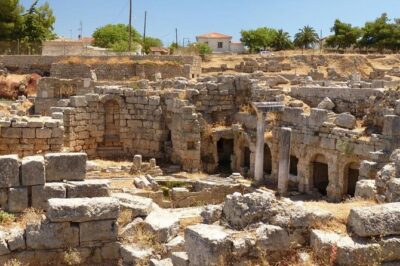
Private Biblical Tour Ancient Corinth & Isthmus Canal from Athens
Read our review →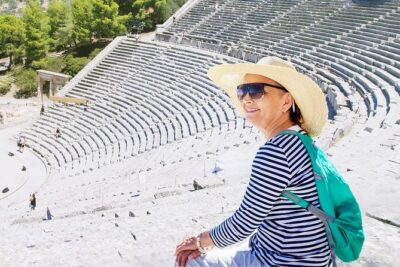
Ancient Corinth & Nafplio Full Day Trip with Swim
Read our review →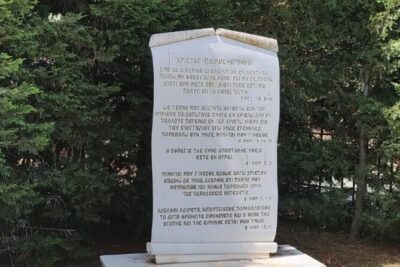
Private Tour of Apostle Paul’s Footsteps in Ancient Corinth
Read our review →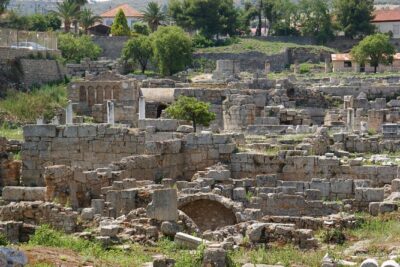
Corinth Half-Day Trip from Athens with Entrance Tickets
Read our review →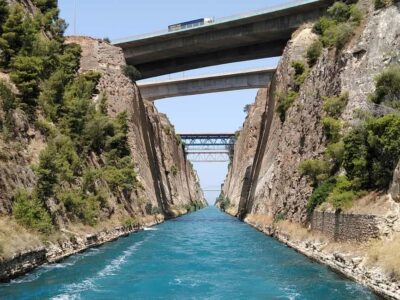
Browse the lists this tour appears in