
Reviewed · WORKSHOPS
Philosophy Experiential Workshop at Plato’s Academy Park -Athens
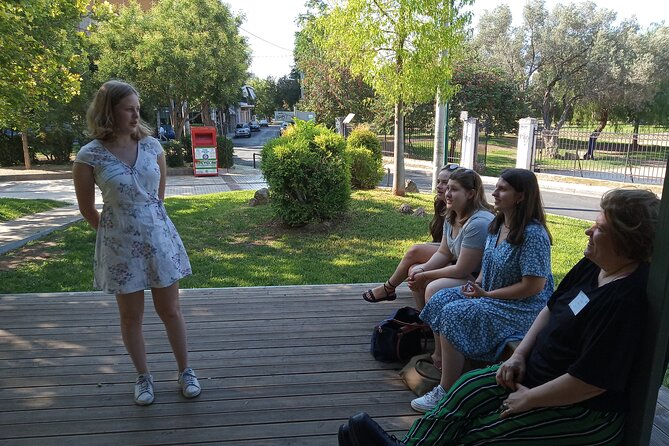
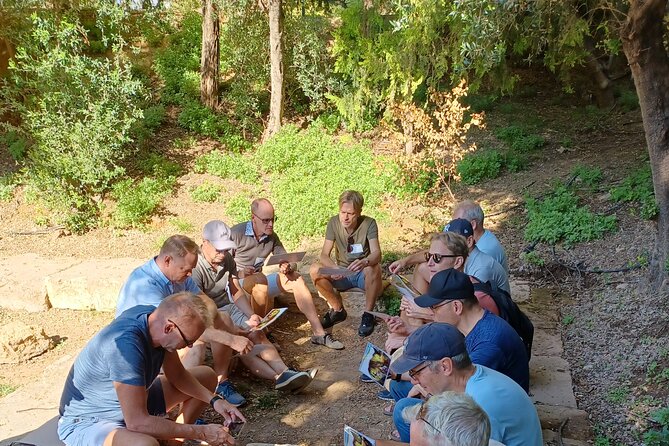
Philosophy gets better outdoors. This two-hour workshop turns Plato’s Academy Park into a classroom, with a short museum visit, ancient ruins, plain-English discussion, and a playful debate using a replica water-timer. I like the small group size, limited to 10 people, and the way the session asks you to think rather than simply listen.
I also like the setting. You discuss Plato’s Allegory of the Cave near the remains of the ancient Gymnasium, where the story of Greek philosophy feels connected to the ground beneath your feet. The main drawback is that this is an outdoor activity, so rain can cancel it, and the museum may be closed without notice.
In This Review
- Key points to know before booking
- Why Plato’s Academy Park makes a good classroom
- Starting at the free Digital Museum
- Reading ancient ideas in plain English
- Walking to the ancient Gymnasium ruins
- Plato’s Allegory of the Cave as a group discussion
- Finishing with a timed ancient-style debate
- Optional Aristotle session on virtue and choice
- What the $53.92 price means
- Timing, weather, and practical concerns
- Who will enjoy this workshop most
- Should you book the Plato’s Academy workshop?
- FAQ
- How long does the workshop last?
- Where does the experience begin and end?
- Is the museum entrance included?
- What happens if the museum is closed?
- Do I need previous knowledge of philosophy?
- What age is suitable for the workshop?
- What happens if bad weather cancels the activity?
- Can I cancel for a full refund?
Key points to know before booking
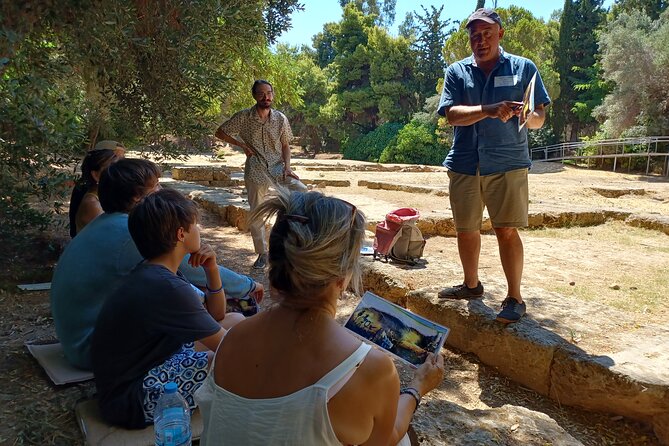
- A real discussion, not a standard sightseeing tour: You read ancient Greek ideas, ask questions, and test your own views.
- The Digital Museum is free: The small museum offers useful background before you enter the park.
- The Socratic method is the main event: Plato’s Allegory of the Cave becomes a lively conversation about knowledge, truth, and modern life.
- The water-timer role-play adds fun: You take part in a timed debate modeled on ancient discussion.
- Small groups help: With no more than 10 participants, it is easier to speak and ask questions.
- An extra Aristotle hour is available: You can add a discussion and game about virtue and choice.
Why Plato’s Academy Park makes a good classroom
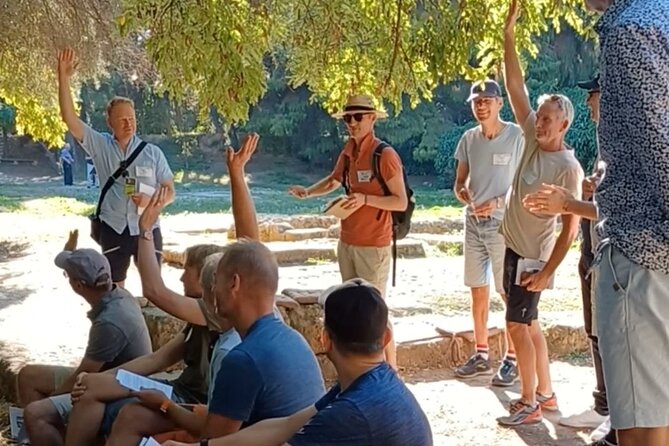
Many Athens excursions ask you to look, take a photo, and move on. This one asks you to stop and think. That change matters. Plato’s Academy was not simply a building to admire. It was a place associated with teaching, conversation, and the pursuit of better questions.
The activity takes place at Plato’s Academy Park, away from the most crowded central sights. You are not being shown a grand monument with every stone intact. Instead, the value comes from connecting a modest archaeological site with ideas that still shape education, politics, ethics, and daily life.
That makes the workshop best for curious people who want more than a quick explanation of who Plato was. You do not need previous study. The session uses plain English and avoids difficult terminology, so you can join even if your last philosophy class was many years ago.
The format also suits families with older teenagers. The material is educational, but it is not presented as a school lecture. Questions, examples, and role-play keep the pace active. Underage participants must book with an adult, and the adult is responsible for supervising them.
A few more Athens half-days to weigh up
- Athens: Classic Cooking Class with Market Visit and Wine
★ 5.0 · 1,101 reviews - Athens: Food Market Visit and Cooking Class with Wine
★ 4.9 · 1,087 reviews - Greek Cooking Class in Athens Including Rooftop Dinner with Acropolis View
★ 5.0 · 826 reviews
Starting at the free Digital Museum
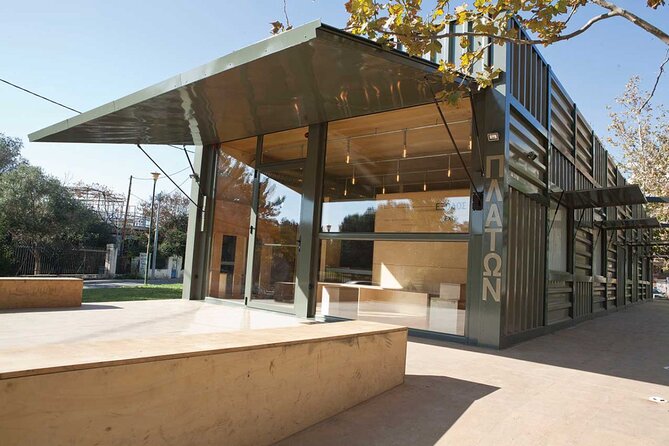
The meeting point is Plato’s Academy Digital Museum at Alkmeonos 1, Athens 104 42. The workshop begins with a brief visit to the museum when it is open.
The museum is small, but that is not a problem for this format. You are not expected to spend half a day indoors. Instead, the visit gives you a quick visual introduction to Plato, the Academy, and the world in which Greek philosophy developed.
I would treat this stop as preparation rather than the main attraction. The museum helps you put names and ideas in place before the outdoor discussion begins. A short visit can be especially useful if you know little about Socrates, Plato, or Aristotle.
The museum is open Tuesday through Friday from 10:00 a.m. to 4:00 p.m. Its hours can change, and it sometimes closes without notice. On days when it is unavailable, the facilitator replaces the visit with a discussion covering the same main points. That means you should not book only for the museum. The workshop is designed to work either way.
Reading ancient ideas in plain English
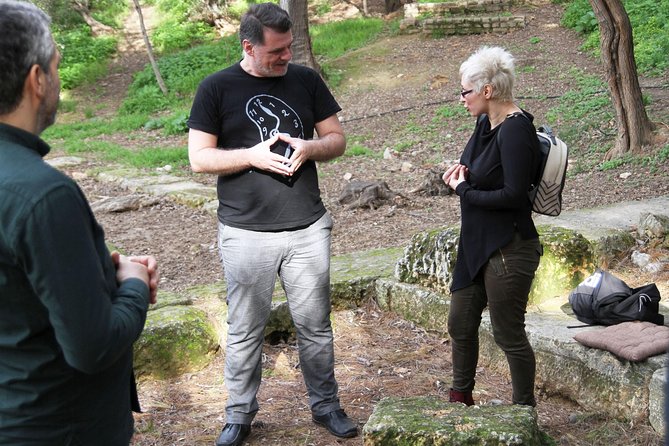
After the museum, the group begins with a philosophical warm-up. You read and interpret ancient Greek texts, with the facilitator helping the group think through the meaning rather than giving a long translation lesson.
This is one of the strongest parts of the experience. Ancient writing can feel remote when you meet it alone on a page. Here, you can test an interpretation, hear another point of view, and see how a short passage opens into larger questions.
The approach is interactive. You are not required to have the correct answer, and you are not expected to speak like a philosophy professor. The goal is to work through the ideas together. That makes the activity less intimidating than its title might suggest.
The language is plain English. Still, this is a thinking activity, so you should expect to concentrate. If you want a relaxed walk with occasional facts, this may feel demanding. If you enjoy asking why, it should be a good match.
Walking to the ancient Gymnasium ruins
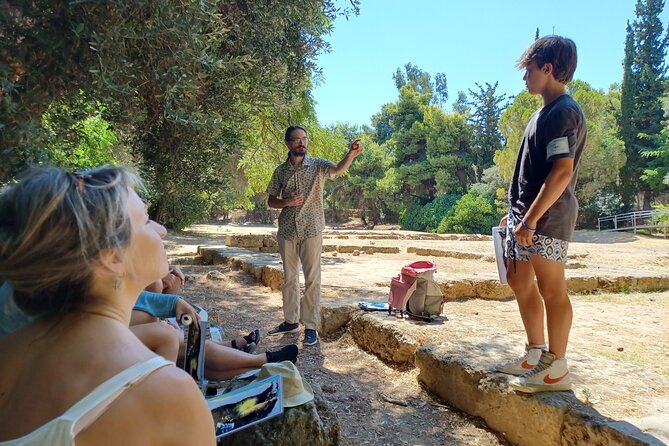
The group then moves through the park to the ruins of the ancient Gymnasium. The walk gives the session a useful rhythm: a little context, a little movement, then another period of discussion.
The archaeological remains are important, but you should set your expectations correctly. This is not a large, fully preserved complex with rooms you can explore. The site’s power comes from its connection to the Academy and from the conversation held nearby.
There is a small chance that excavation work will be taking place during your visit. If that happens, you will view the Gymnasium ruins from a short distance and settle in another part of the park. The central activity continues, but the exact setting may change.
Your facilitator sets out a timeline of Greek philosophical heritage, linking Socrates, Plato, and Aristotle. This gives the workshop a clear structure. Rather than treating Plato as an isolated thinker, the session shows how his ideas grew from earlier conversations and influenced later thought.
This background is especially helpful for first-time learners. Socrates, Plato, and Aristotle are often listed together, but their roles can blur. The timeline helps you understand the basic relationship before the discussion turns to Plato’s own ideas.
Same stretch of coastline, a completely different day out:
- Athens: Acropolis & up to 5 Archaeological Sites Combo Pass
★ 4.4 · 12,619 reviews - Athens: Acropolis Ticket with Optional Audio or Live Guide
★ 4.2 · 11,055 reviews - Athens: Acropolis, Parthenon & Acropolis Museum Guided Tour
★ 4.8 · 9,316 reviews - Athens: Cape Sounion & Poseidon Temple Sunset Half-Day Trip
★ 4.8 · 8,241 reviews
Plato’s Allegory of the Cave as a group discussion
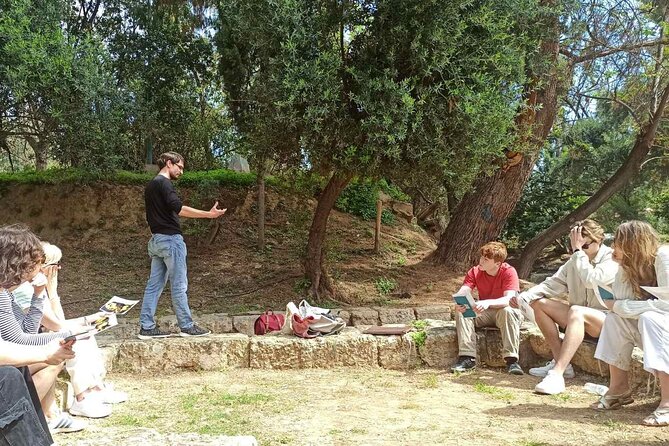
The main discussion focuses on Plato’s Allegory of the Cave. In simple terms, the allegory asks you to consider the difference between appearances and reality, and what happens when someone is forced to see the world in a new way.
The setting gives the subject extra force. You are not sitting in a modern classroom with a slide presentation. You are discussing Plato near the place connected with his Academy, surrounded by the open park and archaeological remains.
The facilitator uses the Socratic method, which means the group reaches ideas through questions rather than a fixed lecture. You may be asked to explain what you think, examine an assumption, or consider how another person could see the issue differently.
This format received the strongest praise in the feedback provided. One participant described the question-and-answer style as more enjoyable than a traditional tour because it made the history and concepts easier to understand. Another particularly liked connecting the allegory with the role of philosophy in modern life.
That modern connection is important. The discussion is not only about an ancient story. It can lead to questions about education, media, personal beliefs, and how people respond when their familiar view is challenged. The exact direction depends on the group, which is part of the appeal and also means no two sessions will be identical.
You should be ready to contribute, but you do not have to deliver a speech. A small group of up to 10 makes it easier to join in without competing with a large crowd. The quality of the session will depend partly on the mix of people and how willing everyone is to listen.
Finishing with a timed ancient-style debate
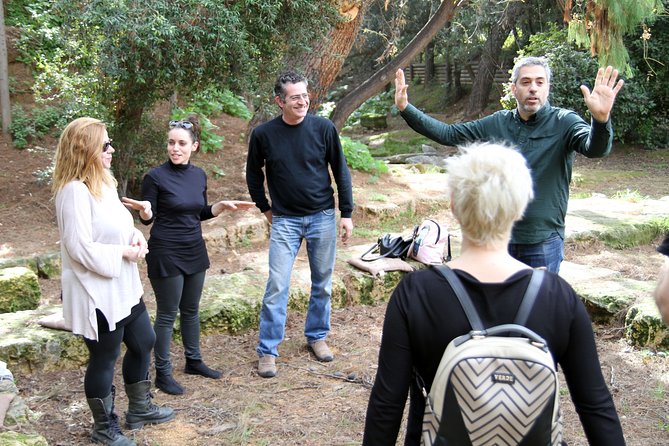
The final activity is a role-play debate using a replica of an ancient water-timer. The device gives each speaker a set amount of time, adding a physical reminder that public discussion in the ancient world had rules and limits.
This is a smart ending because it changes the energy. The workshop begins with interpretation, moves into careful questioning, and finishes with active participation. You are not just hearing about ancient debate. You get to try a simplified version yourself.
The role-play also keeps the activity from becoming too serious. Philosophy can sound heavy when it is presented as a list of major thinkers and difficult terms. A timed debate gives the ideas a practical outlet and lets you see how arguments work under pressure.
The session is educational, but it is also social. You may find yourself defending a position you do not fully hold, listening to a surprising argument, or noticing how quickly a discussion changes when time is limited. That is the kind of detail that makes the experience memorable.
Optional Aristotle session on virtue and choice
You can request an additional hour focused on Aristotle. This extension includes a game about virtue and choice.
The extra hour makes sense if you want a broader look at Greek philosophy rather than a focused introduction to Plato. It also gives you more time for discussion and activity. If your Athens schedule is tight, the standard two-hour program already has a clear beginning, middle, and end, so the add-on is not essential.
The Aristotle section may suit older teenagers and adults who enjoy ethical questions. The subject of virtue and choice connects ancient thought with ordinary decisions, but the supplied information does not specify the exact game format or price of the extra hour. Ask the provider for those details before adding it.
What the $53.92 price means
At $53.92 per person, this is not a low-cost park visit. You are paying for an expert facilitator, a structured two-hour workshop, local VAT, liability insurance, and a small group capped at 10 people.
The value depends on what you want from Athens. If you only want to see the park and ruins, the price may feel high because the archaeological remains are limited and the museum entrance is free. You could visit the area without booking this activity.
If you want guided intellectual time, the price is easier to justify. The facilitator shapes the reading, keeps the discussion moving, explains the philosophical timeline, and organizes the role-play. A normal sightseeing ticket cannot provide that kind of participation.
Group discounts are available, and a private option can be requested. A private session may be useful for a family or a group of friends who want to set the pace themselves, but the supplied information does not state the private price.
The average booking time is 34 days ahead. That suggests you should reserve early if this is important to your Athens plans, especially because the group is small. Free cancellation is available up to 24 hours before the start time. Changes or cancellations inside that window are not accepted for a refund.
Timing, weather, and practical concerns
Plan on about two hours, with the activity starting and ending at the museum meeting point. Public transportation is nearby, and mobile tickets are accepted.
This is an outdoor workshop, so good weather matters. If poor weather forces cancellation, you will be notified at least three hours before the start. You can then choose another date, a similar workshop, or a full refund.
Wear clothing suitable for a historical site and outdoor discussion. The provider asks participants to respect the place through appropriate conduct, cleanliness, dress, volume, and photography. The facilitator can end participation without a refund if someone behaves disrespectfully.
Service animals are allowed, and most people can take part. The supplied information does not give detailed mobility guidance for the park, so you should contact the provider if you have specific access needs.
Photography and video may take place in the public space during the workshop. By attending, you consent to this, although you can withdraw consent in writing before or after the session. The provider is not responsible for images taken and used by other participants.
Who will enjoy this workshop most
I would recommend it to:
- Adults who want ideas as well as monuments
- Teenagers aged 14 and over who enjoy discussion
- Families looking for an educational activity with participation
- Visitors who already know the Acropolis and want a different side of Athens
- Small groups who prefer conversation to a scripted walk
- Anyone curious about Plato but worried that philosophy will be too difficult
It is less suited to you if you want a quiet museum visit, a fast list of facts, or a conventional guided tour. The experience is explicitly an educational workshop, not a standard tour. You will get more from it if you are willing to read, answer questions, listen closely, and take part in the debate.
The age information should be checked carefully. The main description presents the activity for adults and teenagers over 16, while the additional booking information says it is suitable for ages 14 and over. Anyone underage cannot book alone and must attend with an adult.
Should you book the Plato’s Academy workshop?
Book it if you want Athens to make you think. The free museum is useful, the ruins provide an unusual setting, and the discussion-led format is far more active than a standard stop at an archaeological site.
The best reason to choose it is the combination of place and method. You study Plato’s ideas in the setting associated with his Academy, then practice discussion through the Allegory of the Cave and the timed debate. That connection is the heart of the experience.
Skip it if you want major monuments, extensive excavation remains, or a traditional sightseeing guide. The park is not the Acropolis, and the workshop asks for your attention rather than offering a passive look around.
For curious adults, older teenagers, and families who like to talk about big questions, this is a thoughtful use of two hours in Athens. Reserve early, check the museum hours, and keep a weather backup in mind.
FAQ
How long does the workshop last?
The main workshop lasts approximately two hours. An additional hour about Aristotle’s philosophy is available upon request.
Where does the experience begin and end?
It begins at Plato’s Academy Digital Museum, Alkmeonos 1, Athens 104 42, Greece. It ends back at the same meeting point.
Is the museum entrance included?
The Plato’s Academy Digital Museum has free entrance. The workshop includes a brief museum visit when the museum is open.
What happens if the museum is closed?
The museum is open Tuesday through Friday from 10:00 a.m. to 4:00 p.m., but its hours can change and it may close without notice. If it is unavailable, the facilitator replaces the visit with a discussion covering the same key insights.
Do I need previous knowledge of philosophy?
No. The workshop is designed for people without previous knowledge and uses plain English without difficult terminology.
What age is suitable for the workshop?
The additional information states that the workshop is suitable for adults and teenagers aged 14 and over. Underage participants cannot book alone and must attend with an adult who supervises them.
What happens if bad weather cancels the activity?
You will be notified at least three hours before the start. You can choose another date, a similar workshop, or a full refund.
Can I cancel for a full refund?
Yes. You can cancel at least 24 hours before the local start time for a full refund. Cancellations and changes made less than 24 hours before the experience are not accepted for a refund.
Just added around Athens
- Traditional Greek Show in Plaka with Dinner★ 3.6 · 178 reviews
- Santorini Wine Roads Tour with Wine Tastings Morning & Sunset★ 5.0 · 106 reviews
- Private Sunset Wine Tour with 3 Wineries and Tapas★ 5.0 · 34 reviews
- Insightful Pistachio Orchard and Factory Tour★ 4.5 · 27 reviews
- Traditional Villages Full day Tour in Santorini★ 4.0 · 84 reviews
- Half Day Tour★ 5.0 · 63 reviews
- Half-Day Shared Fishing Experience in Hydra★ 5.0 · 35 reviews
- Athens Old City Private Photoshoot Tour / 2 hrs★ 5.0 · 109 reviews
Workshops, compared.

Classic Cooking Class with Market Visit and Wine
Read our review →
Food Market Visit and Cooking Class with Wine
Read our review →
Greek Cuisine Cooking Class in Santorini with Recipes and Wine
Read our review →
Half-Day Cooking Class at Basiliko Family Tavern
Read our review →
Greek Cooking Class in Athens Including Rooftop Dinner with Acropolis View
Read our review →
Greek Small-Group Athens Cooking Class & Dinner
Read our review →
Authentic Cooking Class in the White Mountains
Read our review →
Browse the lists this tour appears in