
Reviewed · ANCIENT CORINTH TOURS
Private Luxury Biblical Tour: Apostle Paul’s Footsteps – Corinth
Corinth brings the Bible story into clear focus. This private half-day trip from Athens links the Corinth Canal, Paul’s arrival port at Kenchreai, the ancient forum, and the Bema where he faced the Roman authorities. I like the door-to-door pickup and the freedom of a private car, and the English-speaking driver-guides add useful historical and biblical context along the way. The main drawback is that your driver is not a licensed guide inside the archaeological sites, and entrance fees are extra.
I also like the relaxed pace. Guides such as Demetrios, Makis, George, Dimitrios, and Pericles have been praised for being patient, flexible, and willing to stop for photos or even ice cream. Just remember that this is a 5 to 6 hour outing including road time, so it gives you a focused look at Corinth rather than a complete tour of every corner.
In This Review
- Key points before you book
- Why Corinth makes a strong biblical day trip
- Comfortable Athens pickup and private transport
- The Corinth Canal and the old crossing
- Kenchreai, the port where Paul arrived
- Ancient Corinth: mythology, law, and Paul’s public trial
- The Temple of Apollo and Corinth’s older world
- The Archaeological Museum of Corinth
- Acrocorinth: the high point of the day
- The Apostle Paul Church in modern Corinth
- Guides, pace, and the private format
- Price, admissions, and overall value
- Who should book this Corinth tour?
- FAQ
- How long does the private Corinth tour last?
- Is hotel and cruise-port pickup included?
- Is airport pickup included?
- Are archaeological entrance fees included?
- What kind of vehicle is used?
- Can I cancel for a full refund?
- Should you book it?
Key points before you book
- Follow Paul’s Corinth story in sequence: See Kenchreai, where Paul arrived, then the forum and Bema tied to his trial before Gallio.
- Enjoy genuine private-tour flexibility: Your group sets the pace, with time for photos, short breaks, and questions.
- Start and finish at your own Athens pickup point: Hotel, apartment, or selected cruise port pickup is included, with drop-off at the original meeting point.
- Ride in comfort: Groups of one to four use a luxury sedan, while groups of five to seven travel in a minivan.
- Budget for the archaeological sites: Admission is not included, and the stated entrance cost is €20 per person.
- Expect a driver-guide, not a site guide: Your English-speaking driver can explain the setting, but a licensed guide to accompany you inside is not included.
Why Corinth makes a strong biblical day trip
Corinth is a good choice if you want more than a general ancient Greek ruins tour. The city connects several strands of history: trade across the Isthmus, Roman power, Greek mythology, and the first Christian communities. Paul spent time here around 51 to 53 AD, and the places on this route help you understand the setting described in Acts 18.
The trip begins in Athens, but the story quickly shifts from modern traffic to the narrow land bridge joining mainland Greece and the Peloponnese. That geography matters. Corinth controlled this crossing and benefited from both overland movement and maritime trade. You are not simply driving to a ruin. You are seeing why Corinth was important in the first place.
I think this tour suits people who want a personal connection to Paul’s ministry without joining a large bus group. It is also a practical choice from Piraeus, especially if you want pickup at the port and drop-off elsewhere in Athens. One couple specifically valued being collected in Piraeus and returned to a different Athens location.
More Ancient Corinth and canal trips:
- From Athens: Ancient Corinth Day Trip with Canal & VR Guide
★ 4.6 · 1,073 reviews - Private Biblical Tour Ancient Corinth & Isthmus Canal from Athens
★ 5.0 · 762 reviews - Athens: Ancient Corinth & Nafplio Full Day Trip with Swim
★ 4.8 · 523 reviews
Comfortable Athens pickup and private transport
Pickup is offered from designated hotels, apartments, and cruise ports. At a hotel or apartment, the driver waits outside. At the port, the driver meets you in the arrival area with a sign showing your name. Airport pickup can also be arranged for an additional charge.
The vehicle setup depends on your party. One to four people ride in a luxury sedan, while five to seven use a comfortable minivan. Air conditioning, bottled water, private transportation, and Wi-Fi are included. Those details may sound basic, but they matter on a warm Greek day when you are moving between open-air sites.
The private format is the biggest practical advantage. You do not have to follow a stranger’s timetable, and you can ask for more time at a place that matters to you. Guides have been praised for waiting without pressure, taking photographs, and adjusting the pace. That makes the outing especially useful for couples, families, and small church groups.
The tour duration is about five to six hours, including the driving between stops. That means the schedule is fairly full. The listed stops add up to roughly three hours of site time, before counting the road from Athens and the movement between Corinth’s locations. You will see a lot, but this is not a slow archaeological study day.
The Corinth Canal and the old crossing
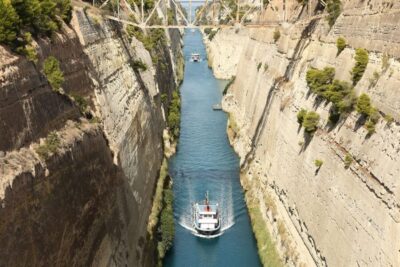
Your first stop is the Isthmus of Corinth, where the modern canal cuts through the rock. You have about 20 minutes here, enough for a look at the dramatic waterway and some photographs. The canal is a 19th-century engineering project, but the location has shaped travel and trade for far longer.
The isthmus is only a narrow strip of land, yet it separated the Gulf of Corinth from the Saronic Gulf. In ancient times, the crossing allowed Corinth to control movement between central Greece and the Peloponnese. The setting gives you a useful introduction before the tour turns to Paul and the early church.
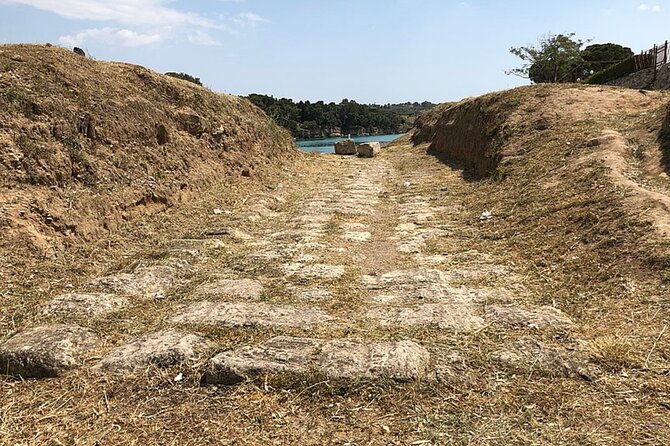
Next comes the Diolkos, an ancient paved route used to move ships overland across the isthmus. The stop lasts about 10 minutes and is brief, so you should not expect a long walk or a major preserved complex. Still, the idea is remarkable: ancient engineers created a practical way to avoid sailing around the Peloponnese.
I find these first two stops valuable because they explain Corinth’s wealth and influence. By the time you reach the ancient city, you have a clearer sense of why this was a major commercial center and why Paul came to a place with such wide connections.
Kenchreai, the port where Paul arrived
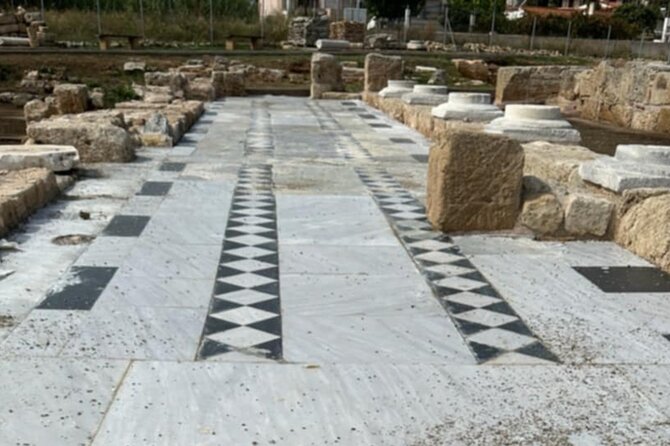
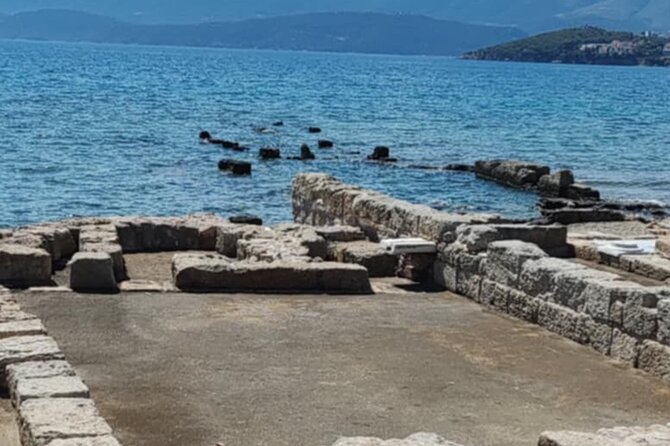
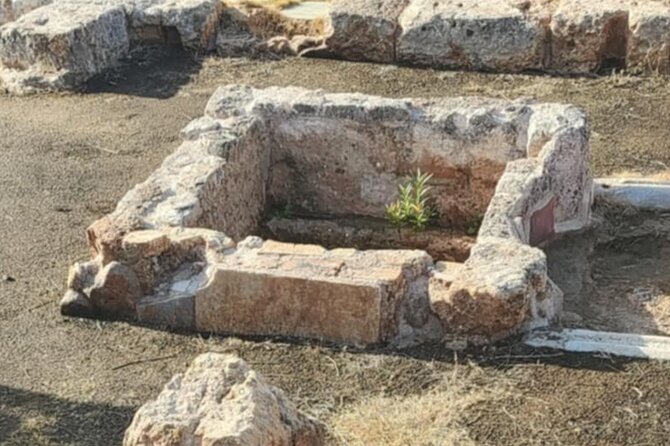
The eastern port of Kenchreai is the first stop with a direct link to Paul’s journey. Paul arrived here around 53 AD, and the harbor served as Corinth’s eastern maritime outlet during the Roman period. You have about 20 minutes to see the remains of the harbor facilities, temples, and early Christian structures.
Do not expect a fully restored port. What makes Kenchreai meaningful is its position in the story. Paul did not appear in an isolated village. He arrived through a port tied to a powerful city and a busy network of people, goods, and ideas.
The stop also helps you picture Paul’s movements beyond the famous forum. Biblical tours can sometimes focus so tightly on one speech or verse that the wider setting disappears. Here, the port gives you a practical sense of how Paul entered Corinth and how he might have continued his missionary work by sea.
Because the stop is short, listen closely to your driver-guide’s explanation and ask questions while you are there. The tour does not include a licensed guide inside the sites, so your understanding will depend partly on the driver’s knowledge and the information available at each location.
A few more Athens half-days to weigh up
- Athens: Acropolis & up to 5 Archaeological Sites Combo Pass
★ 4.4 · 12,619 reviews - Athens: Acropolis Ticket with Optional Audio or Live Guide
★ 4.2 · 11,055 reviews - Athens: Acropolis, Parthenon & Acropolis Museum Guided Tour
★ 4.8 · 9,316 reviews - Athens: Cape Sounion & Poseidon Temple Sunset Half-Day Trip
★ 4.8 · 8,241 reviews
Ancient Corinth: mythology, law, and Paul’s public trial
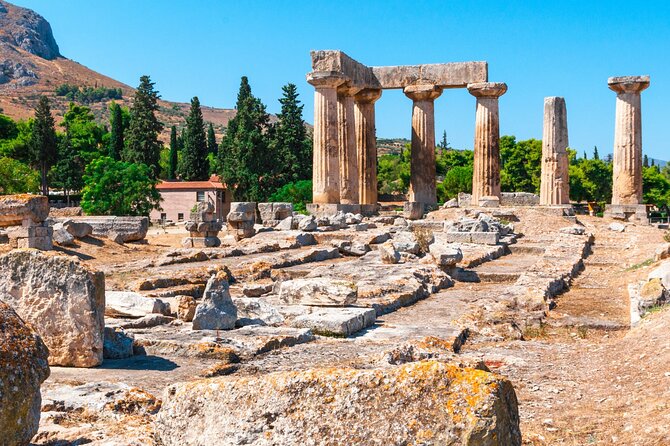
The main archaeological area at Archaia Korinthos is the heart of the excursion. It brings together temples, public buildings, fountains, and the Roman forum. You will need to allow for the separate admission charge here and at the museum.
The Glauke Fountain adds a different note to the day. Cut into the hillside, it is connected with the myth of Glauke, the daughter of King Creon. According to the legend, she sought refuge here after being poisoned by Medea. The story is grim, but it shows how Corinth’s ancient religious and mythical world surrounded the Christian message Paul preached.
The most important stop for many people is the Bema, or raised speaker’s platform, in the Roman Forum. This was used for public addresses and legal decisions. In the Roman period, it functioned as a tribunal where officials issued judgments.
Acts 18 describes Paul being brought before Gallio, the Roman proconsul, around 51 AD. The accusation concerned his religious teaching, but Gallio dismissed the case. That decision allowed Paul to continue his work. At Corinth, the biblical account is not floating somewhere in the past. It is tied to a public place where Roman power, civic law, and religious disputes met.
The Bema is also the place where the tour’s title becomes most meaningful. You can stand near the platform and consider Paul speaking in a city shaped by pagan worship and Roman government. The setting is not grand because it has been rebuilt for modern visitors. Its value comes from the connection between the surviving forum and the account in Acts.
The schedule gives roughly 25 minutes for the Glauke Fountain and Bema area, then another 10 minutes for the Bema presentation. That timing is enough for a clear visit, but not for a detailed study of every structure. If the Bema is your main reason for booking, tell your driver early so you can use your time well.
The Temple of Apollo and Corinth’s older world
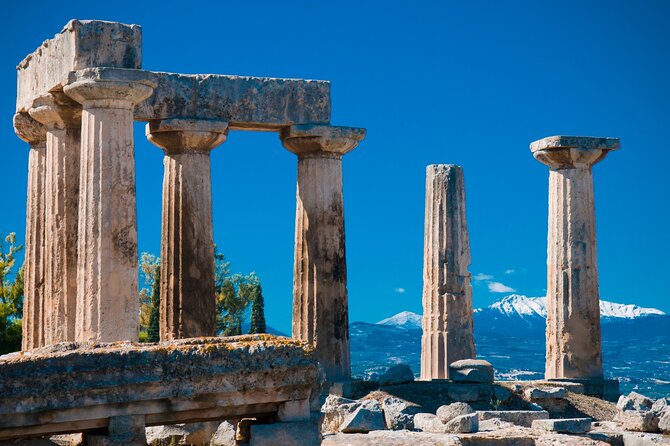
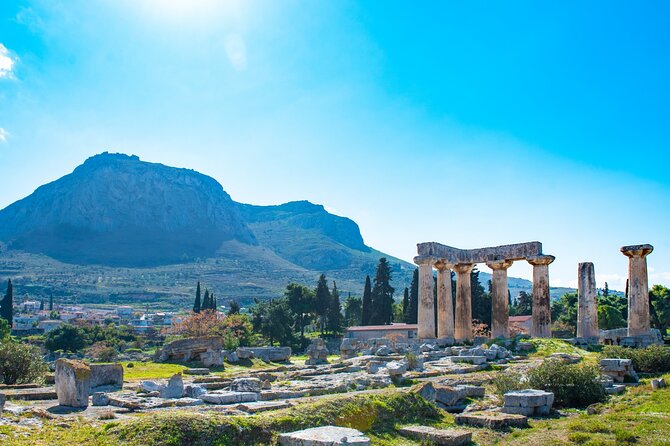
The Temple of Apollo is one of the oldest Doric temples in the Peloponnese. Its surviving columns offer a strong visual reminder of Corinth before the Roman period and before Christianity took root there.
You have about 20 minutes at the temple. The ruins are not a complete building, so a little imagination is required. Still, the columns are powerful because they show the religious setting Paul faced. Corinth was not a blank slate waiting for a new faith. It had old cults, public traditions, and a civic identity shaped by Greek and Roman life.
The schedule also lists a second 10-minute Temple of Apollo stop that describes the Bema of Paul and his encounter with Gallio. In practical terms, these two entries appear to refer to nearby parts of the same ancient Corinth visit rather than two separate temples. Confirm the exact order with your driver when you begin, especially if you want to plan your time around the forum and Bema.
The Archaeological Museum of Corinth
The Archaeological Museum gets about 45 minutes, making it one of the longer stops. That is welcome after the open-air ruins, particularly if the sun is strong. Admission is not included.
Inside, you can see objects from prehistoric times through the Roman era, including statues, pottery, and material from the Sanctuary of Asklepios. The museum helps fill in details that columns and foundations cannot show. Small objects reveal how people lived, worshipped, and used the city.
I would treat the museum as an essential companion to the ruins, not a spare stop. The ancient forum can be hard to read if you do not know what you are seeing. Museum pieces give scale and human detail to the remains outside.
The 45-minute visit is still fairly brisk. You will have time for the principal rooms and major objects, but not an unhurried examination of every display. Ask your driver which pieces connect most closely with the areas you have just seen.
Acrocorinth: the high point of the day
Acrocorinth is the fortified acropolis above ancient Corinth. The stop lasts about 40 minutes and offers broad views over the surrounding area. The site includes layers from classical Greece, the Byzantine period, Frankish rule, and the Ottoman era.
This is the tour’s most demanding stop from a walking point of view. Comfortable shoes are important, and you should bring a hat and sunscreen. The information provided does not promise a particular route or climbing distance, so ask your driver what you will see within the available time.
The high position explains why Acrocorinth mattered for centuries. A strong defensive site could watch movement around Corinth and protect the city below. You will see that the place is not only about ancient Greece. Later rulers reused and strengthened it, leaving a complicated group of fortifications.
The views can also reset the pace after the museum and forum. If you enjoy photographs, this is likely one of the best places to use the driver’s help. Several guides have been praised for taking photos and allowing people to stop without feeling hurried.
The Apostle Paul Church in modern Corinth
The final stop is Apostolos Pavlos Church, a three-aisled basilica built in 1936 on the site of an earlier church associated with Paul. You have about 20 minutes here.
This is not an ancient building from Paul’s lifetime, so it is important to set expectations. Its value is devotional and commemorative. The church shows how Corinth’s connection with Paul remains part of modern religious life.
For people taking the tour as a pilgrimage, the closing stop gives the day a natural ending. You begin with the geography that made Corinth powerful, move through the ancient city and Paul’s legal hearing, and finish at a church dedicated to his influence.
Guides, pace, and the private format
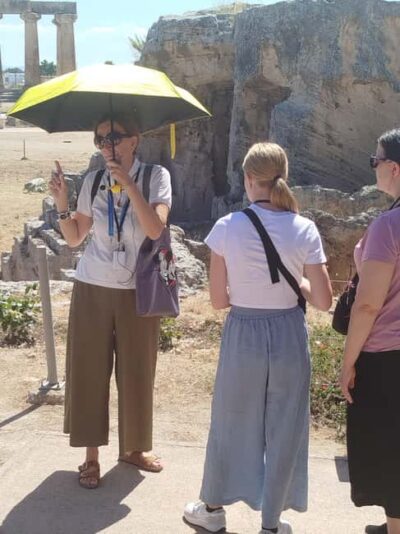
The driver-guide is central to the quality of this experience. The strongest feedback names Demetrios, Dimitrios, Makis, George, Pericles, and Demetris. Their praised qualities are consistent: clear explanations, biblical familiarity, patience, kindness, and a relaxed manner.
George’s Orthodox Christian background was especially useful to one couple who wanted to discuss scripture and history together. Dimitrios was praised for letting a couple set their own pace, offering photos, and making an extra ice cream stop. Demetrios was also noted for looking after water and other small needs.
That does not mean every driver will deliver the same presentation. The company promises an English-speaking driver-guide with extensive historical knowledge, but not a licensed guide inside the archaeological areas. If you want formal archaeological interpretation at every structure, you may prefer to arrange a separate licensed guide.
For most people, the private driver format offers a good middle ground. You receive explanations and personal attention without paying for a large private tour team. You also avoid the fixed rhythm of a big coach.
Price, admissions, and overall value
The listed price is $179.06 per person. Entrance fees are not included and are stated as €20 per person. Gratuities are also separate, and airport pickup costs extra.
At first glance, the price is not the bargain option for a short excursion. But value depends on how you use it. Private transportation from Athens, a dedicated vehicle, hotel or port pickup, bottled water, Wi-Fi, and a flexible schedule are all included. For a couple or small family, those conveniences can make the price reasonable, particularly when cruise-port timing matters.
The price is easier to justify if you value privacy and biblical context. It is less appealing if you only want to see the canal and a few ruins at the lowest possible cost. You are paying for transport, comfort, and personal attention more than for a long guided walk inside each site.
Free cancellation is available up to 24 hours before the start time. Changes made within 24 hours are not accepted, and poor weather can lead to a different date or a full refund. Most people can participate, but plan for walking on ancient surfaces and wear sturdy, comfortable footwear.
Who should book this Corinth tour?
I would recommend it to couples, families, cruise passengers, and small church groups who want Paul’s story placed in its physical setting. It is especially useful if you prefer a quiet car ride, personal questions, and the ability to linger at the Bema or take photographs.
It also suits first-time visitors who want a clear overview of Corinth in half a day. The route covers the canal, Diolkos, Kenchreai, ancient Corinth, the museum, Acrocorinth, and the modern church without asking you to organize several separate transfers.
I would think twice if you want a full-day archaeological visit, a long climb at Acrocorinth, or a licensed specialist guide at every site. The 5 to 6 hour schedule is efficient, but it leaves limited time for slow exploration. Admission costs also need to be added to the headline price.
FAQ
How long does the private Corinth tour last?
The tour lasts approximately 5 to 6 hours, including the time spent traveling between Athens and the Corinth-area stops.
Is hotel and cruise-port pickup included?
Yes. Pickup is available from designated hotels, apartments, and selected cruise ports. The driver waits outside a hotel or apartment and meets port passengers in the arrival area with a sign showing their name.
Is airport pickup included?
Airport pickup is available at an additional cost. It is not included in the standard tour price.
Are archaeological entrance fees included?
No. Entrance fees are separate, and the stated cost is €20 per person. A licensed guide to accompany you inside the archaeological sites is also not included.
What kind of vehicle is used?
Groups of one to four people use a luxury sedan. Groups of five to seven people travel in a comfortable minivan. Air conditioning, private transportation, Wi-Fi, and bottled water are included.
Can I cancel for a full refund?
You can cancel up to 24 hours before the experience start time for a full refund. Cancellations or changes made less than 24 hours in advance are not accepted for a refund. If poor weather forces the operator to cancel, you will be offered another date or a full refund.
Should you book it?
Book this tour if you want Paul’s Corinth, not simply a quick look at Greek ruins. The route gives you the canal and ancient trade setting, Paul’s port of arrival, the forum and Bema, the Temple of Apollo, the museum, Acrocorinth, and a modern church tied to his memory.
The best reason to choose it is the private, easygoing format. Drivers such as Pericles, George, Demetrios, and Dimitrios have been praised for making the day personal without making it feel hurried. Add the €20 admission fee, wear good shoes, and tell your driver which sites matter most. For a focused biblical visit from Athens or Piraeus, this is a practical and worthwhile choice.
Just added around Athens
- Traditional Greek Show in Plaka with Dinner★ 3.6 · 178 reviews
- Santorini Wine Roads Tour with Wine Tastings Morning & Sunset★ 5.0 · 106 reviews
- Private Sunset Wine Tour with 3 Wineries and Tapas★ 5.0 · 34 reviews
- Insightful Pistachio Orchard and Factory Tour★ 4.5 · 27 reviews
- Traditional Villages Full day Tour in Santorini★ 4.0 · 84 reviews
- Half Day Tour★ 5.0 · 63 reviews
- Half-Day Shared Fishing Experience in Hydra★ 5.0 · 35 reviews
- Athens Old City Private Photoshoot Tour / 2 hrs★ 5.0 · 109 reviews
Ancient Corinth Tours, compared.
Ancient Corinth Day Trip with Canal & VR Guide
Read our review →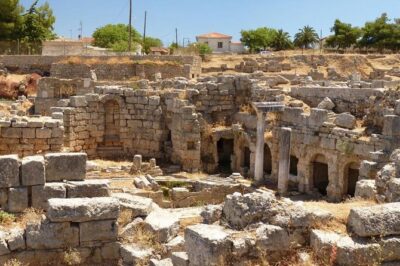
Private Biblical Tour Ancient Corinth & Isthmus Canal from Athens
Read our review →
Ancient Corinth & Nafplio Full Day Trip with Swim
Read our review →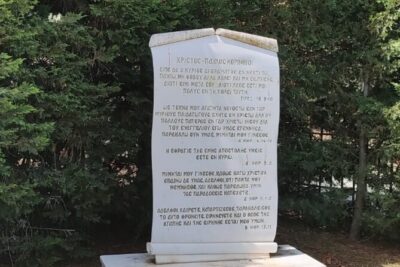
Private Tour of Apostle Paul’s Footsteps in Ancient Corinth
Read our review →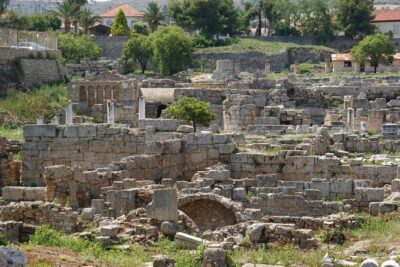
Corinth Half-Day Trip from Athens with Entrance Tickets
Read our review →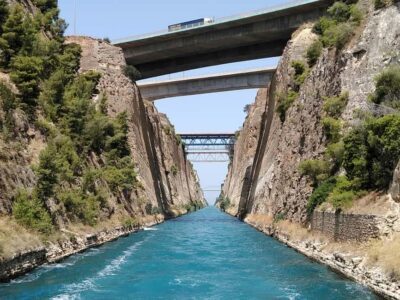
Browse the lists this tour appears in