
Reviewed · ACROPOLIS TOURS
Athens: Acropolis FULLY PRIVATE Tour with Licensed Guide
The Acropolis rewards a closer look. This private tour pairs the Parthenon and its neighboring monuments with a state-accredited archaeological guide who can explain the myths, politics, art, and daily life behind the stones. I especially like the one-to-one attention and the guide’s ability to adjust the explanation for serious history fans, families, or first-time visitors.
I also like the route’s range. You see the Theater of Dionysus, Propylaea, Temple of Athena Nike, Parthenon, Erechtheion, and Odeon of Herodes Atticus, rather than rushing straight to the famous temple. The main consideration is cost: at $163 per person, tickets extra, this makes the most sense for a small group that values private guidance.
In This Review
- Key points to know before booking
- Why a private guide changes the Acropolis visit
- Starting near Makrigianni and entering the ancient site
- The Theater of Dionysus and the origins of drama
- The old defensive walls and the climb to Propylaea
- Temple of Athena Nike and the meaning of victory
- The Parthenon, Athens’ great architectural symbol
- The Erechtheion and the contest between Athena and Poseidon
- Panoramic Athens views from the Acropolis
- Odeon of Herodes Atticus and the descent
- Optional Plaka food and neighborhood extension
- Is $163 per person good value?
- Who should book this Acropolis tour?
- Should you book it?
- FAQ
- How long does the private Acropolis tour last?
- What monuments are included?
- Is the tour private?
- Are Acropolis admission tickets included?
- Can the provider purchase skip-the-line tickets?
- Which languages are available?
- Where does the tour meet?
- Does the tour include hotel pickup?
- Is the tour suitable for wheelchair users?
- Can I cancel the booking?
Key points to know before booking
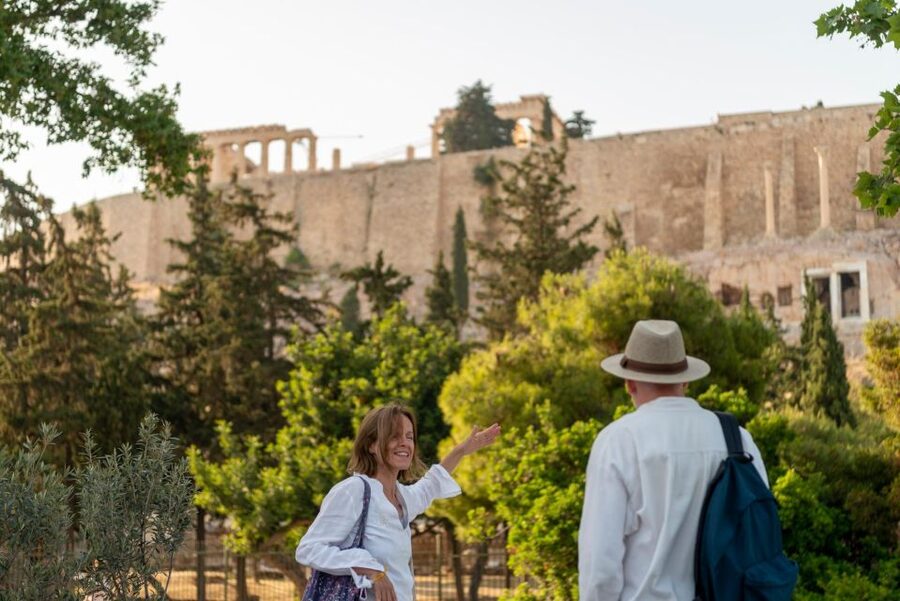
- A truly private group: Your party has its own licensed archaeological guide, rather than sharing the explanation with a large crowd.
- The Parthenon is only one part: The route also covers the Theater of Dionysus, Propylaea, Athena Nike, Erechtheion, and Odeon of Herodes Atticus.
- Golden-hour timing can be excellent: An evening start may offer softer light and memorable views, though available times can change.
- Tickets need attention: Admission is not included in the price, but skip-the-line tickets can be purchased on request after booking.
- The guide sets the pace: Past guide names include Efie, Betty, Lisa, Ava, Ria, Vicky, Kelly, and Calliopeia, with praise focused on clear explanations, warmth, and thoughtful routing.
- Expect steps and uneven ground: The Acropolis is not suitable for wheelchair users, and comfortable walking shoes are important.
Why a private guide changes the Acropolis visit
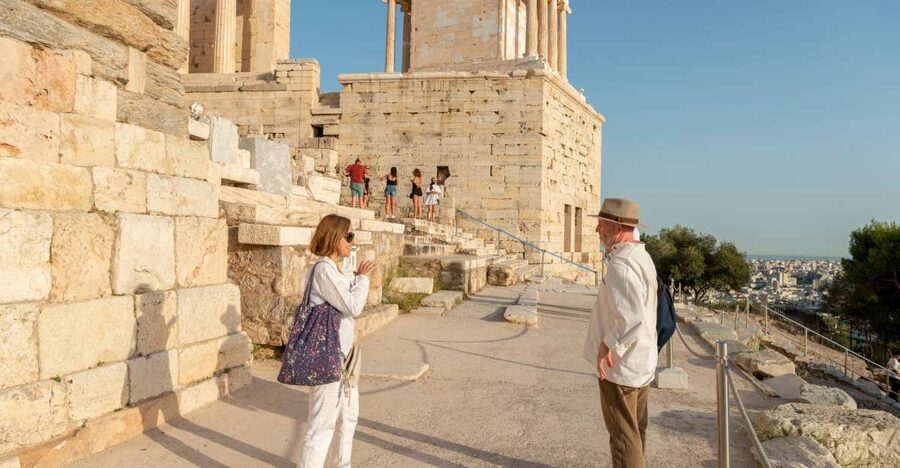
The Acropolis can feel like a pile of famous ruins if you do not have a way to connect the pieces. A private archaeological guide gives you that structure. Instead of simply pointing at the Parthenon, your guide can explain how the buildings fit into Athens’ religious life, political ambitions, theater culture, and old myths.
I like the flexibility here. A seasoned history student can ask for more detail about architecture or ancient society, while a family can focus on stories about Athena, Poseidon, and the people who worshipped them. The guide is also able to spend more time on your questions than a large group tour usually allows.
The experience lasts about 1.5 hours at its shortest, with options extending toward three hours depending on the arrangement you choose. That range matters. A compact visit works well if you have a packed Athens schedule, but the longer version gives you room to pause at the monuments and enjoy the views without feeling hurried.
The private format also helps with practical matters. A guide can point out better photo positions, help you follow the route through the site, and return you to the meeting point at the end if you want assistance with onward directions.
More ways to see the Acropolis:
- Athens: Acropolis & up to 5 Archaeological Sites Combo Pass
★ 4.4 · 12,619 reviews - Athens: Acropolis Ticket with Optional Audio or Live Guide
★ 4.2 · 11,055 reviews - Athens: Acropolis, Parthenon & Acropolis Museum Guided Tour
★ 4.8 · 9,316 reviews
Starting near Makrigianni and entering the ancient site
The meeting point is in the Makrigianni area, with listed starting options at Makrigianni 7 and Makrigianni 11. Check the exact option you book, since the meeting location can vary.
Hotel pickup is not included if your hotel is within an easy walk of the Acropolis. That is not a major drawback for many central Athens visitors, but you should allow time to reach the meeting point and confirm the precise address before setting off.
Once inside, the route brings you into a site built and rebuilt across many centuries. The Acropolis is not only a classical Greek monument complex. Its walls and structures reflect different periods, and the guide helps you notice those layers instead of treating every stone as part of one single age.
The approach includes steps and uneven surfaces. I would wear sturdy shoes, bring water, and avoid carrying anything that makes climbing awkward. The site is exposed, and the amount of walking can feel greater than the tour length suggests.
The Theater of Dionysus and the origins of drama
The Theater of Dionysus is an excellent opening stop because it gives the Acropolis a human and cultural setting. This is described as the world’s oldest theater, where some of ancient Greece’s most famous plays were first performed.
Your guide can help you picture the theater as a working place of performance rather than a silent ruin. The ancient audience came for drama, comedy, and public events, and theater was closely tied to religious festivals honoring Dionysus.
The scheduled explanation here is about 15 minutes. That is enough for a useful introduction, though the stop will naturally feel brief if you are fascinated by Greek drama. The private setup gives you a chance to ask for more context without holding up a large group.
This is also a good place to understand why the Acropolis was more than a temple platform. Religion, public ceremony, art, and civic identity all met here.
The old defensive walls and the climb to Propylaea
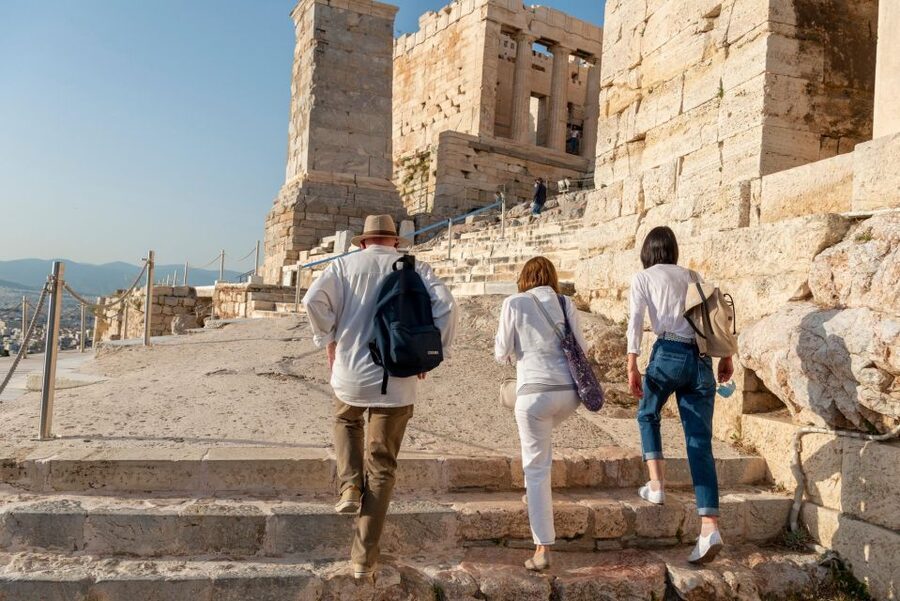
As you continue upward, the guide points out defensive walls that are about five meters thick. Their importance is that they were not built by the classical Greeks, but by ancestors from an earlier period, roughly another thousand years before the classical age.
That detail helps correct a common mistake. Athens did not begin with the Parthenon. The hill had meaning and strategic value long before the buildings most people recognize today.
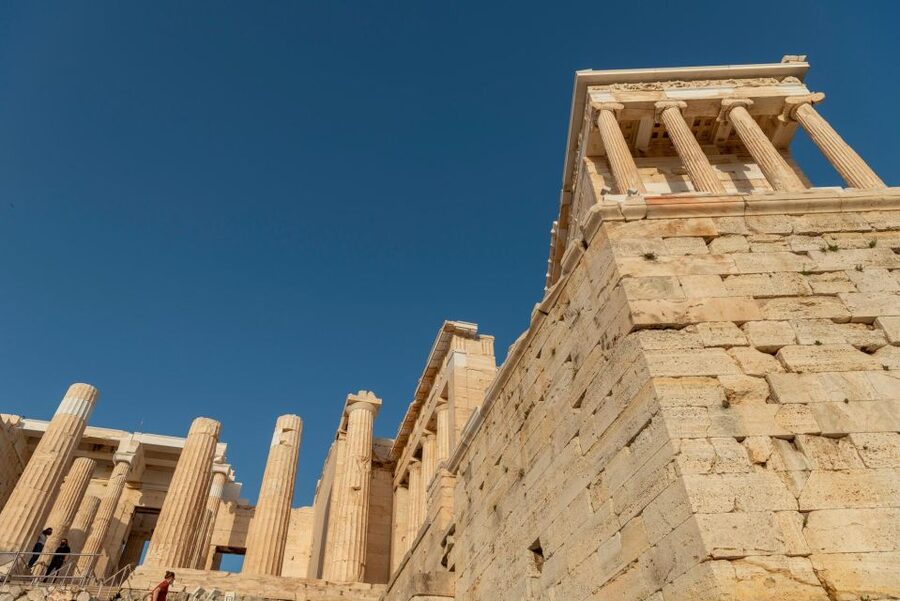
The Propylaea forms the monumental entrance to the upper Acropolis. It was designed to make arrival feel grand, and the climb gives you a sense of moving from the city below into a sacred precinct.
The supplied description includes a striking story about the huge statue of Athena that once stood near the entrance. Its bronze spear tip was said to catch the sunlight, making it visible from far away. The tale connects the Acropolis to sailors leaving Cape Sounion, about 70 kilometers away, for trade and war in the Mediterranean.
That is the sort of detail I value from a guide. It links architecture to how the hill was seen by people moving across the wider region, not just by tourists standing beneath it today.
A few more Athens half-days to weigh up
- Athens: Cape Sounion & Poseidon Temple Sunset Half-Day Trip
★ 4.8 · 8,241 reviews - Athens: Acropolis and Parthenon Guided Walking Tour
★ 4.6 · 5,882 reviews - All Day Cruise -3 Islands to Agistri,Moni, Aegina with lunch and drinks included
★ 5.0 · 4,958 reviews - Athens, Piraeus, and Coastline: Blue Hop-On Hop-Off Bus
★ 3.9 · 4,849 reviews
Temple of Athena Nike and the meaning of victory
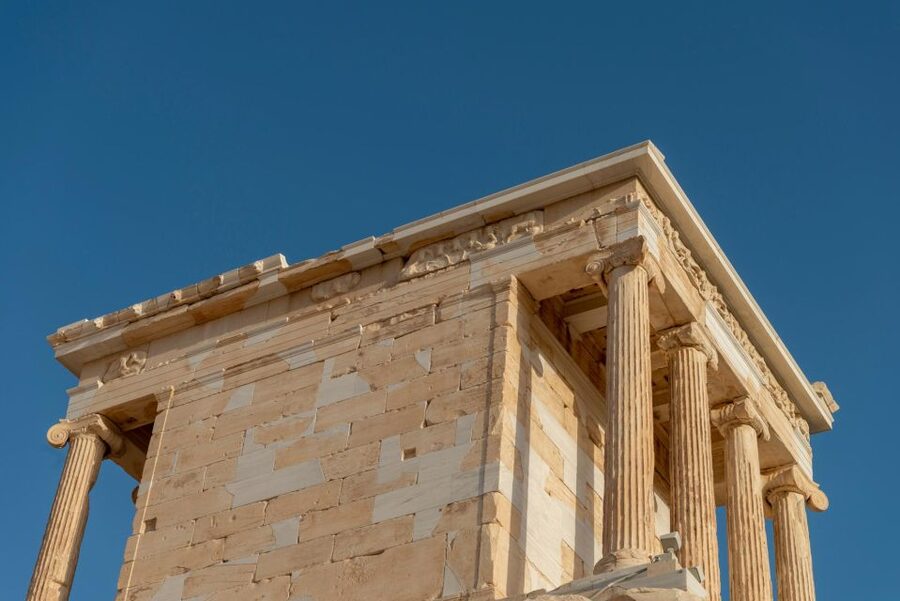
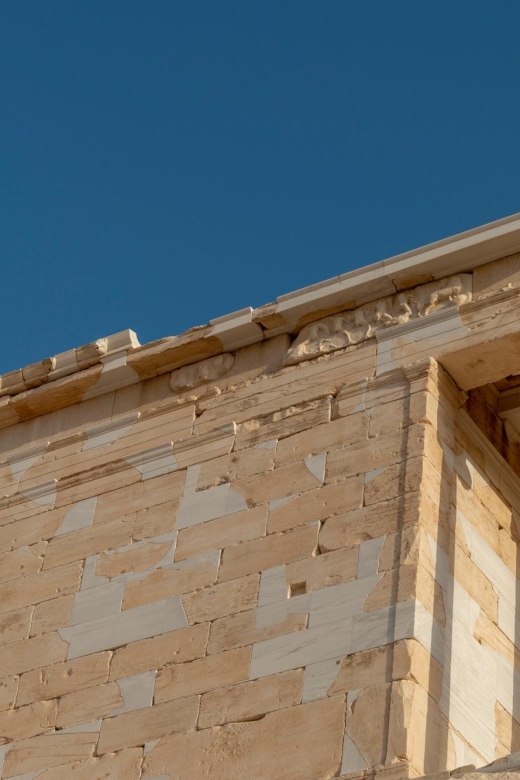
Near the entrance is the Temple of Athena Nike, a smaller monument with a very specific purpose. Athena appears here as Nike, the goddess of victory.
A good guide can explain how the temple’s position and name reflect the hopes Athenians placed in their patron goddess. This is a brief stop, listed at about 15 minutes, but it adds meaning to the entrance route.
You may find this monument harder to appreciate at first than the Parthenon because it is smaller and more tightly placed within the complex. That is exactly why guidance helps. The temple is not competing with the Parthenon in size. Its importance comes from its role and setting.
The Parthenon, Athens’ great architectural symbol
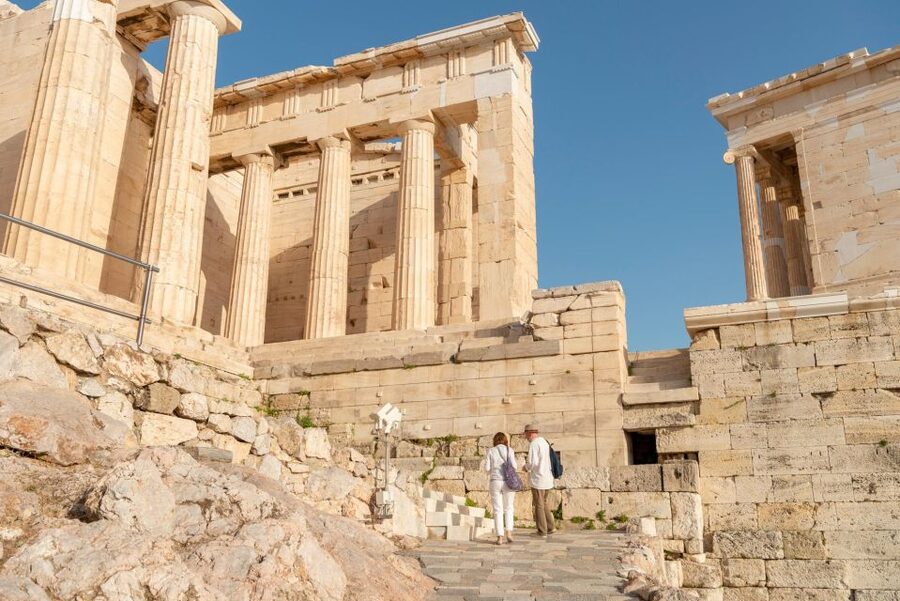
The Parthenon receives the most attention, and rightly so. It is a masterpiece of classical Greek architecture, but its fame can make it difficult to see clearly. You are likely to arrive expecting one perfect temple and instead find a building under conservation, with missing sculptures and years of damage behind it.
That is where the licensed guide earns the fee. The explanation can turn the Parthenon from a famous silhouette into a building with design choices, religious purpose, and political meaning.
Your guide can discuss the temple as a home for Athena and as a public statement about Athens. The surrounding views also matter. From the hill, you see the city stretching below, giving you a sense of the Acropolis’ commanding position.
I would not judge the stop only by how close you get to the columns. The best part is often understanding how the temple was meant to be approached and seen as part of the whole hill.
A 15-minute listed segment may sound short for such an important monument. In practice, the full Acropolis portion is longer, and the private format lets you ask questions along the way. If you want a very slow architectural study, confirm that the longer tour option is available.
The Erechtheion and the contest between Athena and Poseidon
The Erechtheion is one of the most memorable buildings on the Acropolis because its design is less uniform than the Parthenon. It is linked to several sacred traditions, including the contest between Athena and Poseidon for control of Athens.
The story says that Poseidon offered a gift connected with water, while Athena gave the city the olive tree. The myth explains why Athena became Athens’ patron, and it also gives the olive tree a place in the identity of the region.
The Erechtheion’s unusual shape reflects the fact that several sacred areas had to be included within one complex. Your guide can help you see this as a place with several layers of worship, not simply another temple.
This is one of the stops where a private guide is especially useful. The myth is easy to remember, but the site’s architectural details and religious connections are harder to grasp without help.
Panoramic Athens views from the Acropolis
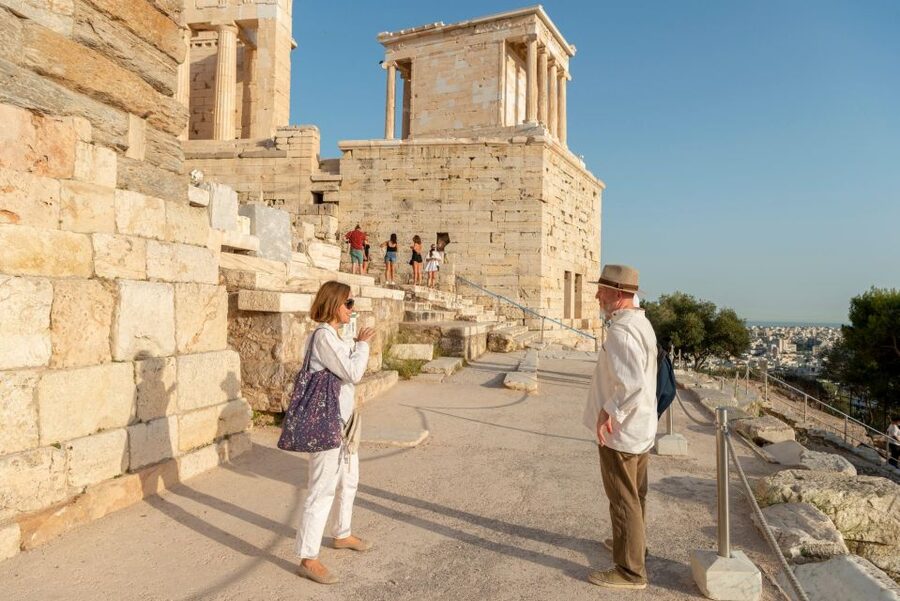
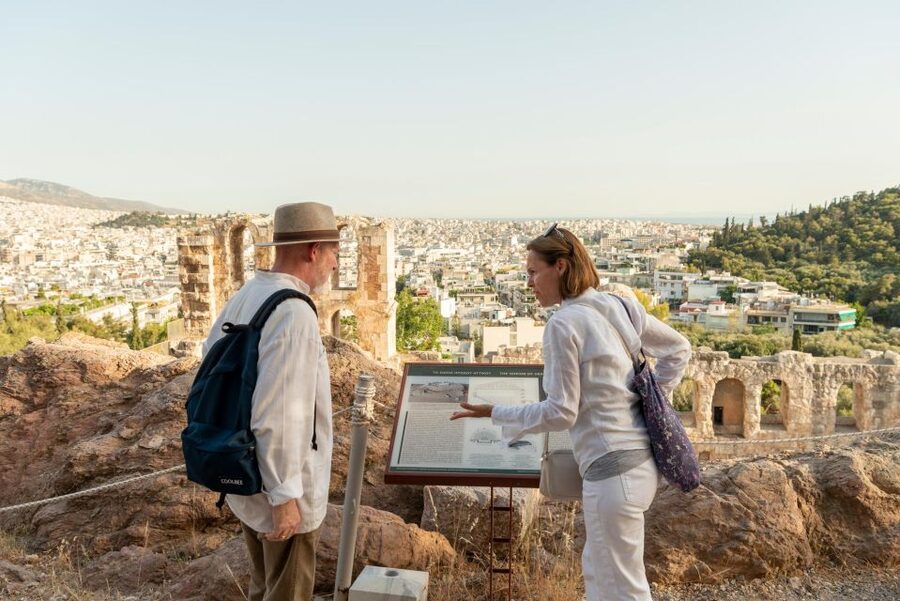
The views from the summit are not a bonus tacked onto the tour. They are part of understanding why this hill mattered.
Below you, Athens spreads in every direction. The guide can use the outlook to connect the Acropolis with the surrounding city and the wider ancient world. The view also gives you a needed pause after the climb.
Timing can shape this part of the experience. One booking at golden hour produced especially striking light, and late-day visits may be appealing if you want softer photographs. Availability is not guaranteed, and the starting time can be changed when options are limited, so do not build an inflexible dinner reservation immediately afterward.
The private setup makes the viewpoint more pleasant. You can ask the guide to pause for photographs or spend a little longer discussing what you can see. You should still expect other people around you, since this is one of Athens’ most visited sites.
Odeon of Herodes Atticus and the descent
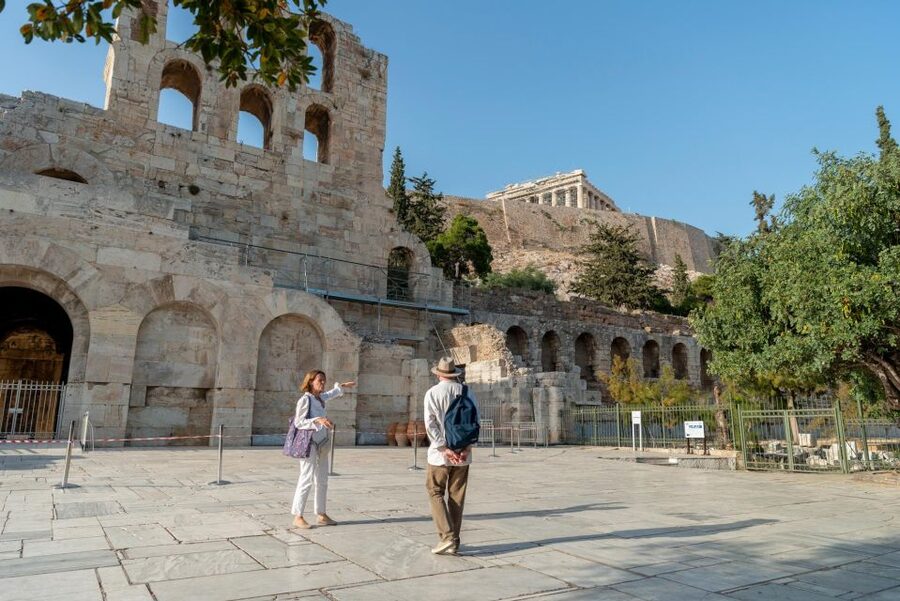
The route descends through olive trees toward the Odeon of Herodes Atticus. This ancient theater is still used for performances each summer, which makes it easier to imagine the Acropolis as a living cultural place rather than a finished archaeological display.
The theater’s continued use is a useful contrast with the damaged monuments above. Some ancient spaces survive as ruins, while others still serve their original broad purpose as venues for performance.
The descent may feel easier than the climb, but uneven ground remains part of the route. Your guide can return you to the meeting point, or you can remain nearby and continue enjoying the views.
Some options finish in Plaka. That is useful if you want to continue your afternoon on foot rather than return directly to your starting point.
Optional Plaka food and neighborhood extension
The tour offers flexible options to add private guiding at another site or explore Plaka. The neighborhood option can include Greek coffee or mountain tea, souvlaki, traditional savory pies, and sweet or cake delicacies.
This extension changes the character of the experience. The Acropolis portion is focused on monuments and ancient culture, while Plaka adds a more everyday Athens setting. I like the food stops because they give the history a practical follow-up: after studying ancient civic and religious life, you get a taste of how Athens is experienced today.
The available information does not specify the extra duration or exact food venues, so confirm those details before booking. If you only want the archaeological site, choose the shorter private tour. If you have more time and want help with a neighborhood introduction, the Plaka option may offer better value than arranging another activity separately.
Is $163 per person good value?
At $163 per person, this is not a budget Acropolis visit. Admission fees are not included, so the final cost rises if you ask the provider to purchase skip-the-line tickets.
The value depends heavily on group size. For one or two people, the price is a serious splurge. For a family or small group, the total cost of a private guide can compare more favorably with several separate admissions and a large shared tour, especially if you care about asking questions and setting the pace.
The guide quality is the main reason to consider it. The tour uses state-accredited licensed archaeological guides, and the named guides praised in the supplied feedback include Efie, Betty, Lisa, Ava, Ria, Vicky, Kelly, and Calliopeia. The strongest themes are clear teaching, enthusiasm for Greek culture, kindness, and careful movement through the site.
One guide was especially praised for finding ways to avoid crowds, choosing good photo spots, and reducing unnecessary hills. That does not remove the Acropolis’ steps, but thoughtful routing can make the visit less tiring.
The tour also carries a 4.9 rating from 54 reviews, which supports the idea that the private guiding is the product’s strongest feature. Still, I would confirm the ticket arrangement and meeting point before paying, since both affect the practical value.
Who should book this Acropolis tour?
I would choose this tour if you want the Acropolis explained rather than simply photographed. It suits first-time visitors, families, couples, small groups, and history fans who want a real conversation with an expert.
It is also a good choice if you have limited time in Athens. The route covers the major monuments in a focused visit, and the guide can help you avoid wandering without context.
You should think twice if you are traveling on a tight budget, dislike walking uphill, or need step-free access. The tour is not suitable for wheelchair users, and the site has steps and uneven surfaces.
For the best chance of a relaxed visit, bring your admission ticket or arrange skip-the-line tickets after booking, wear practical shoes, and leave room in your schedule in case the starting time changes.
Should you book it?
Book this private Acropolis tour if personal attention, strong storytelling, and a flexible pace matter more to you than finding the lowest price. The combination of the Parthenon, Theater of Dionysus, Propylaea, Athena Nike, Erechtheion, and Odeon gives you a fuller visit than a quick photo stop.
I would especially recommend it for a small group that can share the cost and for anyone who wants the myths and architecture explained in plain terms. Skip it if you only need admission and a short look around. In that case, the extra fee for a private licensed guide may not fit your priorities.
FAQ
How long does the private Acropolis tour last?
The tour lasts between 1.5 and 3 hours, depending on the option selected and available starting time.
What monuments are included?
The route includes the Acropolis, Theater of Dionysus, Propylaea, Temple of Athena Nike, Parthenon, Erechtheion, and Odeon of Herodes Atticus.
Is the tour private?
Yes. The tour is exclusive to your group and includes a licensed expert archaeological guide.
Are Acropolis admission tickets included?
No. Ticket and admission costs are not included in the listed price.
Can the provider purchase skip-the-line tickets?
Yes. You can ask the provider by message after booking to purchase skip-the-line tickets for you.
Which languages are available?
Live guiding is available in English, German, and Italian.
Where does the tour meet?
The meeting point depends on the option booked. Listed meeting locations include Makrigianni 7 and Makrigianni 11.
Does the tour include hotel pickup?
Hotel pickup and drop-off are not included if your hotel is within an easy walking distance of the Acropolis.
Is the tour suitable for wheelchair users?
No. The Acropolis has steps and uneven surfaces, and the tour is not suitable for wheelchair users.
Can I cancel the booking?
You can cancel up to 24 hours before the tour for a full refund. A reserve-now, pay-later option is also available.
Just added around Athens
- Delphi One Day Trip from Athens★ 4.0 · 98 reviews
- Mercedes Private Tour to Delphi and Arachova★ 5.0 · 30 reviews
- Private Delphi and Hosios Loukas Monastery – Great Lunch and Drinks Included★ 5.0 · 36 reviews
- Day tour to Ancient Olympia,Ancient Sparta Mycenae Including Meal★ 5.0 · 54 reviews
- Athens: Half Day Trip To Cape Sounio/Poseidon Temple Semi Private★ 5.0 · 131 reviews
- From Athens: Day Tour to Mykonos★ 5.0 · 64 reviews
- Culinary Secrets of Downtown Athens★ 5.0 · 103 reviews
- Athens Half-Day Private Tour Acropolis, Parthenon City Highlights★ 5.0 · 35 reviews
Acropolis Tours, compared.
Acropolis & up to 5 Archaeological Sites Combo Pass
Read our review →

Acropolis, Parthenon & Acropolis Museum Guided Tour
Read our review →
Acropolis, Parthenon & Acropolis Museum Guided Tour
Read our review →

Acropolis: Acropolis and Parthenon Guided Walking Tour
Read our review →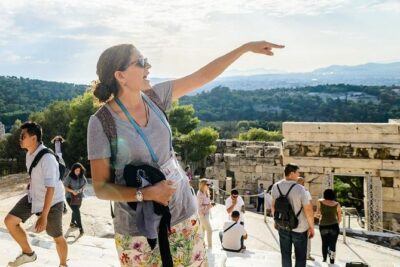
Acropolis monuments & Parthenon Walking Tour with Optional Acropolis Museum
Read our review →Browse the lists this tour appears in