
Reviewed · ACROPOLIS TOURS
Athens: Guided Tour of Acropolis and Parthenon Tickets Included
Ancient stones tell better stories with a guide. This roughly two-hour walk takes you through the Acropolis, Parthenon, Propylaea, Erechtheion, and lesser-visited northern temples with pre-reserved admission and a local guide. I like the choice of departure times, which helps you fit the Acropolis into a busy Athens day, and I like that the tour uses headsets so you can hear explanations even when the site is crowded. The main caution is the steep, uneven climb and strict timed entry.
The tour costs $119.47 per person and is offered in English. That is not a bargain entry ticket, but it includes the Acropolis admission, a small-group walk, and a guide who explains what you are looking at instead of leaving you alone among a pile of impressive marble. The group can include up to 20 people, so small-group means more personal than a large coach tour, not private.
The strongest praise goes to guides such as Frosso, Victoria, and Dora, who were described as warm, clear, well paced, and careful about keeping the group together. Still, this is a scheduled shared tour. Arrive 10 minutes early, because tickets are timed and can expire within 5 to 10 minutes. A late taxi or bus is not a harmless delay here.
In This Review
- Key points to know before booking
- Meeting at Makrigianni 7
- Climbing the Acropolis for about 90 minutes
- The Propylaea makes a grand first impression
- The Parthenon remains the main event
- The Erechtheion brings myth into the stones
- Northern temples offer a quieter pause
- Choose your finish: more views or the south route
- What the guides add to the visit
- Crowds, heat, and hearing the commentary
- Is $119.47 a fair price?
- Who should book this Acropolis walk?
- Should you book it?
- FAQ
- How long does the Acropolis and Parthenon tour last?
- What is included in the price?
- Is the Acropolis Museum included?
- Where does the tour meet?
- How early should I arrive?
- Can I join if I arrive late?
- Is the tour suitable for people with limited mobility?
- Can I stay at the Acropolis after the guided tour?
Key points to know before booking

- Timed entry saves time, but not always every queue: High-season visitors may still wait in the designated queue for skip-the-line ticket holders.
- The climb is real: You need moderate fitness, sturdy shoes, and confidence on steep, uneven surfaces.
- The Parthenon is only part of the visit: You also see the Propylaea, Erechtheion, northern temples, and areas near the Theater of Dionysus.
- Guides are the main value: Frosso, Victoria, Dora, and other guides received praise for clear explanations, good pacing, and helpful stops in shade.
- The Acropolis Museum is not included: You can visit it separately, and some guides may offer practical help with planning that extra visit.
- You may continue after the guided portion: You can stay on the Acropolis independently for views, or follow a route toward the south exit.
Meeting at Makrigianni 7
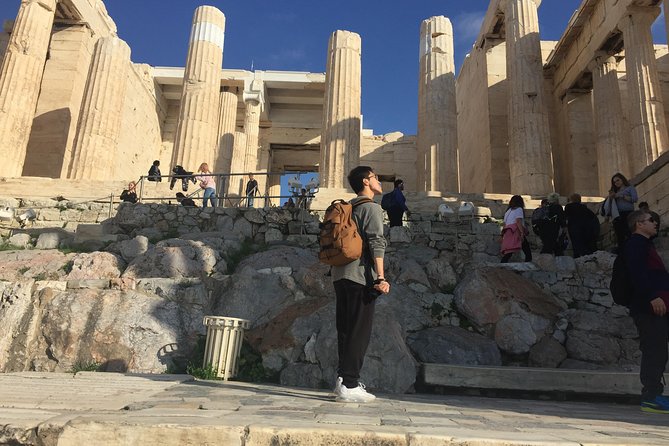
The tour begins at Makrigianni 7, Athina 117 42, close to public transportation and near the Acropolis area. You are expected to arrive at least 10 minutes before your scheduled start. This is not polite advice from the tour office. It is essential.
Your ticket is tied to a particular entry time. The tour operator says tickets can expire within 5 to 10 minutes, and the group cannot wait for late arrivals without risking the admission of everyone else. No-shows and late arrivals are not refunded.
That hard rule has caused frustration when taxis, traffic, or buses ran late. I understand the irritation, but the warning is clear: build in extra time and walk to the meeting point if that is practical. Do not plan to arrive exactly at the start time.
More ways to see the Acropolis:
- Athens: Acropolis & up to 5 Archaeological Sites Combo Pass
★ 4.4 · 12,619 reviews - Athens: Acropolis Ticket with Optional Audio or Live Guide
★ 4.2 · 11,055 reviews - Athens: Acropolis, Parthenon & Acropolis Museum Guided Tour
★ 4.8 · 9,316 reviews
Climbing the Acropolis for about 90 minutes
The first part of the visit covers the Acropolis site itself. You walk uphill through one of the most important ancient religious centers in the world, stopping at monuments while the guide explains their purpose, myths, construction, and place in Athenian life.
The hill requires a moderate level of fitness. The route includes climbing, uneven ground, and limited shade. Several guides made a point of stopping in shaded areas, which matters greatly on hot days, but shade cannot be guaranteed across the whole site. One rating specifically noted that the experience would be far harder in 40-degree weather than in more comfortable conditions.
Wear sturdy shoes. Bring only what you need. The site can be crowded, and keeping track of bags, phones, and wallets takes attention. Pickpocketing can occur around major European attractions, so keep valuables secure in a zipped pocket or close-fitting bag.
The tour is not designed for children under six, and baby strollers of any kind are not permitted inside the Acropolis. If someone in your party has knee problems or finds hills difficult, take the physical demands seriously. The supplied information states that there is no elevator access, so do not count on an easier mechanical route to the top.
The Propylaea makes a grand first impression
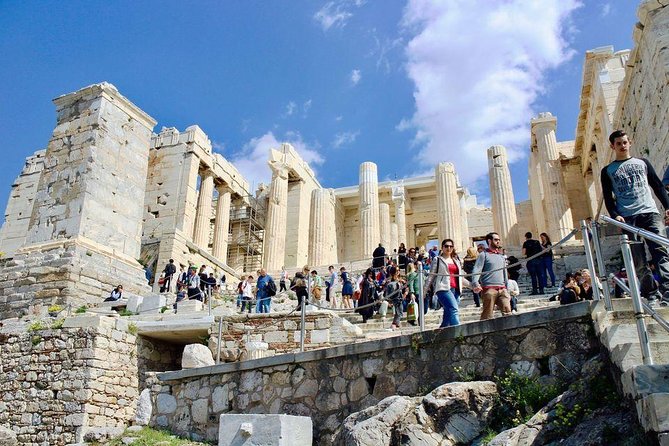
The Propylaea is the monumental gateway to the Acropolis. It was built to create a ceremonial entrance, and its marble columns gave ancient visitors a strong sense that they were entering a sacred and powerful place.
This is an excellent early stop for a guide-led tour because the structure can otherwise seem like a grand but incomplete doorway. Your guide connects its design to religious processions, ritual movement, and the public image of Athens. The entrance was not merely practical. It helped frame the Acropolis as a place of ceremony and civic pride.
Crowds can gather here, and several groups may be moving through the same route. A good guide chooses a place where you can hear and then points out the details once the group has room to move. Headsets are used on the tour, and that is a welcome feature when other guides and visitors are nearby.
The Parthenon remains the main event
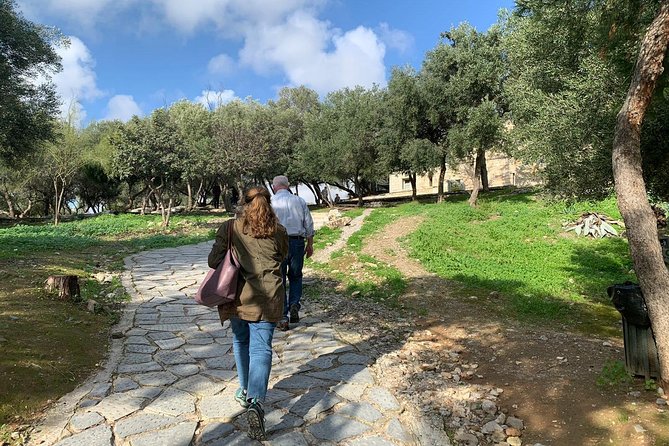
The Parthenon receives about 30 minutes of the guided visit, although its importance continues through the rest of the walk. Dedicated to Athena, the city’s patron goddess, it reflects the ambition of Athens at the height of its power.
The useful part of the explanation is not just learning the temple’s name and date. You hear how it was designed, how it functioned, and why it became linked with Athenian democracy, political power, and artistic achievement. The guide helps you look at columns, proportions, sculpture, and restoration work with more purpose.
You will not have the Parthenon to yourself. The site is one of Europe’s most visited ancient monuments, and crowds can make it difficult to stand in the ideal spot or hear every sentence. One guide was praised for answering many questions, while another made the route easier by choosing shady places to speak. Even so, you may need to concentrate when several groups are gathered nearby.
The tour is especially useful for a first visit. Without context, the Parthenon can become a famous outline against the sky. With a strong guide, you begin to understand the religious, civic, and artistic ideas packed into the building.
A few more Athens half-days to weigh up
- Athens: Cape Sounion & Poseidon Temple Sunset Half-Day Trip
★ 4.8 · 8,241 reviews - Athens: Acropolis and Parthenon Guided Walking Tour
★ 4.6 · 5,882 reviews - All Day Cruise -3 Islands to Agistri,Moni, Aegina with lunch and drinks included
★ 5.0 · 4,958 reviews - Athens, Piraeus, and Coastline: Blue Hop-On Hop-Off Bus
★ 3.9 · 4,849 reviews
The Erechtheion brings myth into the stones
The Erechtheion has a different character from the Parthenon. Its design is more complex, and its religious associations are tied to both Athena and Poseidon.
The guide explains the famous contest between the two gods, along with the temple’s role in Athenian worship. This is where mythology and architecture meet in a direct way. You are not simply looking at another ruined temple. You are learning why particular gods mattered to the city and why this unusual building held such an important place on the Acropolis.
The marble craftsmanship is one of the highlights. The distinctive columns and carefully shaped details reward a slower look, though the crowd may limit how long you can stand in one position. Keep your group in sight, especially around narrow or busy sections.
Northern temples offer a quieter pause
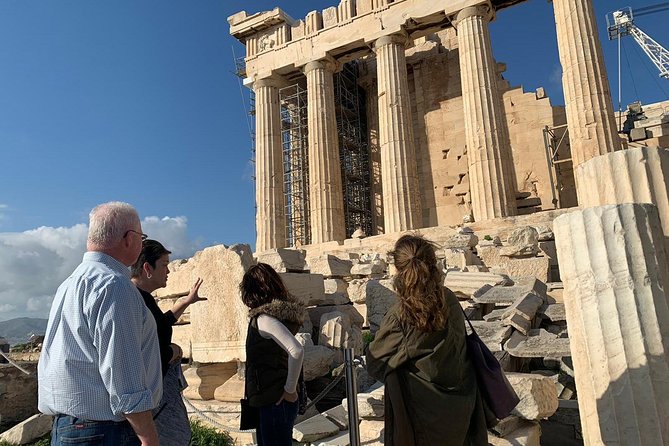
The northern side includes lesser-visited temples and sanctuaries that are easy to overlook when everyone is focused on the Parthenon. This portion adds useful depth because it shows the Acropolis as a working religious center, not just the home of one celebrated temple.
Here, the guide discusses early Athenian cults and worship connected with the Olympian gods. The setting can feel calmer than the main monuments, giving you a chance to pause and consider how many layers of religious life occupied this hill.
This quieter section is one of the better reasons to choose a guided walk instead of simply following the largest crowd. You still need to stay with the group, but the route gives you a broader view of the site and its sacred spaces.
Choose your finish: more views or the south route
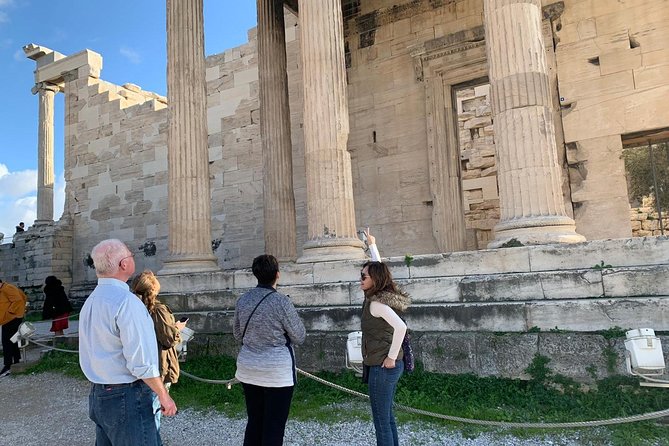
After the guided section, you may remain on the Acropolis and continue looking around on your own. This is valuable because the views are a major part of the experience. From the hill, you can look across Athens and, on a clear day, toward the Aegean Sea.
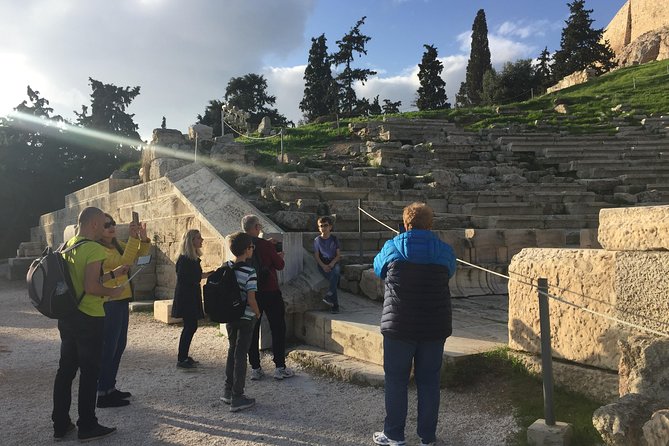
You can also follow the guide along a different route toward the south exit. This route passes the Sanctuary of Asclepius and the Theater of Dionysus, often associated with the birth of theatrical drama.
The choice affects how you use the rest of your day. If you want photographs, extra time with the ruins, or a slower look at the city views, staying on the hill makes sense. If you want the historical route to continue, the south exit adds two worthwhile sites before the experience ends.
The listed duration is about two hours. In practice, the exact amount of guided time can be affected by queues, toilet lines, crowd movement, and group pace. One experience lost about 20 minutes while the group waited for facilities, and another group was asked to return its headsets before continuing toward the museum. You may still be allowed to explore independently, but the guided commentary will not continue.
What the guides add to the visit
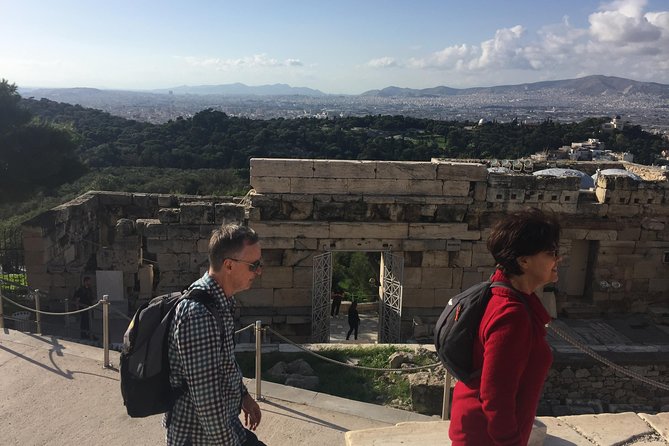
The guides are the heart of this experience. The most praised qualities are clear history, friendly manner, calm pacing, and the ability to answer questions without turning the tour into a lecture marathon.
Frosso was singled out for being extremely informed, personable, and careful to keep the group together. Victoria was praised for a calm and thoughtful approach, along with thorough explanations. Dora was noted for sharing useful history, pointing out good photo spots, and allowing needed breaks during the uphill walk.
Those details matter. A guide who chooses shade, checks the pace, and makes sure people can hear can change the whole experience. Several ratings described the tours as easy to understand and well paced, with just the right amount of information.
The group size can reach 20 people. That is manageable, but it does not guarantee that the guide will be beside you at every moment. In crowded areas, stay alert, keep the guide in sight, and use the headset properly. If your parents or companions walk slowly, a private or slower-paced tour may be a better fit than this shared departure.
Crowds, heat, and hearing the commentary
Skip-the-line admission is useful, but it does not mean walking directly through every entrance with no waiting. During high season, pre-reserved ticket holders may still queue in their own line. The benefit is better planning and less uncertainty, not a magic doorway.
Crowds are part of the Acropolis experience. At some points, several tour groups may occupy the same viewing area. This can make it hard to see the feature being discussed, and even with headsets, you need to stay attentive.
Heat adds another challenge. There is not much shade on the hill. Choose a cooler departure time if the available options suit your schedule, carry water as permitted, and avoid bringing an unnecessary heavy bag. The tour company offers departure choices, but the supplied details do not identify which time is best in every season.
Is $119.47 a fair price?
At $119.47 per person, this is a premium way to see the Acropolis. The price includes the admission ticket, a small-group guided walk, an English-speaking local guide, and headsets. It does not include transportation or entry to the Acropolis Museum.
The value depends on what you want. If you only need access to the site and prefer reading signs or using your own guidebook, the package may feel expensive. If this is your first visit and you want the buildings explained in real time, the guide can make the cost worthwhile.
I especially see value in the pre-reserved, timed admission. Athens can be hot, crowded, and busy with tour groups. Having the ticket arranged and a clear meeting plan reduces some of the day’s friction. The strongest value comes when your guide is as good as Frosso, Victoria, or Dora, and when you use the explanations to understand the site rather than simply taking a quick photograph.
The museum is a separate expense and a separate visit. Read the booking details carefully so you do not assume it is part of this tour. One person found the price disappointing for that reason, but the tour is described as an Acropolis visit only.
Who should book this Acropolis walk?
I would choose this tour for a first-time visitor who wants the main monuments explained by a local guide and prefers a planned entry over arranging every detail alone. It also suits someone with limited time in Athens who wants to cover the Acropolis in about two hours and then move on to the museum or another part of the city.
You should be comfortable walking uphill and standing on uneven ground. This is not a good match for someone with serious knee trouble, very limited mobility, or a need for a flexible schedule.
Families with children under six need another option, and strollers cannot enter the site. Older adults can enjoy the tour, but a private format may be wiser if they need frequent pauses or a slower pace.
Arrive early, wear good shoes, secure your valuables, and bring realistic expectations about crowds. Those simple steps address the main problems that can spoil an otherwise excellent visit.
Should you book it?
Book this tour if you want history with your ruins, a timed ticket, and a guide who can make the Acropolis easier to understand. The 4.4 average from 163 ratings reflects a strong experience with some clear limits: crowds, heat, a demanding climb, and strict late-arrival rules.
Skip it if you want a cheap ticket, a museum visit included, or complete freedom to arrive whenever you please. For most first-time visitors who can manage the hill, the guide and organized entry make the $119.47 price reasonable, especially when the departure time fits your Athens plans.
FAQ
How long does the Acropolis and Parthenon tour last?
The guided experience lasts approximately two hours. About 90 minutes is allocated to the Acropolis visit, with about 30 minutes focused on the Parthenon.
What is included in the price?
The price includes pre-reserved admission to the Acropolis, a small-group tour, an expert local guide, headsets, and the approximately two-hour guided experience.
Is the Acropolis Museum included?
No. The Acropolis Museum is not included in this tour. You can plan a separate museum visit.
Where does the tour meet?
The meeting point is Makrigianni 7, Athina 117 42, Greece. The area is near public transportation.
How early should I arrive?
Arrive at least 10 minutes before the scheduled start time. The tour departs punctually because Acropolis tickets are timed and may expire within 5 to 10 minutes.
Can I join if I arrive late?
Late arrival may mean you cannot join the tour. The tour operator does not wait for late participants, and missed tours are not refunded.
Is the tour suitable for people with limited mobility?
The tour requires moderate physical fitness and includes uphill walking and uneven surfaces. Baby strollers are not permitted, and the supplied information states that there is no elevator access.
Can I stay at the Acropolis after the guided tour?
Yes. You may remain on the Acropolis and explore independently, enjoy the views, or follow the guide along a route toward the south exit past the Sanctuary of Asclepius and Theater of Dionysus.
Just added around Athens
- Delphi One Day Trip from Athens★ 4.0 · 98 reviews
- Mercedes Private Tour to Delphi and Arachova★ 5.0 · 30 reviews
- Private Delphi and Hosios Loukas Monastery – Great Lunch and Drinks Included★ 5.0 · 36 reviews
- Day tour to Ancient Olympia,Ancient Sparta Mycenae Including Meal★ 5.0 · 54 reviews
- Athens: Half Day Trip To Cape Sounio/Poseidon Temple Semi Private★ 5.0 · 131 reviews
- Athens Half-Day Private Tour Acropolis, Parthenon City Highlights★ 5.0 · 35 reviews
- From Athens: Day Tour to Mykonos★ 5.0 · 64 reviews
- Culinary Secrets of Downtown Athens★ 5.0 · 103 reviews
Acropolis Tours, compared.
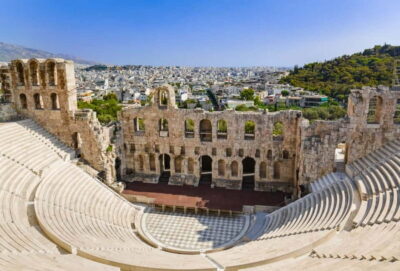
Acropolis & up to 5 Archaeological Sites Combo Pass
Read our review →

Acropolis, Parthenon & Acropolis Museum Guided Tour
Read our review →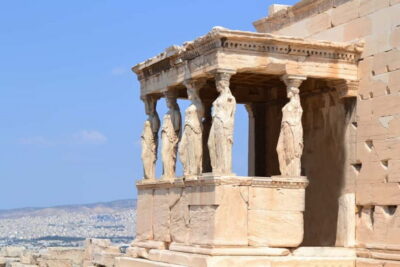
Acropolis, Parthenon & Acropolis Museum Guided Tour
Read our review →

Acropolis: Acropolis and Parthenon Guided Walking Tour
Read our review →
Acropolis monuments & Parthenon Walking Tour with Optional Acropolis Museum
Read our review →Browse the lists this tour appears in