
Reviewed · MUSEUMS
Athens: National Archaeological Museum Private Guided Tour
Ancient Greece comes alive inside these halls. This private two-hour tour gives you a clear route through Greece’s largest archaeological museum, with a licensed guide explaining the objects instead of leaving you to decode labels on your own. I especially like the focus on major works and the chance to see the Antikythera mechanism, often described as the world’s oldest analogue computer.
I also like the private format, which lets the guide adjust the pace and answer your questions. Christos Theodoropoulos receives repeated praise for making the collection lively, explaining Greek history in simple terms, and keeping children and adults involved. The main drawback is time: two hours is enough for an excellent introduction, but not enough to see all 11,000-plus exhibits.
In This Review
- Key points to know before you book
- Why this museum deserves two hours of your Athens time
- Meeting the guide at 44 Patission Street
- What the two-hour route can realistically cover
- Prehistoric Greece, Cycladic figures, and Mycenaean gold
- Sculpture from the seventh to fifth centuries BC
- Vases and smaller objects that reveal daily life
- The Antikythera mechanism and the Bronze Collection
- Egyptian and Near Eastern antiquities
- Why Christos makes a difference
- Is $400 good value for your group?
- Who should book this private museum visit?
- Practical advice for making the most of the visit
- Should you book the Athens National Archaeological Museum tour?
- FAQ
- Where does the National Archaeological Museum tour meet?
- How long does the guided tour last?
- Is the museum entry ticket included?
- Is hotel transfer included?
- How much does the private tour cost?
- Which languages are available?
- Who guides the tour?
- Can I cancel for a full refund?
- Can I reserve now and pay later?
Key points to know before you book

- The Antikythera mechanism is a major highlight: You will see an ancient device built with remarkable mechanical skill, linked to astronomy and the measurement of celestial cycles.
- Christos Theodoropoulos leads the experience: His tours are praised for clear explanations, humor, flexible pacing, and strong command of Greek history.
- Two hours means highlights, not the whole museum: The museum covers thousands of years and eight thousand square meters of galleries, so plan to continue on your own if you want more.
- The private group price favors small groups: At $400 for up to six people, the per-person cost becomes more reasonable as your group fills.
- Museum admission costs extra: The entry ticket is listed at €10 per person, and hotel transfer is not included.
- The meeting point is at the main entrance: Meet at the steps of the National Archaeological Museum, 44 Patission Street, 10682 Athens.
Why this museum deserves two hours of your Athens time
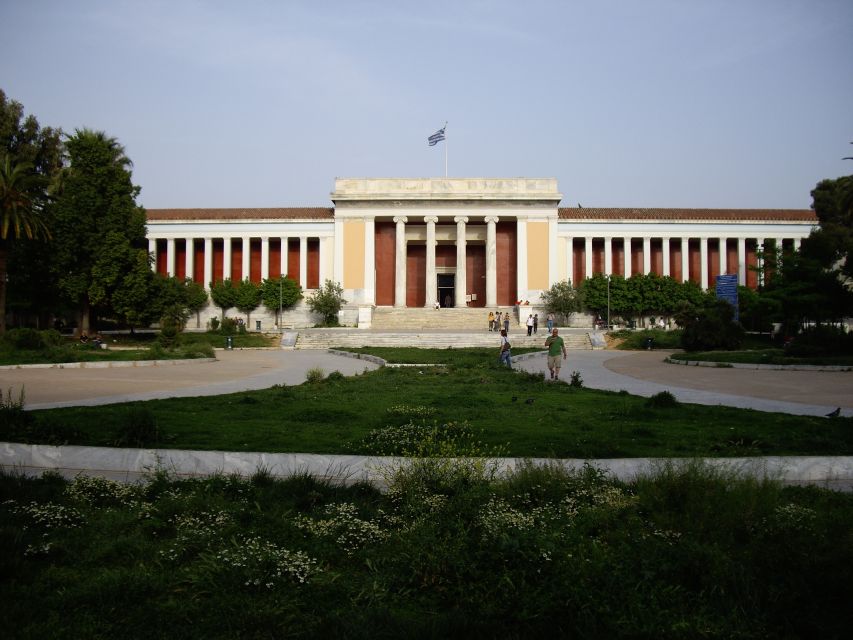
The National Archaeological Museum is not simply another stop filled with statues. It is the main storehouse of ancient Greek art, with objects gathered from excavations in Athens and across Greece. The collection reaches from prehistoric communities to late antiquity, giving you a long view of how art, religion, technology, trade, and daily life changed over time.
That range is both the museum’s strength and its challenge. You can walk from Neolithic objects to Cycladic figures, Mycenaean gold, classical sculpture, Roman-era pieces, and Egyptian antiquities without leaving the building. Without a plan, the scale can feel intimidating.
A guide gives the collection a human shape. Instead of treating every room as equally important, Christos can point you toward the pieces that best explain a period or idea. His role is not just to identify objects. It is to connect them, so you understand why a small bronze figure, painted vase, or carved statue matters.
I would treat this tour as an orientation to one of Athens’ most important museums. You get the main story first, then you can return to favorite galleries after the official tour ends.
More Museums in Athens
- Athens: Acropolis, Parthenon & Acropolis Museum Guided Tour
★ 4.8 · 9,316 reviews - Athens: Mythology of Delphi, Museum and Arachova Guided Tour
★ 4.6 · 4,008 reviews - Athens: Acropolis, Parthenon & Acropolis Museum Guided Tour
★ 4.8 · 3,579 reviews
Meeting the guide at 44 Patission Street
The advertised meeting point is on the steps in front of the main entrance at the National Archaeological Museum, 44 Patission Street, postal code 10682. The activity information also gives 28is Oktovriou 42 as a starting location, so check the exact confirmation details before setting out. Both addresses refer to the museum area, but clear meeting instructions matter in central Athens.
There is no hotel transfer. You are responsible for reaching the museum and buying your own admission ticket. The entrance fee is listed as €10 per person, separate from the guide fee.
Once inside, the guide can help you get oriented. That matters here because the building is large, the galleries extend across multiple areas, and the collection spans thousands of years. You will spend less time wondering where to go and more time looking at the objects.
The tour is offered in English, Turkish, German, and Greek. It is a private group experience, with the listed price covering up to six people. One published account describes a group of seven, but the stated capacity is six, so you should confirm the price and group limit if your party is larger.
What the two-hour route can realistically cover
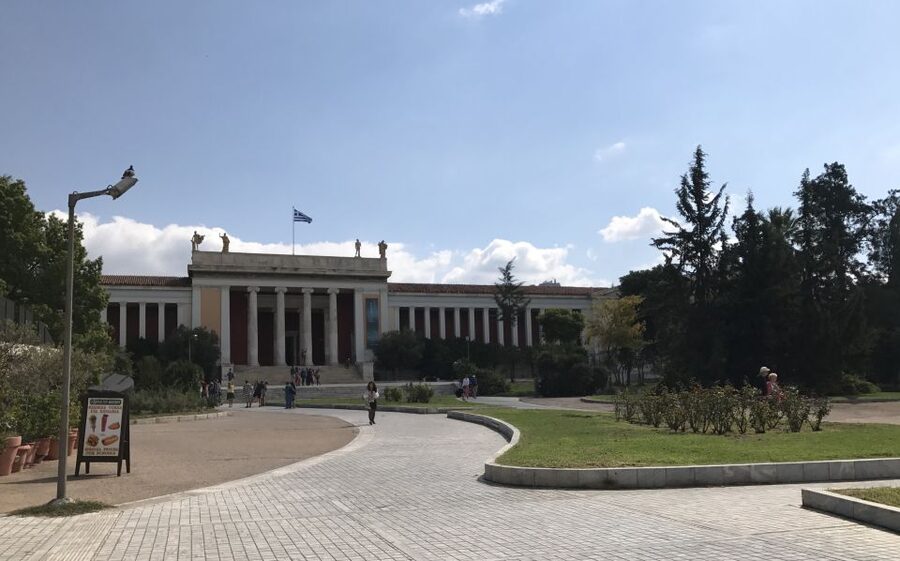
Two hours sounds generous until you consider the size of the museum. The collection includes more than 11,000 exhibits and about 8,000 square meters of exhibition space. A good guide therefore has to make choices.
Expect the route to focus on major collections and famous objects rather than every room. You will receive a broad lesson in Greek civilization, then stop for closer explanations of important works. The exact sequence can vary, which is useful in a private tour because the guide may respond to your interests and the group’s pace.
The tour’s quick rhythm is worth understanding. One parent described the pace as brisk because there was so much to see, while still finding the visit engaging for two children. That is a fair description of the trade-off. You get more coverage, but you may not have long stretches for quiet, unhurried viewing.
If you want to examine every vase or read every label, two hours will feel short. If you want a strong introduction before exploring independently, two hours works well. I would leave extra time after the guided portion if your schedule allows.
Prehistoric Greece, Cycladic figures, and Mycenaean gold
The Collection of Prehistoric Antiquities reaches from the sixth millennium BC to about 1050 BC. It includes Neolithic, Cycladic, and Mycenaean material, along with finds from the prehistoric settlement at Thera.
These objects help set the stage for later Greek art. You can see how early communities made pottery, shaped figures, worked precious materials, and expressed beliefs long before the classical period most people picture when they hear ancient Greece.
This is one place where a guide adds real value. It is easy to look at a small abstract Cycladic figure and move on. With context, you can consider its shape, purpose, and place within Aegean culture. Mycenaean objects also make more sense when they are presented as part of a wider prehistoric world rather than as isolated displays.
The museum’s prehistoric collection is especially useful for correcting the usual Athens shortcut. Greek civilization did not begin with the familiar fifth-century BC statues and temples. The story reaches much farther back, and these galleries show the foundations.
More museums and sites in Athens:
- Acropolis monuments & Parthenon Walking Tour with Optional Acropolis Museum
★ 5.0 · 2,678 reviews - Athens All Included: Acropolis and Museum Guided Tour with Ticket
★ 4.5 · 2,673 reviews - Athens: Acropolis Museum Ticket with optional Audio Guide
★ 4.4 · 2,652 reviews - From Athens: Small-Group Delphi, Museum & Arachova Day Trip
★ 4.8 · 2,476 reviews
Sculpture from the seventh to fifth centuries BC
The Sculpture Collection follows the development of ancient Greek sculpture from the seventh to the fifth centuries BC. This is the section many visitors anticipate, but it rewards slow looking.
The period includes major changes in how artists represented the human body. A guide can help you notice the movement from more formal, rigid figures toward greater attention to anatomy, balance, expression, and motion. Instead of seeing a row of marble figures, you begin to see an argument about how people understood the human form.
The point of a guided visit is not to turn the museum into a lecture hall. The best moments come when the guide gives you just enough background to make your own observations. Christos is frequently praised for explaining difficult subjects in accessible language and for using humor to keep the pace from becoming dry.
If sculpture is your main interest, tell the guide early. The private format makes that request more practical than it would be on a large group tour. You may still need to move on, but the guide can give more attention to the works that matter most to you.
Vases and smaller objects that reveal daily life
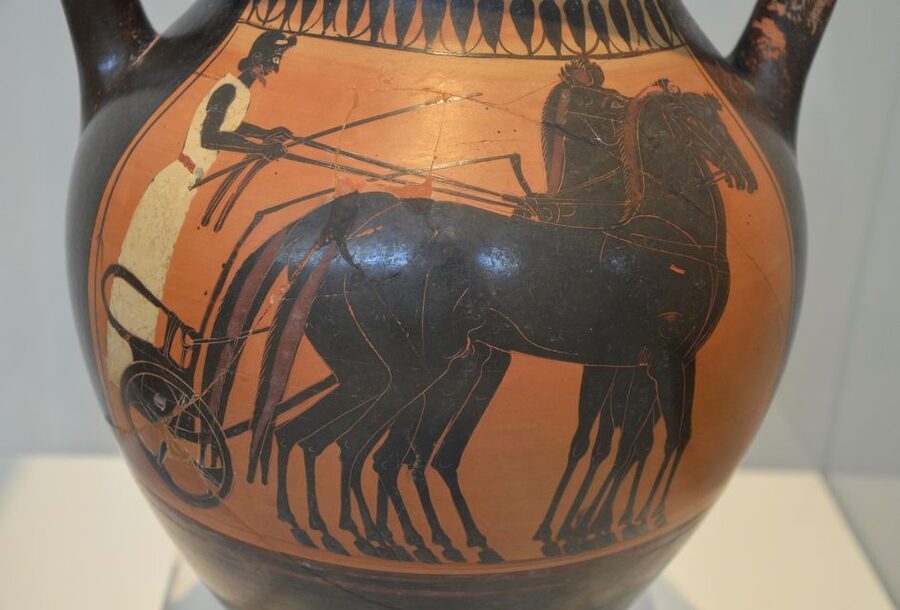
The Vase and Minor Objects Collection covers Greek pottery from the eleventh century BC through the Roman period. It also includes the Stathatos Collection, a group of smaller objects from different eras.
Large statues tend to get the attention, but the smaller pieces often bring ancient life closer. Vases can show scenes of work, ritual, sport, family life, warfare, and myth. Minor objects can reveal the skills and habits that monumental sculpture leaves out.
A guide helps you read these displays. The painting on a vessel is not decoration alone. Its figures, gestures, clothing, and setting can offer clues about the values and stories of the society that made it.
This section also shows why you should not judge the museum only by its famous masterpieces. A two-hour visit may not allow a long stop at every case, but the overview helps you decide where to return. If painted pottery interests you, ask for a little more time here.
The Antikythera mechanism and the Bronze Collection
The Antikythera mechanism is the headline object for many visitors. It is an ancient mechanical device associated with astronomical calculations and often called the world’s oldest analogue computer.
Its importance is easy to underestimate when you first see it. It is not a giant machine or a dramatic monument. Its power lies in the precision of its gears and in what it suggests about ancient scientific and technical skill. This is exactly the sort of object that benefits from explanation, since the physical remains alone do not tell the whole story.
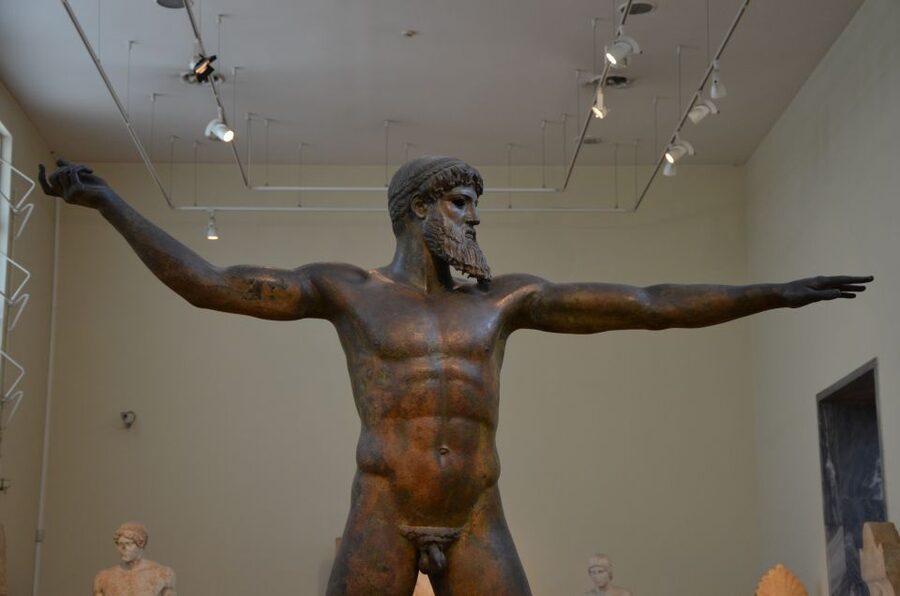
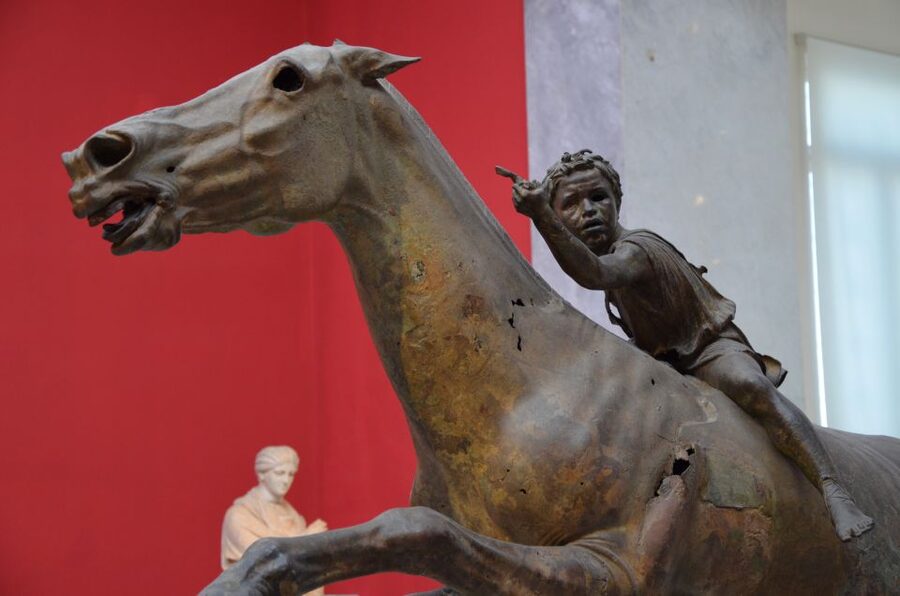
The Bronze Collection includes statues, figurines, and smaller objects. Bronze work has a different look and feel from marble, and the collection gives you another way to understand ancient craftsmanship.
Ask the guide to compare bronze and stone when you are in this area. The question can open up useful discussion about technique, materials, preservation, and the kinds of objects that survive from antiquity. You will get more from the display when you look beyond the famous name and consider how the object was made.
Egyptian and Near Eastern antiquities
The museum also houses Greece’s only Egyptian and Near Eastern Antiquities Collection. The objects range from the predynastic period, around 5000 BC, to the Roman conquest.
This collection broadens the museum’s story. Ancient Greece did not develop in isolation, and the Egyptian and Near Eastern material gives you a wider setting for the Aegean world. It also prevents the visit from becoming a narrow march through classical Greek sculpture.
The collection is useful for visitors who want to compare cultures and periods. It may be especially appealing if your group includes people with different interests. One person can focus on Greek sculpture while another finds more to enjoy in the Egyptian galleries.
Because the tour lasts only two hours, you should not expect every collection to receive equal time. Still, a good guide can give you a map of the museum’s full scope and point out what deserves a return visit.
Why Christos makes a difference
The strongest praise attached to this experience centers on Christos Theodoropoulos. His explanations are described as detailed but easy to follow, and several accounts praise his ability to make a potentially dry museum visit feel lively.
He is also credited with answering questions, adjusting the schedule, and showing flexibility with afternoon timing. For families, that matters. Children and teenagers rarely want a long academic speech, but they can stay engaged when the guide keeps the story moving and connects objects to larger ideas.
One particularly useful example involves a visitor with a professional interest in ancient jewelry. Christos arranged access to a jewelry room that was usually locked at that time of year. You should not treat this as a guaranteed part of every tour, but it shows the benefit of telling the guide about a serious interest before you arrive.
Another account describes the guide continuing to show parts of the upper floor after the official time had ended. Again, you should not assume extra time is promised. The practical lesson is simpler: ask questions, explain your interests, and use the private setting well.
The guide’s strength is not just factual detail. It is the ability to choose what matters most when the museum gives you far too many choices.
Is $400 good value for your group?
The listed price is $400 per private group of up to six people. Museum admission is extra at €10 per person, and transport is not included.
For one or two people, the guide fee is a serious expense. For six, it works out to about $67 per person before admission, which is easier to justify for a two-hour private tour in one of Europe’s major archaeological museums.
The value depends on what you want. If you enjoy reading labels and setting your own route, the museum is laid out clearly enough to visit without a guide. One published experience specifically notes that a guide was helpful but not essential.
If you feel overwhelmed by large museums, want a crash course in Greek history, or have limited time in Athens, the cost buys structure and personal attention. It can also be worthwhile for families, since the guide can keep younger members involved instead of leaving adults to manage both sightseeing and explanations.
The price makes the most sense when you fill the group. A party of friends or a family of five or six gets much better value than a solo visitor. If you are traveling alone, compare the private cost with a group tour or self-guided visit.
Who should book this private museum visit?
I would recommend it most strongly to first-time visitors who want context quickly. The museum can be intimidating, and a good introduction helps you understand what you are seeing rather than simply collecting photographs.
It also suits families with older children and teenagers. The guide’s reported ability to use humor and maintain a quick pace can make ancient art more approachable. Still, anyone who prefers long, quiet examination of individual objects may find the pace too fast.
Art and archaeology enthusiasts should consider sharing their interests in advance. The jewelry example shows that a private guide may be able to shape the visit around a specialist subject, though special access is not guaranteed.
This is less suitable if your Athens schedule allows only a rushed two-hour window including transport. The tour itself lasts two hours, and you still need to reach the museum, purchase admission, and possibly spend extra time afterward.
Practical advice for making the most of the visit
Arrive at the main entrance steps with enough time to find the meeting point. The information gives both 44 Patission Street and 28is Oktovriou 42, so check your booking confirmation for the precise address.
Wear comfortable shoes. The museum is large, and even a highlights tour involves steady movement between galleries. You may want to continue exploring once the guide leaves, especially if you only see the main collections during the official time.
Tell Christos what interests you before the tour starts. Mention ancient jewelry, sculpture, pottery, prehistoric Greece, Egyptian objects, or the Antikythera mechanism. A private tour gives you a better chance of shaping the visit than a fixed large-group outing.
Do not expect to see everything. The best approach is to let the guide give you the main framework, then return to the sections that caught your attention. Two hours can make the museum manageable, but it cannot make a vast national collection small.
Free cancellation is available up to 24 hours before the activity for a full refund, and you can reserve now and pay later. Those terms are useful if your Athens plans are still shifting, but the key decision remains the same: are you paying for facts alone, or for a clear route and a personal conversation?
Should you book the Athens National Archaeological Museum tour?
Book it if you want a strong introduction to ancient Greek art, prefer a private guide, or are traveling with a group large enough to share the $400 fee. Christos Theodoropoulos appears especially well suited to families, first-time museum visitors, and anyone who wants history explained in plain language.
Skip it if you are happy to explore independently, want to linger at a small number of objects, or are traveling alone on a tight budget. The museum is well labeled and understandable without a guide.
For most small groups, the best plan is to use the two hours to get your bearings, see the Antikythera mechanism and major collections, then continue on your own if time permits. That combination gives you both the human explanation and the freedom to look at the museum at your own speed.
FAQ
Where does the National Archaeological Museum tour meet?
The meeting point is at the steps in front of the main entrance of the National Archaeological Museum, 44 Patission Street, 10682 Athens. The activity information also lists 28is Oktovriou 42, so check your confirmation for the exact meeting details.
How long does the guided tour last?
The guided tour lasts two hours.
Is the museum entry ticket included?
No. The museum admission ticket is not included. The listed price is €10 per person.
Is hotel transfer included?
No. Hotel transfer is not included, so you must make your own way to the museum.
How much does the private tour cost?
The price is $400 per private group of up to six people. Museum admission costs extra.
Which languages are available?
The live guide is available in Turkish, English, German, and Greek.
Who guides the tour?
The experience provider is Christos Theodoropoulos, an experienced licensed archaeologist guide.
Can I cancel for a full refund?
Yes. You can cancel up to 24 hours in advance for a full refund.
Can I reserve now and pay later?
Yes. The activity allows you to reserve your place and pay later, which keeps your plans flexible.
Just added around Athens
- Delphi One Day Trip from Athens★ 4.0 · 98 reviews
- Private Delphi and Hosios Loukas Monastery – Great Lunch and Drinks Included★ 5.0 · 36 reviews
- Mercedes Private Tour to Delphi and Arachova★ 5.0 · 30 reviews
- Day tour to Ancient Olympia,Ancient Sparta Mycenae Including Meal★ 5.0 · 54 reviews
- Athens: Half Day Trip To Cape Sounio/Poseidon Temple Semi Private★ 5.0 · 131 reviews
- Athens Half-Day Private Tour Acropolis, Parthenon City Highlights★ 5.0 · 35 reviews
- From Athens: Day Tour to Mykonos★ 5.0 · 64 reviews
- Culinary Secrets of Downtown Athens★ 5.0 · 103 reviews
Museums, compared.
Acropolis, Parthenon & Acropolis Museum Guided Tour
Read our review →
Mythology of Delphi, Museum and Arachova Guided Tour
Read our review →Acropolis, Parthenon & Acropolis Museum Guided Tour
Read our review →
Acropolis monuments & Parthenon Walking Tour with Optional Acropolis Museum
Read our review →
Athens All Included: Acropolis and Museum Guided Tour with Ticket
Read our review →
Acropolis Museum Ticket with optional Audio Guide
Read our review →
Small-Group Delphi, Museum & Arachova Day Trip
Read our review →
Parthenon & Acropolis Museum with Audio or Live Tour Option
Read our review →Browse the lists this tour appears in