

Reviewed · MUSEUMS
Athens: National Archaeological Museum Ticket & Audio Guide
Ancient Greece waits indoors. This National Archaeological Museum ticket combines pre-booked entry with a phone-based audio guide, letting you move through thousands of years of Greek art at your own pace. I like the easy digital access and the guide’s focus on major pieces such as the Mask of Agamemnon, the bronze Zeus or Poseidon, and the Mycenaean Bull. The main drawback is that the audio route skips some rooms and can be confusing to follow.
I also like that the audio content works offline and can be replayed before or after your visit. That makes the $31 price reasonable if you want context without joining a group. Still, you must bring your own charged smartphone and headphones, and the regular ticket may not be the best deal if you qualify for free or reduced-price admission.
In This Review
- Key points to know before entering
- Why the National Archaeological Museum deserves your time
- Getting inside with the digital ticket
- The Mycenaean rooms and the Mask of Agamemnon
- Bronze statues that still feel alive
- Marble sculpture, pottery, jewelry, and everyday life
- Roman and Hellenistic works add another layer
- How the smartphone audio guide works
- Planning your visit around the time you have
- What $31 buys you
- Who will enjoy this experience most
- The drawbacks to keep in mind
- Should you book the National Archaeological Museum audio guide?
- FAQ
- How long does the National Archaeological Museum experience last?
- Is the ticket a regular admission ticket?
- Is there a live guide?
- Which languages are available for the audio guide?
- Do I need my own smartphone and headphones?
- Can I use the audio guide offline?
- Can I use the audio guide more than once?
- Are pets allowed inside?
Key points to know before entering

- The bronze galleries are a major highlight: Look for the powerful statues of Zeus or Poseidon and the famous Horse Rider.
- The Mycenaean collection gives the museum its drama: Gold, silver, and bronze objects bring the Bronze Age to life.
- The audio guide covers highlights, not every room: Plan on roughly 90 minutes for the suggested route, or stay two to four hours and explore beyond it.
- Pre-booking can save time at the ticket booth: You still pass through security, but the ticket lets you proceed to entry afterward.
- The museum cafe is worth a pause: It opens onto an inner courtyard with greenery and artwork.
- Bring the right equipment: You need a charged Android or iPhone, compatible device, and headphones.
Why the National Archaeological Museum deserves your time
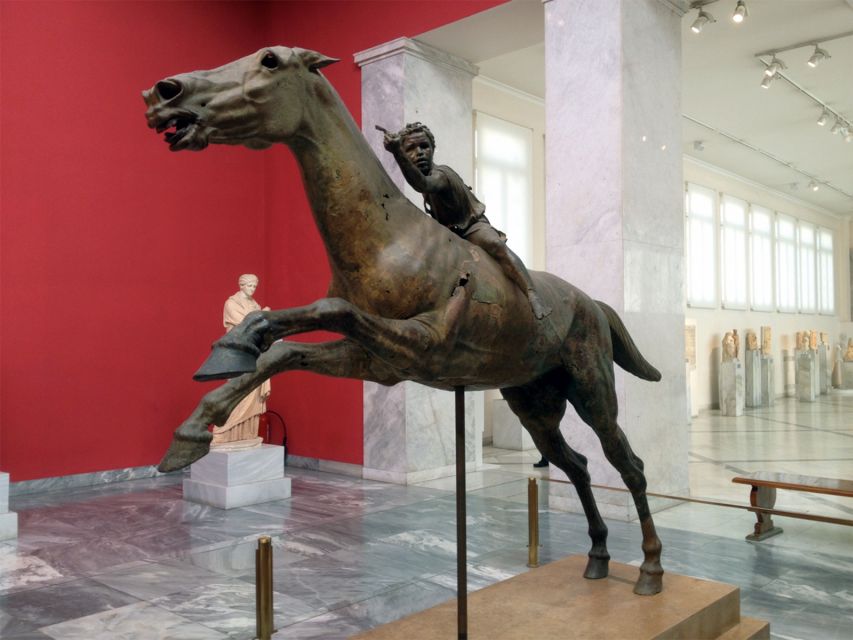
Athens has famous ruins under the open sky, but this museum gives you the objects themselves. Here you can see gold burial goods, marble sculpture, pottery, tools, jewelry, and bronze statues gathered from across Greece.
The collection follows broad periods of Greek history, from early prehistoric cultures through the Classical and Hellenistic eras, with Roman material as well. That range is the museum’s great strength. You are not seeing one temple or one archaeological site. You are watching ideas in art and society change across centuries.
The museum can also feel like a lot. The building is large, and the route is not always easy to follow. Some rooms may seem out of order if you are not already familiar with Greek archaeology. The audio guide helps by pointing you toward selected objects, but it does not explain every display.
I would allow at least two hours for a first visit. If you enjoy sculpture, mythology, or ancient societies, three or four hours can pass quickly. If your schedule is tight, the 45-minute option gives you a brisk introduction, though it will leave much unseen.
More Museums in Athens
- Athens: Acropolis, Parthenon & Acropolis Museum Guided Tour
★ 4.8 · 9,316 reviews - Athens: Mythology of Delphi, Museum and Arachova Guided Tour
★ 4.6 · 4,008 reviews - Athens: Acropolis, Parthenon & Acropolis Museum Guided Tour
★ 4.8 · 3,579 reviews
Getting inside with the digital ticket
Your entry ticket arrives by email, along with instructions for downloading the audio guide. You use the ticket at the museum rather than waiting to buy a regular admission ticket at the booth.
Pre-booking matters most during busy periods. The queue outside can look long, although part of it may be the security check rather than the ticket line. With a ticket already in hand, you can pass security and continue inside without first stopping at the sales counter.
That does not mean instant entry under every condition. You still need to follow the museum’s security process, and possible bag checks can slow things down. One useful practical detail is that photos are allowed, but bags may need to be checked at the entrance.
Meeting arrangements can vary by the option you select, so read the email carefully before leaving for the museum. Download the ticket and audio content in advance rather than trying to sort it out at the door.
The included ticket is the regular admission ticket for all ages. If you are entitled to free or reduced-price entry, go directly to the museum ticket booth instead. Paying $31 for a regular ticket may not make sense in that case.
The Mycenaean rooms and the Mask of Agamemnon

Start with the Mycenaean displays if you want the strongest opening. This section includes elaborate metalwork from the Bronze Age, with gold, silver, and bronze objects that show the wealth and skill of early Greek societies.
The Mask of Agamemnon is the best-known piece in this area. Its fame can make it feel almost overhyped, but seeing the gold mask in person is still a memorable moment. The audio guide gives it a story and historical setting, helping you look beyond the famous name.
The Mycenaean Bull is another piece singled out by the audio route. It is the kind of object that benefits from explanation because a short label cannot always tell you how it fits into ancient beliefs, craft, and daily life.
This part of the museum works well for first-time visitors because the objects are visually striking. It also helps establish a useful theme for the rest of the visit: ancient Greek culture was not limited to white marble statues. Metalwork, painted pottery, jewelry, and practical tools matter just as much.
Bronze statues that still feel alive
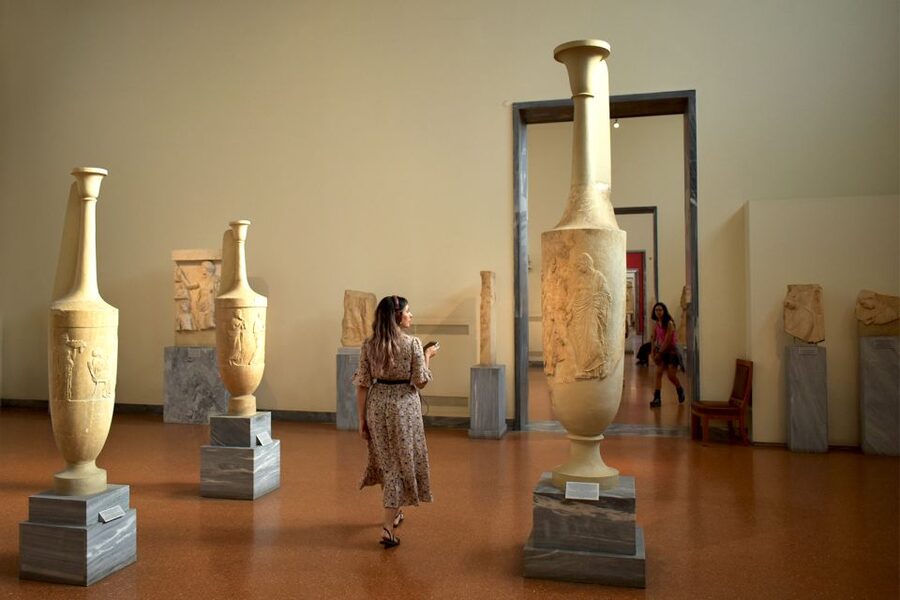
The bronze gallery is a high point. The statues have a physical force that marble sometimes lacks, and the dark metal gives them a different presence from the pale sculptures found elsewhere in Athens.
Look for the large bronze figure usually described as Zeus or Poseidon. The exact identity remains debated, which gives the piece extra interest. Is the figure about to throw a thunderbolt, or is he holding a trident? The audio guide uses this famous uncertainty as part of the story.
The Horse Rider is another important stop. The figure captures movement in a way that makes the ancient work feel surprisingly immediate. You can study the rider, the horse, and the balance of the composition without needing to imagine a complete modern restoration.
I would not rush through these rooms. Even if you are not an archaeology specialist, the sculptures are easy to appreciate at a glance. The audio explanations add useful background, but you can also pause the narration and simply look.
More museums and sites in Athens:
- Acropolis monuments & Parthenon Walking Tour with Optional Acropolis Museum
★ 5.0 · 2,678 reviews - Athens All Included: Acropolis and Museum Guided Tour with Ticket
★ 4.5 · 2,673 reviews - Athens: Acropolis Museum Ticket with optional Audio Guide
★ 4.4 · 2,652 reviews - From Athens: Small-Group Delphi, Museum & Arachova Day Trip
★ 4.8 · 2,476 reviews
Marble sculpture, pottery, jewelry, and everyday life
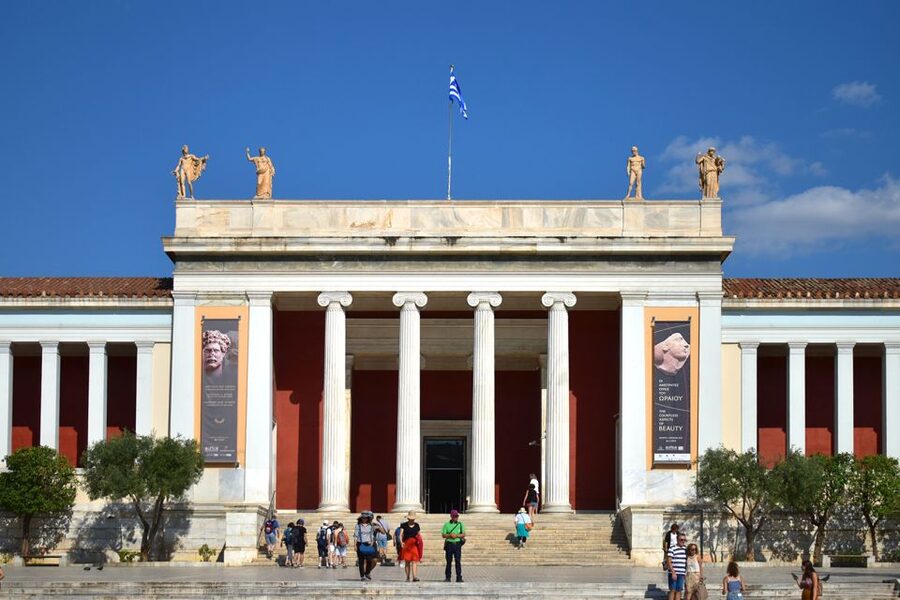
The museum is not only a parade of famous masterpieces. Its value lies in the ordinary objects too.
Pottery can show how people stored goods, served food, and pictured myths. Tools and jewelry offer small clues about work, status, and personal life. The collection of intact or well-preserved objects helps connect grand stories about Greece with the daily lives of people who lived long ago.
The marble sculpture rooms are likely to be a favorite if you enjoy Classical art. You will see idealized bodies, portraits, religious figures, and fragments that require some imagination. Many pieces are not complete, but that is part of the archaeological reality. The museum also uses images to suggest how some objects may originally have looked.
The audio guide is useful here because it cuts through the sheer quantity of material. Instead of trying to read every label, you can listen to a selection of objects and then decide where to spend more time.
Most displays include information in Greek and English, which makes independent exploration easier. Still, the chronology and room order may not always feel clear. Downloading the museum map before arrival is a sensible move, especially if you want to return to rooms after finishing the audio route.
Roman and Hellenistic works add another layer
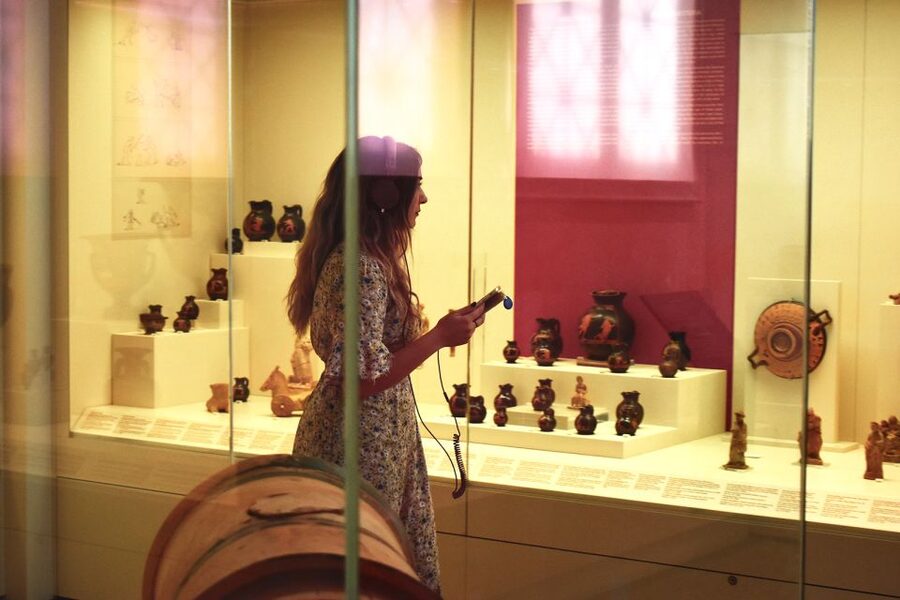
Although the museum is centered on Greek archaeology, the story does not stop with Classical Athens. Hellenistic and Roman works show how Greek artistic ideas continued to develop and travel.
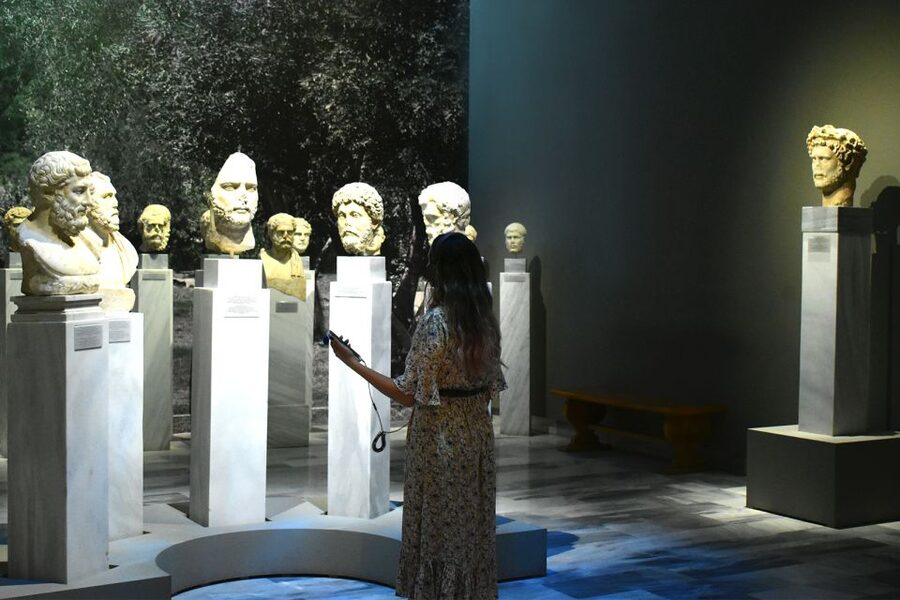
A particularly interesting thread involves Roman admiration for Greek art. Sculptures connected with Hadrian are a highlight for visitors interested in the emperor and his attachment to Hellenic culture. A temporary Hadrian exhibition may also be present, though temporary displays can change, so do not plan your entire visit around it.
These later galleries help correct a common misunderstanding. Greek art was not sealed in one golden age. Later artists and rulers studied, copied, preserved, and reshaped earlier models. The museum lets you see that long conversation through sculpture and portraiture.
The audio guide does not cover every object, but its selected stops can give you a clean outline. You can then explore beyond the route, especially if Roman art or Hellenistic sculpture interests you more than the suggested highlights.
How the smartphone audio guide works
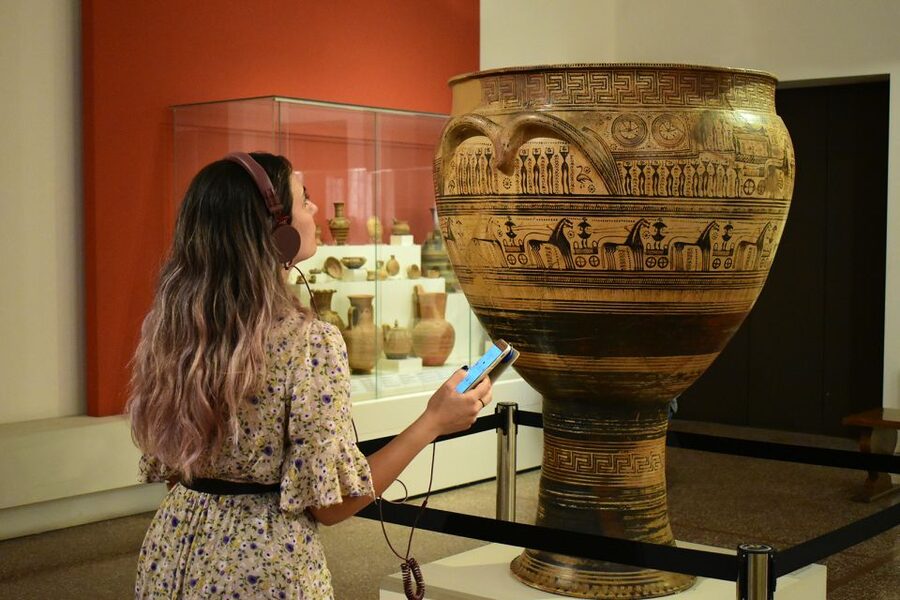
The audio guide is self-guided, not a live tour. You download the content to an Android or iOS device, then use your own headphones as you walk through the museum.
Offline maps, text, and narration are included. This is helpful inside a large building where mobile service may be weak or where you do not want to use mobile data. The guide is available in English, French, German, Greek, Italian, and Spanish.
The storytelling is the strongest part. It gives selected objects a human angle, adds historical facts, and brings in anecdotes that are easy to miss on a small museum label. Several audio stops focus on the Mask of Agamemnon, the Mycenaean Bull, the bronze Zeus or Poseidon, and the Horse Rider.
The route is not perfect. You may need to search for a room or retrace your steps, and the guide does not cover every gallery. Some sections could use clearer directions. If you treat it as a highlights companion rather than a complete museum map, it works better.
I would listen to a stop, pause the narration, and look carefully at the object. You do not need to follow the suggested pace. The audio can be used again after your visit, so you can replay a section at your hotel or use it to remember what you saw.
Planning your visit around the time you have
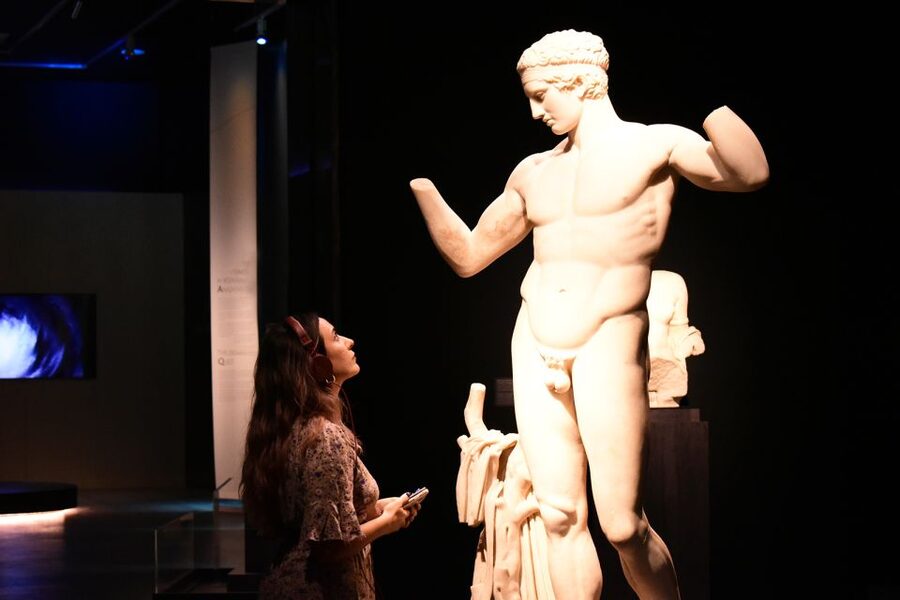
The listed duration ranges from 45 minutes to four hours. That wide range reflects the way the experience works rather than a fixed itinerary.
For a short visit, follow the main audio highlights. You will get the major names and periods without trying to absorb the entire collection. Around 90 minutes is a practical target if you want the audio route and a little time to look around.
For a fuller visit, allow two hours at minimum. Add time for the Mycenaean rooms, the bronze sculptures, the marble galleries, and the later Greek and Roman displays. The building can feel maze-like, so some minutes will go toward finding rooms or returning to objects you missed.
Three hours is a comfortable choice for someone who enjoys museums. Four hours suits serious ancient-history fans, but you should plan a break. The ground-floor cafe opens onto an inner courtyard with greenery and artwork, giving you a pleasant place to rest without leaving the museum.
An early start can help if you want quieter galleries. Busy conditions are possible, especially during popular periods, and the museum’s size makes crowds more tiring than they might be in a small gallery.
What $31 buys you
At $31 per person, the value depends on what you want from the visit. The ticket itself buys convenience, not a private experience. You still explore independently, and there is no live guide, transportation, food, or drink included.
The audio guide makes the price easier to justify. It provides selected explanations in six languages, offline access, a map, and repeat use. If you would otherwise wander past unfamiliar objects without context, that added structure can make the museum more rewarding.
The price is less attractive if you only want to walk through quickly or if you qualify for a reduced admission rate. It is also worth checking the museum’s own options before booking, since a separate museum audio guide may sometimes be available at no extra cost with identification held at the desk as collateral. The exact arrangement can change, so check before paying for an outside audio product.
The biggest value is time saved at the ticket counter. If the museum is busy and your schedule is fixed, having the admission ticket ready can be useful. If there is no ticket queue when you arrive, the convenience is smaller.
Who will enjoy this experience most
I would recommend it to you if you want to explore alone but do not want to read every label. It suits people interested in Greek mythology, sculpture, Bronze Age culture, or the development of Greek and Roman art.
It is also a good fit for independent visitors who prefer stopping, skipping, and returning rather than staying with a live group. Families and couples can split up briefly and meet again, although each person needs access to the audio content and headphones.
Students and archaeology enthusiasts may want more than the selected route. The audio guide gives a useful framework, but it will not cover every object or answer every specialist question.
If you dislike phone-based tours, bring a backup plan. The museum remains worth visiting without the audio, but the building can be confusing, and the guide’s storytelling adds much of the experience’s value.
Check your device before booking. The audio is not compatible with Windows phones, iPhone 5, iPhone 5C, older iPod Touch models, iPad 4th generation or older, or the first-generation iPad Mini. A charged smartphone and headphones are required.
The drawbacks to keep in mind
The museum itself is excellent, but the digital format has limits. Directions can be unclear, and the suggested audio path may skip entire rooms. If you follow it rigidly, you could finish with the feeling that you missed too much.
The solution is simple: use the guide as a backbone, then explore on your own. Download a map, note the rooms you want to revisit, and leave enough time beyond the audio duration.
The non-refundable booking policy also means you should be confident about your date and schedule before paying. The meeting point may vary by option, so do not rely on a generic assumption about where to go.
Finally, a pre-booked ticket does not remove security checks. If you arrive with a large bag, allow extra time for the entrance process.
Should you book the National Archaeological Museum audio guide?
Book it if you want a convenient entry ticket and a well-paced introduction to the museum’s best-known objects. The audio storytelling is especially helpful around the Mask of Agamemnon, Mycenaean metalwork, the bronze Zeus or Poseidon, and the Horse Rider.
Skip this particular package if you qualify for free or reduced admission, prefer a live guide, or already have access to a museum audio tour. You should also compare the cost with any audio option offered directly by the museum.
For most independent visitors, the strongest plan is to book an early time, download everything before arrival, bring headphones, and allow at least two hours. Follow the highlights, then wander beyond them. That gives you both the convenience of a prepared tour and the freedom to discover the museum’s quieter surprises.
FAQ
How long does the National Archaeological Museum experience last?
The stated duration is 45 minutes to four hours. A short visit can cover the main audio highlights, while two to four hours allows time to explore more of the collection.
Is the ticket a regular admission ticket?
Yes. The package includes a regular entry ticket for all ages. If you qualify for free or reduced-price admission, go directly to the museum ticket booth.
Is there a live guide?
No. The experience includes a self-guided audio tour on your smartphone, not a live guide.
Which languages are available for the audio guide?
The audio guide is available in English, French, German, Greek, Italian, and Spanish.
Do I need my own smartphone and headphones?
Yes. You need a charged compatible Android or iOS smartphone and your own headphones. The package does not provide either item.
Can I use the audio guide offline?
Yes. Offline content includes the text, audio narration, and maps. You receive instructions by email for downloading the ticket and audio tour.
Can I use the audio guide more than once?
Yes. The audio tour can be used repeatedly and at any time, including before or after your museum visit.
Are pets allowed inside?
Pets are not allowed. Assistance dogs are permitted.
More Audio Tours in Athens
- Athens: Acropolis Ticket & Optional Self-Guided Audio Tours
★ 4.1 · 2,542 reviews - Parthenon & Acropolis Museum with Audio or Live Tour Option
★ 4.1 · 2,446 reviews - Athens: Peloponnese Highlights Day Trip and V.R. Audio Guide
★ 4.5 · 1,425 reviews - Athens: Acropolis Ticket with Multilingual Audio Guide
★ 3.9 · 926 reviews
More Self-Guided Tours in Athens
- Athens: Acropolis Ticket with Optional Audio or Live Guide
★ 4.2 · 11,055 reviews - Athens: Cape Sounio & Poseidon Temple Trip with Audio Guide
★ 4.4 · 4,521 reviews - Athens: Acropolis Ticket with Audio Guide
★ 4.0 · 3,575 reviews - From Athens: Delphi Full Day V.R. Audio Guided Tour
★ 4.6 · 3,028 reviews
Just added around Athens
- Delphi One Day Trip from Athens★ 4.0 · 98 reviews
- Mercedes Private Tour to Delphi and Arachova★ 5.0 · 30 reviews
- Private Delphi and Hosios Loukas Monastery – Great Lunch and Drinks Included★ 5.0 · 36 reviews
- Day tour to Ancient Olympia,Ancient Sparta Mycenae Including Meal★ 5.0 · 54 reviews
- Athens: Half Day Trip To Cape Sounio/Poseidon Temple Semi Private★ 5.0 · 131 reviews
- Athens Half-Day Private Tour Acropolis, Parthenon City Highlights★ 5.0 · 35 reviews
- From Athens: Day Tour to Mykonos★ 5.0 · 64 reviews
- Culinary Secrets of Downtown Athens★ 5.0 · 103 reviews
Museums, compared.

Acropolis, Parthenon & Acropolis Museum Guided Tour
Read our review →
Mythology of Delphi, Museum and Arachova Guided Tour
Read our review →Acropolis, Parthenon & Acropolis Museum Guided Tour
Read our review →
Acropolis monuments & Parthenon Walking Tour with Optional Acropolis Museum
Read our review →
Athens All Included: Acropolis and Museum Guided Tour with Ticket
Read our review →
Acropolis Museum Ticket with optional Audio Guide
Read our review →
Small-Group Delphi, Museum & Arachova Day Trip
Read our review →
Parthenon & Acropolis Museum with Audio or Live Tour Option
Read our review →Browse the lists this tour appears in