Reviewed · TICKETS
Athens: Temple of Olympian Zeus Entrance Ticket
Fifteen columns tell a surprisingly large story. This timed ticket puts you beside the Temple of Olympian Zeus, one of ancient Greece’s biggest temples, and I like its central location near the Acropolis and Syntagma Square. I also like the freedom of exploring at your own pace, with a self-guided audio tour of Plaka included. The main drawback is value: at $30, the ticket can feel costly when only a small part of the temple survives.
The site is compact, so an hour is enough for a focused visit. You will see the surviving columns, traces of earlier walls and homes, and a Roman bathhouse. But recent conditions have made the view less complete, with scaffolding hiding much of the monument at times. You should check the current state before booking, especially if this is your only reason to visit.
In This Review
- Key points to know before you book
- What you are really visiting at the Temple of Olympian Zeus
- From a 515 BC plan to Hadrian’s finished temple
- The surviving columns and the problem of scaffolding
- More than columns: walls, homes, and a Roman bathhouse
- How the timed entry works at the central Athens site
- The Plaka audio tour is useful, but know what it is
- Is $30 a fair price for one hour?
- Who will appreciate this short archaeological visit?
- Practical timing for a one-hour visit
- Should you book the Temple of Olympian Zeus ticket?
- FAQ
- Where is the Temple of Olympian Zeus located?
- How long does the visit last?
- Is the ticket valid for a specific time?
- Is there a live guide?
- Does the audio tour explain the Temple of Olympian Zeus?
- Can children use this ticket?
- Is the site wheelchair accessible?
- Can I bring a stroller or large bag?
Key points to know before you book
- The temple is only about a quarter mile from the Acropolis, making it easy to pair with other central Athens sights.
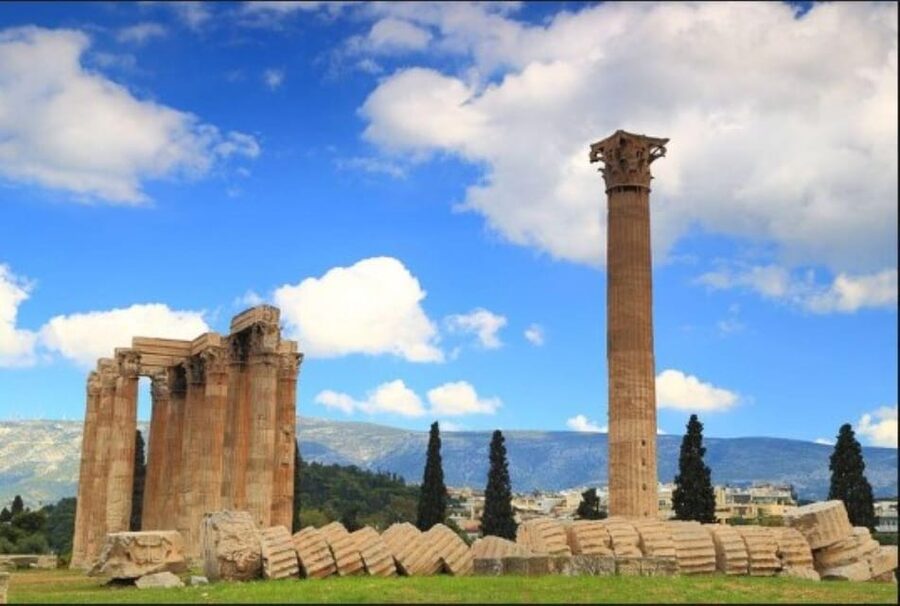
- The original temple had 104 columns, but only 15 remain today, with one falling in a storm in 1852.
- Your ticket is valid only for a selected time slot, with entry allowed from 15 minutes before to 15 minutes after that time.
- The audio tour covers Athens Old Town and Plaka, not a live guided visit of the temple itself.
- The site can be seen quickly, so the $30 price makes the most sense if you value convenience and ancient architecture.
- Scaffolding may limit the view, and large bags, luggage, and baby strollers are not allowed inside.
What you are really visiting at the Temple of Olympian Zeus
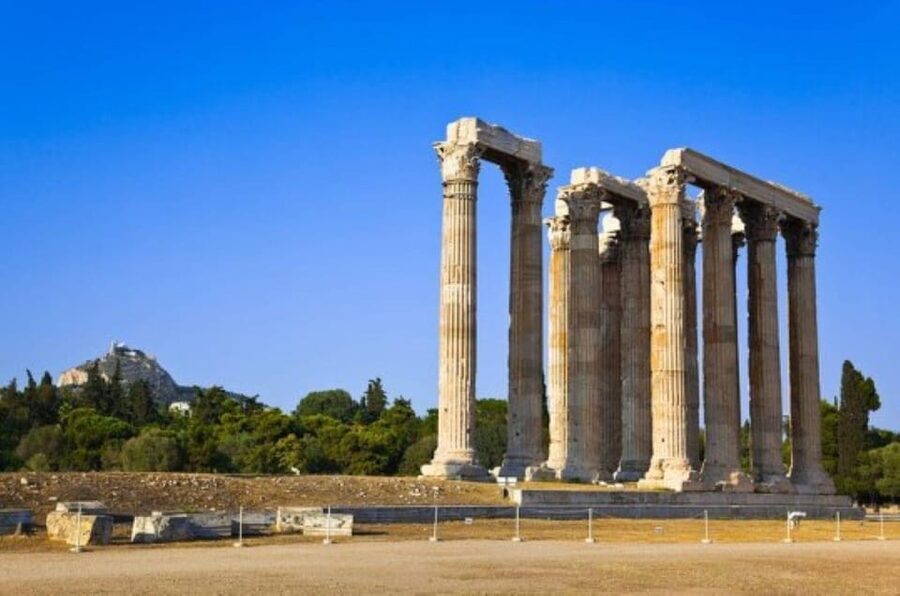
The Temple of Olympian Zeus is not a complete building. It is an open archaeological site with a group of towering marble columns, scattered remains, and traces of later construction.
That may sound modest compared with the Acropolis, but the scale of the original project helps you read the ruins. The temple was planned as one of the largest religious buildings in the ancient world. Its story began around 515 BC, yet construction took centuries to reach its final form.
The completed temple was built in the Corinthian style with Pentelic marble. It had two rows of 20 columns along each long side and three rows of eight columns at the front and rear. That made 104 columns in the surrounding colonnade.
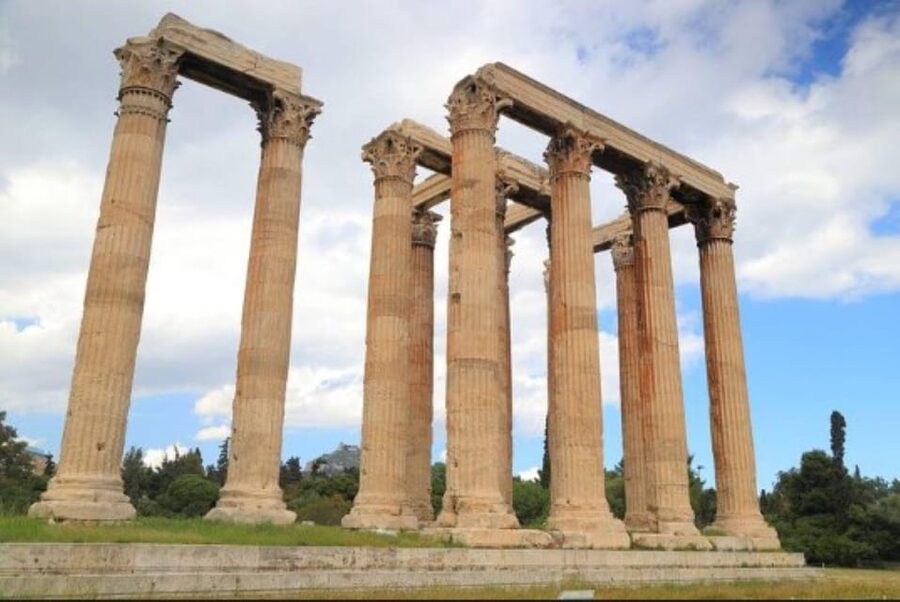
Today, 15 remain standing. One more column collapsed during a storm in 1852, a useful reminder that these ruins are not frozen in one neat moment. Weather, earthquakes, reuse, and time have all changed what you see.
I find the contrast between the original plan and the present remains especially useful. You are not simply looking at isolated pillars. You are standing inside the footprint of a massive temple that took roughly six and a half centuries to complete.
A few more Athens half-days to weigh up
- Athens: Acropolis & up to 5 Archaeological Sites Combo Pass
★ 4.4 · 12,619 reviews - Athens: Acropolis Ticket with Optional Audio or Live Guide
★ 4.2 · 11,055 reviews - Athens: Acropolis, Parthenon & Acropolis Museum Guided Tour
★ 4.8 · 9,316 reviews
From a 515 BC plan to Hadrian’s finished temple
The earliest work likely began around 515 BC. The project was connected with the ambition of building a sanctuary worthy of Zeus, but progress was slow and the temple was not completed during the original Greek period.
The final version came under the Roman emperor Hadrian in 131 or 132 AD. Hadrian completed the building in a form that reflected Roman-era power and taste, using the Corinthian architectural style and brilliant Pentelic marble.
This long timeline is the key to appreciating the site. The Temple of Olympian Zeus is not the product of one ruler or one brief building campaign. It represents a project that outlasted political changes and moved from the Greek world into the Roman era.
You will not get a complete interior or roofline here. Instead, the columns give you the proportions and height of the lost building. Look carefully at the spacing between them and imagine the three rows at each end. The empty gaps are part of the experience, but they also explain why some people may feel the visit is short.
The surviving columns and the problem of scaffolding
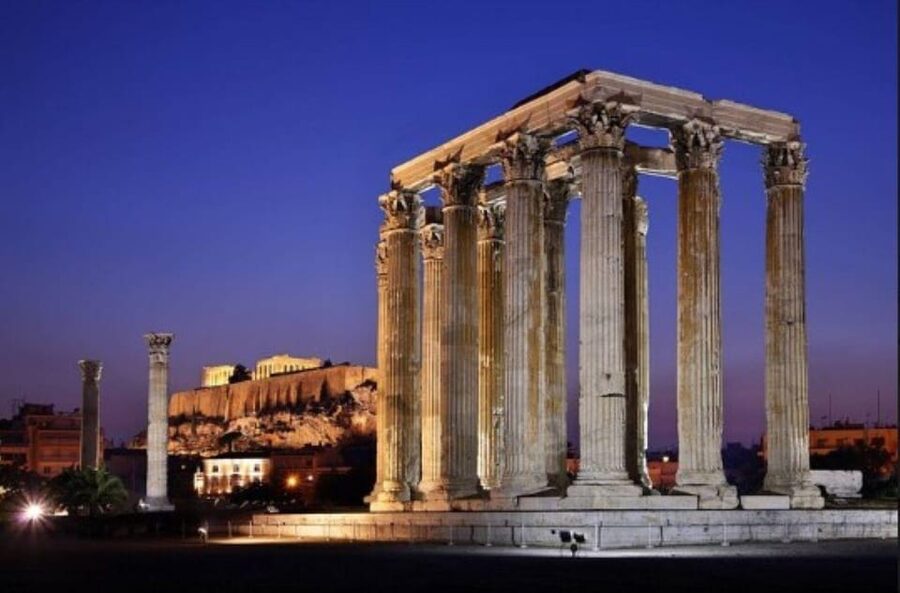
The columns are the main event. They are tall, pale, and widely spaced, giving the site an open feel. Even in partial form, they make it easy to understand why the completed temple was described as one of the largest in Greece until the second century AD.
Your view may not be fully clear. Scaffolding has hidden much of the temple at times, and one recent visit described being able to see only three or four columns clearly from the available route. That limitation matters at a $30 entry price.
If the work is still present during your visit, expect a more restricted visual experience. You can still study the columns and the remains, but the grand overall impression may be reduced. This is the biggest practical point to check before committing to a non-refundable ticket.
The site can take about 20 minutes if you read the information panels and move steadily. The supplied duration is one hour, which gives you enough time to look closely, pause for photographs, and examine the additional remains north of the main temple. It does not mean you will receive a full hour of guided interpretation.
More than columns: walls, homes, and a Roman bathhouse
The archaeological area includes more than the temple itself. North of the main remains, you can see part of a gate from the Themistoclean Wall, built in 479 or 478 BC.
That wall belongs to an earlier stage of Athens, long before Hadrian’s finished temple. Its presence adds another layer to the visit. You are not looking at only one monument, but at traces from several periods of the city.
The site also contains remains of ancient dwellings dating from the fifth and fourth centuries BC through the second century AD. These domestic traces help balance the grand scale of the temple. The columns represent imperial ambition, while the homes suggest everyday life around the sanctuary and city.
A Roman bathhouse is also visible. The information provided does not promise a fully restored bathing complex, so keep your expectations in check. You will see remains rather than a complete building, but they help show how the area continued to function long after the temple project began.
For many people, these smaller features will take less time than the columns. They are still worth seeking out, especially if you want more than the quick photo stop available from the surrounding streets.
Same stretch of coastline, a completely different day out:
- Athens: Cape Sounion & Poseidon Temple Sunset Half-Day Trip
★ 4.8 · 8,241 reviews - Athens: Acropolis and Parthenon Guided Walking Tour
★ 4.6 · 5,882 reviews - All Day Cruise -3 Islands to Agistri,Moni, Aegina with lunch and drinks included
★ 5.0 · 4,958 reviews - Athens, Piraeus, and Coastline: Blue Hop-On Hop-Off Bus
★ 3.9 · 4,849 reviews
How the timed entry works at the central Athens site
You enter at the archaeological site’s own entrance. There is no separate meeting with a guide, and you must make your own way there.
The location is convenient. The temple is about a quarter mile southeast of the Acropolis and about a quarter mile south of Syntagma Square. That places it within an easy central Athens sightseeing route, although the ticket does not include transportation.
You select a date and time slot when booking. Entry is allowed only during that window, from 15 minutes before to 15 minutes after the selected time. Arriving much earlier or later may leave you unable to use the ticket.
This rule deserves more attention than it might seem to. Athens sightseeing days often involve crowded streets, delayed meals, and long visits at major sites. Plan your route so you can reach the entrance on time. Since the ticket cannot be amended and is non-refundable, a small scheduling mistake can become an expensive one.
There is also no guarantee that the ticket office will have an open slot when you arrive. If you want a particular time, advance booking gives you more control, but it also removes flexibility.
The Plaka audio tour is useful, but know what it is
The ticket includes a self-guided audio tour of Athens Old Town, known as Plaka. This is separate from a live guided tour of the Temple of Olympian Zeus.
That distinction is important. You should not expect a guide waiting at the entrance, a group briefing, or a person explaining the columns as you walk. The temple visit is self-guided, and the audio material is aimed at Plaka.
One piece of feedback specifically noted that there was no audio guide. The likely source of confusion is the wording of the inclusion. The package provides a self-guided Plaka audio tour, not necessarily an audio guide inside the temple grounds.
Treat the Plaka audio tour as an added city-walking feature rather than the main reason to buy this ticket. If you already plan to explore Plaka, it may add useful structure to that walk. If your sole goal is detailed interpretation of the temple, you may prefer to bring your own background notes or choose a separate guided experience.
Is $30 a fair price for one hour?
At $30 per person, this is a premium price for a small archaeological site. The ticket offers timed access and convenience, but it does not include a live guide, transportation, or a full audio presentation inside the temple.
The value improves if you want a fixed entry time and prefer to avoid relying on same-day ticket availability. It also improves if you plan to use the Plaka audio tour as part of a wider day in central Athens.
The value falls if scaffolding blocks much of the monument or if you expect a long visit. One person found the site interesting but expensive for the amount visible. Another considered the visit barely 20 minutes when taking time to read the panels. Those are fair concerns.
I would compare this ticket with your wider Athens budget. If you are already spending heavily on the Acropolis and other archaeological sites, the Temple of Olympian Zeus may feel like an optional extra. If ancient architecture is a major interest, the surviving columns and long construction story may justify the cost.
The regular adult-price ticket applies to people of all ages. That means children and younger adults may still pay the full price unless they qualify for the stated admission exemptions. From April 1, 2025, EU citizens under 25 and non-EU citizens under 18 can receive free admission by showing identification at the ticket booth.
People with disabilities can also receive free admission by presenting a Disability Certificate at the booth. The site is listed as wheelchair accessible, but large bags, luggage, baby strollers, alcohol, and drugs are not allowed.
Who will appreciate this short archaeological visit?
I think the ticket suits you best if you already plan to be in central Athens and want a brief, focused stop near the Acropolis. The location makes it easy to fit between other sights, and the compact site does not demand a half-day commitment.
It also suits visitors who like reconstructing ancient buildings from partial remains. The 104-column original plan gives you plenty to think about, even though only 15 are standing.
You may be less satisfied if you need a full guided explanation, a long itinerary, or a complete monument. The temple is not presented as a polished reconstruction, and the current scaffolding may reduce the view.
Families should note the no-stroller rule. You will need to leave baby strollers outside, and large bags or luggage are also prohibited. Comfortable shoes and comfortable clothes are sensible because the visit takes place outdoors at an archaeological site.
Practical timing for a one-hour visit
Allow time to reach the entrance before your slot. You can enter from 15 minutes before to 15 minutes after the scheduled time, so do not aim to arrive at the last second.
Once inside, begin with the main temple remains. Spend time looking at the height, spacing, and arrangement of the surviving columns rather than rushing straight through. Then continue toward the northern section to see the Themistoclean Wall remains, ancient dwellings, and Roman bathhouse.
If you read the information panels, the visit may take close to 20 minutes or more. With photographs and a slower look at the layout, you can use much of the one-hour period. Still, the site is not designed as a long guided program.
The Plaka audio tour can extend your sightseeing after you leave, but you should plan it as a separate walk through the old town. The included material does not turn the temple visit into a live tour.
Should you book the Temple of Olympian Zeus ticket?
Book it if you value a guaranteed time slot, want to see one of Athens’ most important ancient monuments, and are already planning a walk through central Athens and Plaka.
Think twice if you are mainly looking for a long activity or detailed on-site commentary. At $30, the price is hard to defend when scaffolding limits the view or when you complete the archaeological site in about 20 minutes.
Before paying, check current site conditions and confirm that the selected date and time fit your day. If the columns are clearly visible and you care about ancient architecture, this can be a worthwhile short stop. If the monument is heavily covered, you may find that the exterior view gives you most of what the ticket offers.
FAQ
Where is the Temple of Olympian Zeus located?
The temple is in central Athens, about a quarter mile southeast of the Acropolis and within a quarter mile south of Syntagma Square.
How long does the visit last?
The stated duration is one hour, although the archaeological remains can be seen in about 20 minutes if you read the information panels and move at a steady pace.
Is the ticket valid for a specific time?
Yes. The ticket is valid for the selected date and time slot. Entry is permitted from 15 minutes before to 15 minutes after that time.
Is there a live guide?
No. The ticket does not include a live guided tour. It includes entry and a self-guided audio tour for Athens Old Town and Plaka.
Does the audio tour explain the Temple of Olympian Zeus?
The included audio tour is for Athens Old Town and Plaka. The provided information does not identify it as an audio guide for the temple itself.
Can children use this ticket?
People of all ages can use the regular adult-price ticket and pay the full price. From April 1, 2025, EU citizens under 25 and non-EU citizens under 18 can receive free admission by showing identification at the ticket booth.
Is the site wheelchair accessible?
Yes, the activity is listed as wheelchair accessible. People with disabilities can receive free admission by presenting a Disability Certificate at the ticket booth.
Can I bring a stroller or large bag?
No. Baby strollers, luggage, and large bags are not allowed. Comfortable shoes and comfortable clothes are recommended.
Just added around Athens
- Delphi One Day Trip from Athens★ 4.0 · 98 reviews
- Mercedes Private Tour to Delphi and Arachova★ 5.0 · 30 reviews
- Private Delphi and Hosios Loukas Monastery – Great Lunch and Drinks Included★ 5.0 · 36 reviews
- Day tour to Ancient Olympia,Ancient Sparta Mycenae Including Meal★ 5.0 · 54 reviews
- Athens: Half Day Trip To Cape Sounio/Poseidon Temple Semi Private★ 5.0 · 131 reviews
- Culinary Secrets of Downtown Athens★ 5.0 · 103 reviews
- Athens Half-Day Private Tour Acropolis, Parthenon City Highlights★ 5.0 · 35 reviews
- From Athens: Day Tour to Mykonos★ 5.0 · 64 reviews
Tickets, compared.

Athens All Included: Acropolis and Museum Guided Tour with Ticket
Read our review →
Acropolis Museum Ticket with optional Audio Guide
Read our review →
Acropolis Ticket & Optional Self-Guided Audio Tours
Read our review →
Knossos Palace Entry Ticket with Optional Audio Guide
Read our review →