

Reviewed · ACROPOLIS TOURS
Athens:Acropolis – Historical Center Walking Tour in Spanish
Ancient stones tell lively stories. This four-hour Spanish-language walking tour combines the Acropolis with Athens’ old center, giving you both the city’s great monument and its most atmospheric streets. I especially like the early 8:00 to 9:00 Acropolis entry slot, which can help you start before the strongest crowds, and the route through Plaka, where the city feels more intimate and human. The main catch is important: the Acropolis admission ticket is not included in the $57 price.
The tour also takes you through the south slope entrance, past the Theater of Dionysus, rather than beginning at the main gate. That is a smart route for seeing more of the Acropolis complex. Spanish-speaking guides such as Efi and Andrea have earned strong praise for clear explanations, patience, humor, and useful Athens tips, though one review felt the historical commentary could be shorter.
In This Review
- Key points to know before booking
- Why this four-hour route works well in Athens
- Meeting at the south slope of the Acropolis
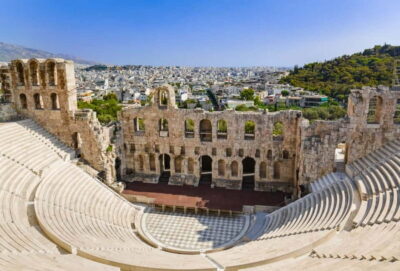
- Theater of Dionysus and the story of Athena
- Propylaea, Athena Nike, and the Caryatids
- The Parthenon and the Acropolis views
- Walking down into Plaka
- The Tower of the Winds and Athens Cathedral
- What the Spanish guidance adds
- Is $57 a fair price?
- Who should book this Athens tour?
- Should you book it?
- FAQ
- Is the Acropolis entrance ticket included?
- What language is the tour conducted in?
- Where does the tour meet?
- Does the tour include the Ancient Agora?
- How long does the tour last?
- Is the tour suitable for people with mobility impairments?
Key points to know before booking
- The Acropolis starts through the south slope gate, with the Theater of Dionysus included before the hilltop monuments.
- The required ticket costs extra, and you need an Acropolis admission slot between 8:00 and 9:00.
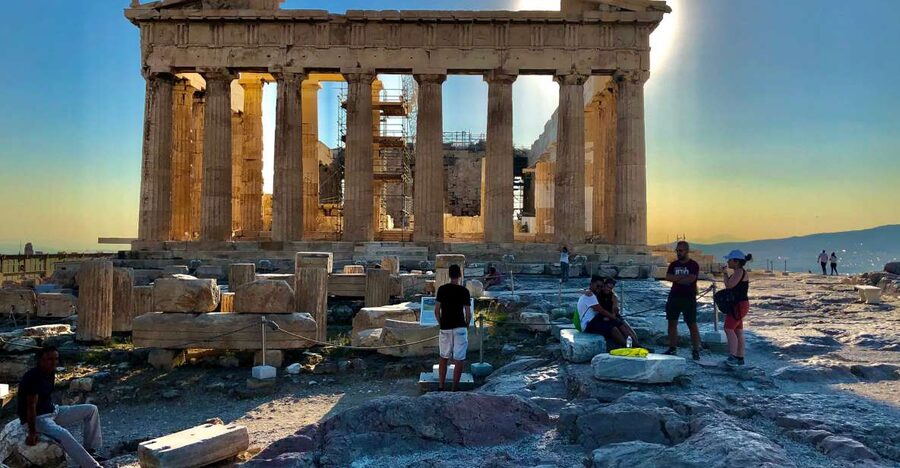
- The Parthenon receives the main focus, with explanations of its purpose, design, and lasting fame.
- Plaka and the historic center follow the Acropolis, including exterior views of the Ancient Agora and the Tower of the Winds.
- Spanish is the only tour language, with a licensed guide and headphones supplied.
- The route requires walking and uneven historic ground, so it is not suitable for people with mobility impairments, baby carriages, or electric wheelchairs.
Why this four-hour route works well in Athens
Athens can feel scattered at first. The Acropolis rises above the center, ancient ruins appear beside modern streets, and Plaka’s lanes can seem like a maze. This route gives you a clear order: begin with the city’s most important archaeological site, then walk downhill and through the old neighborhoods.
I like that the tour does not stop at the famous hilltop view. After the Acropolis, you continue into the historic center and Plaka, then finish near the Tower of the Winds and the Metropolitan Cathedral of Athens. You get a useful first look at several major places instead of spending four hours on one monument alone.
The pace should suit you if you want a guided introduction rather than a long archaeological lecture. The itinerary includes time for photographs and short pauses, an important detail on the Acropolis, where the sun, stone paths, and crowds can make a visit tiring. One guest particularly appreciated being allowed to rest, take pictures, and enjoy the setting without being hurried.
Still, four hours is a tight frame for Athens. The guide has plenty to explain, and one person found some of the historical descriptions too long. If you prefer a fast overview, you may want to ask for shorter explanations at some stops. If you enjoy stories and context, the extra detail will likely be welcome.
More Walking Tours in Athens
- Athens: Acropolis and Parthenon Guided Walking Tour
★ 4.6 · 5,882 reviews - Greek Food Walking Tour in Athens
★ 5.0 · 4,740 reviews - Acropolis: Acropolis and Parthenon Guided Walking Tour
★ 4.7 · 3,442 reviews
Meeting at the south slope of the Acropolis
The meeting point is at the lower gate of the Acropolis, a few meters from the Acropolis Museum. Look for a guide holding a sign with the office logo. There is no hotel pickup, so you need to make your own way to the meeting point.
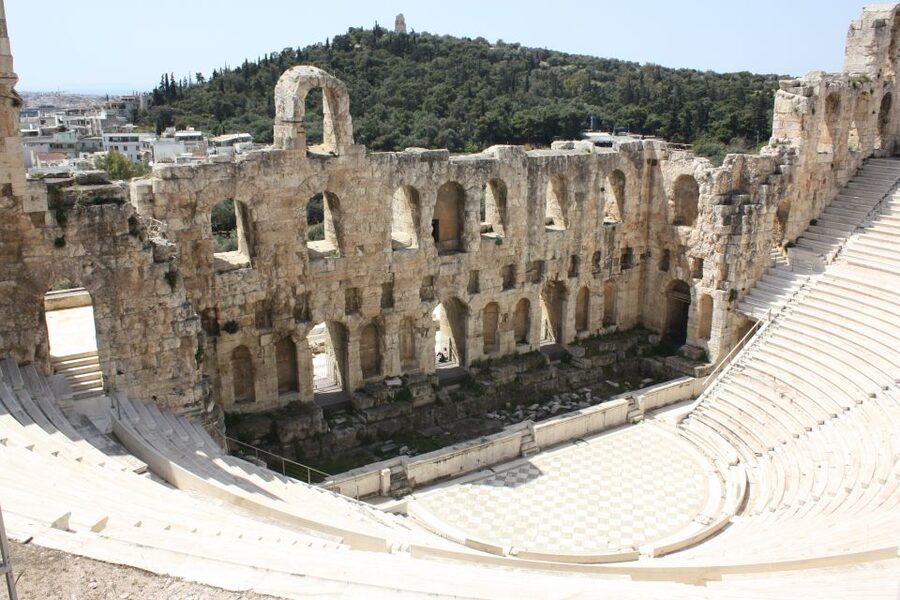
Starting at the south slope is one of the tour’s best choices. The entrance takes you toward the Theater of Dionysus, identified here as the oldest theater in the world. This is where the tour begins to connect architecture with civic life, performance, religion, and public gatherings rather than treating the Acropolis as a collection of detached ruins.
The route also helps avoid beginning with the busiest main access. That does not mean the Acropolis will be quiet, since this is Athens’ top sight, but an early start and a side entrance can make the first part more manageable.
Wear comfortable shoes. The tour is on foot, and the Acropolis has stone surfaces, slopes, and historic paths. Baby carriages and electric wheelchairs are not allowed, and the experience is not suitable for people with mobility impairments.
Theater of Dionysus and the story of Athena
At the Theater of Dionysus, your Spanish-speaking guide begins setting the scene for ancient Athens. This is a useful opening because you see the Acropolis not only as a defensive hill or religious center, but also as part of a city that valued drama, public debate, festivals, and shared ceremonies.
The guide then turns to the old contest between Athena and Poseidon. The story explains how Athena became the city’s patron goddess, and it gives a human shape to the rivalry behind Athens’ identity. A good guide can make this kind of myth useful rather than decorative, showing how the stories connect to the monuments you are about to see.
Efi has been praised for her passion, clarity, and long experience, including 27 years guiding. Andrea has also been singled out for interesting facts and practical advice for the rest of a Greece visit. The guide assigned to your date may differ, but the experience is designed around a licensed Spanish-speaking professional.
Headphones are included. That matters on a crowded archaeological site, where staying close enough to hear every explanation can be awkward. You can look at the ruins, take photographs, and still follow the commentary without needing to stand directly beside the guide at every moment.
Propylaea, Athena Nike, and the Caryatids
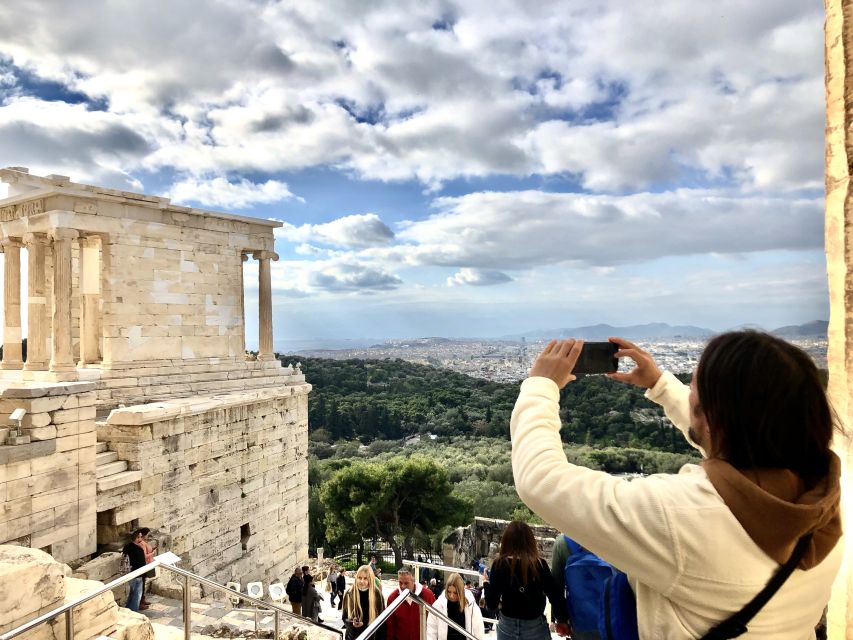
The Propylaea forms the monumental entrance to the Acropolis. Your guide explains how this grand gateway shaped the approach, creating a controlled passage and a sense of preparation before the sacred buildings came into view.
That idea is easy to miss if you visit alone. You may walk through the entrance while focusing on the Parthenon ahead, but the Propylaea itself deserves attention. Its scale and position show that reaching the summit was part of the experience. The approach was meant to impress before you ever arrived at the main temple.
You also see the Temple of Athena Nike, a smaller Ionic building with a more delicate appearance than the larger Doric structures around it. The tour presents it as an Ionic jewel, a helpful contrast to the heavier, more restrained forms elsewhere on the hill.
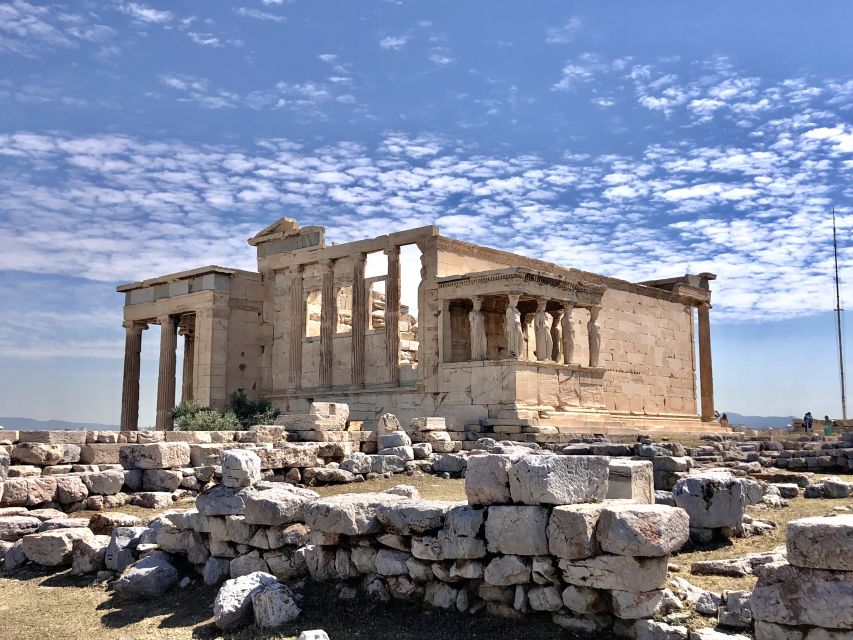
The Caryatids provide another change in style. These sculpted female figures serve as architectural columns at the Erechtheion, creating one of the Acropolis’ most recognizable views. Your guide can help you understand why the building feels less symmetrical and more intricate than the Parthenon.
The tour’s stop at the Caryatids is also a reminder to look closely. The Acropolis is famous for broad views and monumental scale, but the smaller details often reward a slower glance. Give yourself time for photographs, since this is one of the most photogenic parts of the hill.
More ways to see the Acropolis:
- Athens: Acropolis & up to 5 Archaeological Sites Combo Pass
★ 4.4 · 12,619 reviews - Athens: Acropolis Ticket with Optional Audio or Live Guide
★ 4.2 · 11,055 reviews - Athens: Acropolis, Parthenon & Acropolis Museum Guided Tour
★ 4.8 · 9,316 reviews - Athens: Acropolis, Parthenon & Acropolis Museum Guided Tour
★ 4.8 · 3,579 reviews
The Parthenon and the Acropolis views
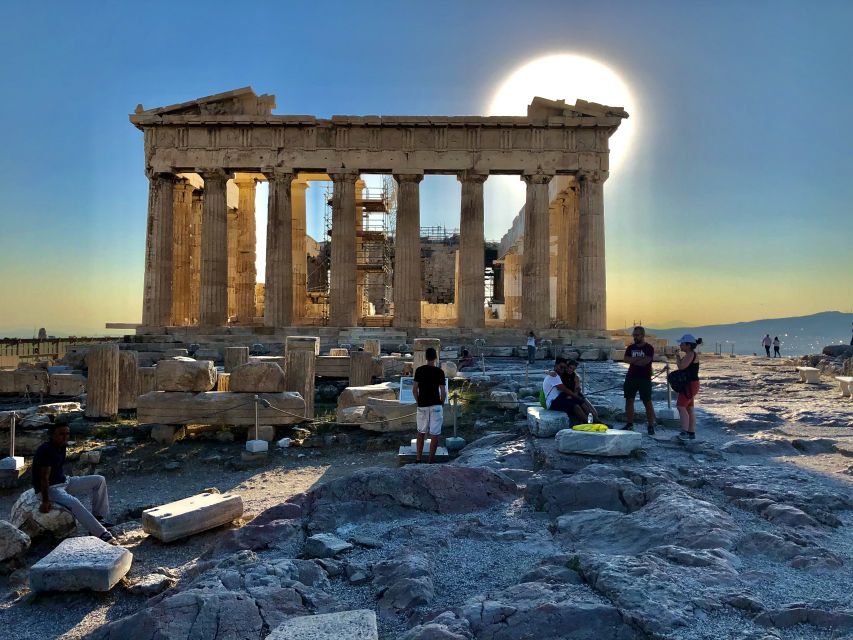
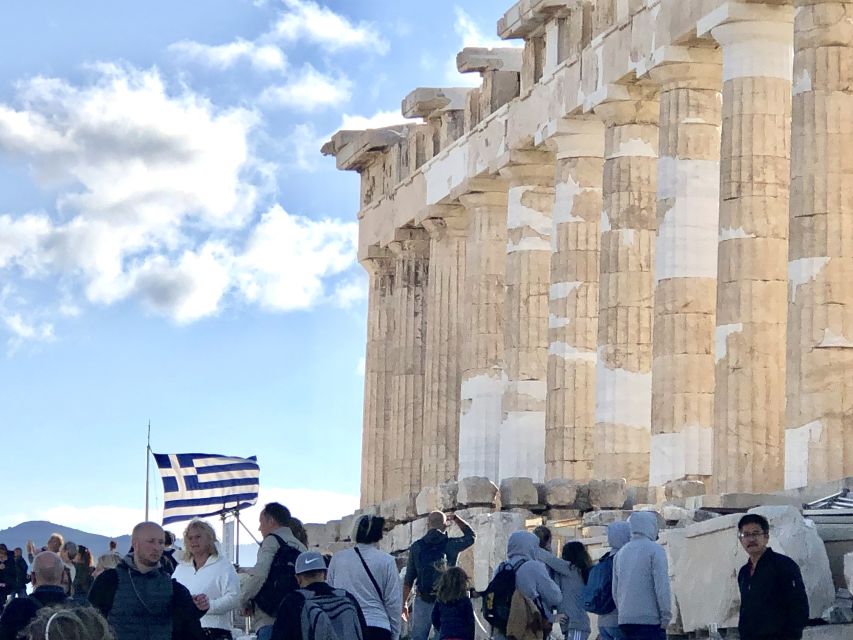
The main stop is the Parthenon. You pause in front of it while the guide explains why the building was created around 2,500 years ago and how its design became famous for balance and harmony.
The value of this explanation is not simply learning dates. The Parthenon is often reduced to a symbol of ancient Greece, but its proportions, architectural choices, and religious purpose help explain why it has had such a long afterlife in world architecture. A Spanish explanation can make the details easier to follow if Spanish is your strongest language.
Your guide also places the monument within the larger Acropolis setting. From the summit, you can look toward the Arch of Hadrian, the Temple of Olympian Zeus, the Odeon of Herodes Atticus, the National Observatory, Mount Lycabettus, Philopappos Hill, and the Areopagus.
These views give you a useful map of Athens. You can see how the ancient center sits inside the modern city, with hills, temples, theaters, churches, and streets layered around it. The Odeon of Herodes Atticus remains especially relevant because it hosts the Athens festival today, linking the ancient performance tradition with modern cultural life.
Expect a photo break here, but do not assume the guide will simply point out monuments and move on. The strongest part of the tour is the combination of views and explanation. The guides have been praised for being patient, enthusiastic, and willing to let you enjoy the site between talks.
Walking down into Plaka
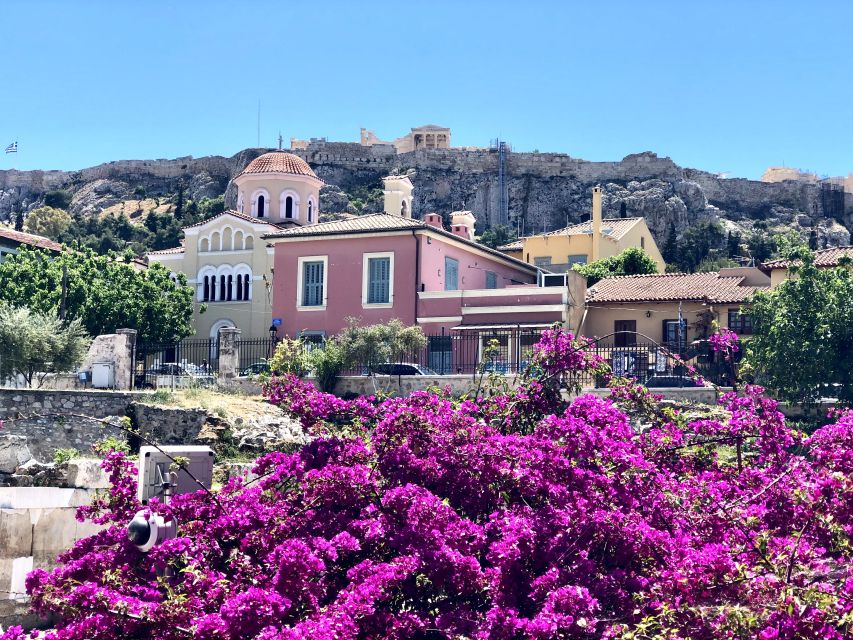
After the Acropolis, the tour shifts from monumental ruins to the old town and Plaka. This change of mood is one of the itinerary’s main strengths. You move from large temples and open views into streets that feel closer, more colorful, and easier to explore at a relaxed pace.
Plaka is presented as Athens’ most picturesque and photogenic neighborhood. That does not mean every lane is quiet or free from shops, but the area gives you a more approachable side of the city. The walk helps you get your bearings for later independent exploring, especially if this is your first visit.
I like this part because it lets the guide explain how ancient Athens, later religious buildings, and the present-day city fit together. You are not simply walking through a pretty neighborhood. You are seeing how Athens grew around its ancient center.
The route passes outside the Ancient Agora. You do not enter the site on this tour, so keep that limitation clear when comparing options. Even from the exterior, the area has strong historical importance. Socrates, Plato, and Aristotle are associated with this part of Athens, and the guide uses it to connect the physical city with the intellectual life that shaped Western thought.
The tour also points out the best-preserved temple in Athens. Since the Ancient Agora entrance is not included, you may want to return separately if you want a closer look inside the archaeological area.
The Tower of the Winds and Athens Cathedral

The final stops bring together science, religion, and modern royal history. The Tower of the Winds is described as the oldest meteorological observatory in the world. Its purpose gives you a different way to understand ancient Athens, where public buildings could also serve practical and scientific roles.
This is a good closing sight because it is smaller and more detailed than the Acropolis monuments. After several hours of temples and broad views, the tower gives the guide a chance to focus on how people measured and understood the world around them.
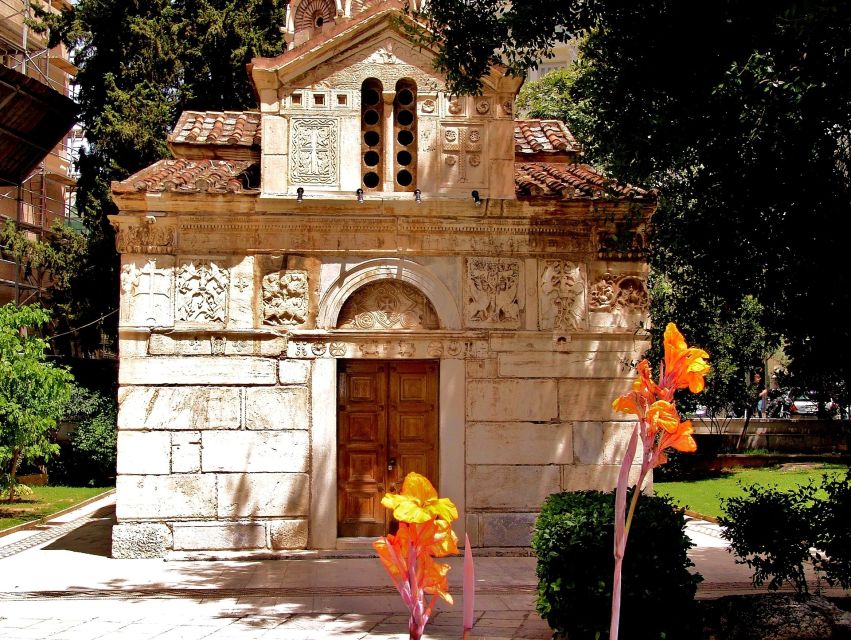
The tour ends at the Metropolitan Cathedral of Athens, known locally as the Mitropolis. The church is associated with the marriage of Queen Sofía and Juan Carlos, and the guide explains the Orthodox religion that remains central to much of Greek society.
This stop gives the walking tour a modern cultural finish. You have seen pagan temples, ancient theaters, classical monuments, and now a living Christian tradition. I find that mix more useful than a route that treats Athens as if its story ended in antiquity.
What the Spanish guidance adds
The biggest reason to choose this tour is the Spanish guide. Ancient architecture can be hard to understand when the language is not comfortable, and the Acropolis has many names, myths, and building terms to keep straight.
Efi has been praised for being eloquent, warm, and highly prepared, while Andrea has received similar praise for clear storytelling and practical tips. The comments also describe the guides as attentive, patient, and enthusiastic. One person said the small group made the experience feel more personal, though the exact group size is not stated.
That personal attention may matter if you want to ask questions or need a short pause. The tour is not designed as a silent audio route. You are traveling with a live guide, and the value depends heavily on how much you enjoy listening and asking questions.
The main caution is presentation style. One review suggested that the guide could be more concise. If you prefer brisk sightseeing, tell the guide early that you want the key points first. If you like stories, mythology, and architectural detail, the longer explanations may be exactly what you want.
Is $57 a fair price?
The tour costs $57 per person, before the Acropolis entrance fee. At first glance, that makes the total higher than the headline price suggests, so you should budget for the admission separately.
The value comes from the licensed Spanish guide, headphones, the south slope route, and the four-hour combination of the Acropolis, historic center, Plaka, Ancient Agora exterior, Tower of the Winds, and Mitropolis. You are paying for structure and interpretation, not transportation, meals, or a skip-the-line promise.
The ticket requirement also needs attention. You must have an Acropolis ticket for the 8:00 to 9:00 time slot. After booking, the provider may contact you if you do not have one and manage the purchase at the official cost. Confirm this point before your visit so you do not arrive without the required admission.
For a first Athens visit, I think the price can be sensible if Spanish guidance matters to you and you want one organized morning. It is less attractive if you already know the Acropolis well, want to visit the museum with a guide, or prefer to explore at your own pace. A guided museum option was not available to one person during a particular season, so do not assume this tour includes museum commentary.
You receive free cancellation up to 24 hours before the tour and can reserve now while paying later. Those terms help if your Athens schedule is still changing, but the Acropolis time slot remains the detail to handle carefully.
Who should book this Athens tour?
I would choose this experience if you are visiting Athens for the first time, prefer Spanish, and want a clear introduction to the Acropolis without giving up the old town afterward. It suits people who enjoy stories, mythology, architecture, and practical suggestions for the rest of a Greece trip.
It also works well for anyone who wants an early start and a focused half-day. The route packs in major sights without adding hotel transfers or a meal stop, so you can use the afternoon for the Acropolis Museum, the Agora, or your own Athens plans.
I would hesitate if you have limited mobility, need a stroller, use an electric wheelchair, or dislike uneven walking routes. I would also reconsider if you want to enter the Ancient Agora, take a guided museum visit, or spend a long time at each Acropolis monument.
Should you book it?
Book this tour if Spanish explanation, early Acropolis access, and a broad first look at central Athens are your priorities. The guides have received especially strong praise for passion, patience, clear storytelling, and useful local advice, with Efi earning repeated approval.
Before paying, make sure you understand the separate Acropolis ticket cost and secure the 8:00 to 9:00 admission window. If you can handle the walking and prefer a guide-led morning, this is a well-shaped introduction to Athens. If you want maximum independence or a slower archaeological study, buy your ticket and explore on your own instead.
FAQ
Is the Acropolis entrance ticket included?
No. The $57 tour price does not include the Acropolis admission ticket. You need an Acropolis ticket for the 8:00 to 9:00 time slot.
What language is the tour conducted in?
The tour is conducted in Spanish with a live licensed guide. Headphones are included.
Where does the tour meet?
Meet at the lower gate of the Acropolis, a few meters from the Acropolis Museum. The guide will hold a sign with the office logo.
Does the tour include the Ancient Agora?
The tour passes outside the Ancient Agora but does not include entry into the site.
How long does the tour last?
The walking tour lasts four hours. Starting times depend on availability.
Is the tour suitable for people with mobility impairments?
No. The experience is not suitable for people with mobility impairments. Baby carriages and electric wheelchairs are also not allowed.
More Historical Tours in Athens
- Historical Delphi One Day Tour with Arachova Stop & Expert Guide
★ 4.5 · 1,247 reviews - Historic Athens: Small Group Electric Bike Tour
★ 4.9 · 740 reviews - The History of Athens: Greek Mythology Private Tour
★ 5.0 · 138 reviews - Athens Highlights by E-Bike: Small-Group Historic Tour
★ 5.0 · 131 reviews
Just added around Athens
- Delphi One Day Trip from Athens★ 4.0 · 98 reviews
- Mercedes Private Tour to Delphi and Arachova★ 5.0 · 30 reviews
- Private Delphi and Hosios Loukas Monastery – Great Lunch and Drinks Included★ 5.0 · 36 reviews
- Day tour to Ancient Olympia,Ancient Sparta Mycenae Including Meal★ 5.0 · 54 reviews
- Athens: Half Day Trip To Cape Sounio/Poseidon Temple Semi Private★ 5.0 · 131 reviews
- Athens Half-Day Private Tour Acropolis, Parthenon City Highlights★ 5.0 · 35 reviews
- From Athens: Day Tour to Mykonos★ 5.0 · 64 reviews
- Culinary Secrets of Downtown Athens★ 5.0 · 103 reviews
Acropolis Tours, compared.
Acropolis & up to 5 Archaeological Sites Combo Pass
Read our review →

Acropolis, Parthenon & Acropolis Museum Guided Tour
Read our review →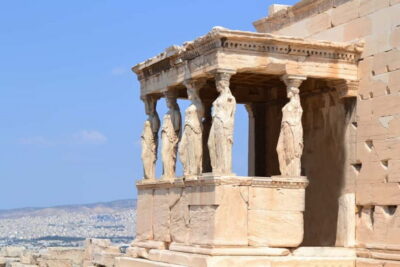
Acropolis, Parthenon & Acropolis Museum Guided Tour
Read our review →

Acropolis: Acropolis and Parthenon Guided Walking Tour
Read our review →
Acropolis monuments & Parthenon Walking Tour with Optional Acropolis Museum
Read our review →Browse the lists this tour appears in