
Reviewed · KNOSSOS PALACE TOURS
Heraklion: Knossos Private Guided Tour & Skip-the-Line Entry
Knossos still keeps one big secret. This private 1.5-hour visit makes the sprawling Bronze Age palace easier to understand, with skip-the-line entry and a licensed guide who connects the Minotaur myth to the real people, buildings, and rituals of ancient Crete. I like the private format, since you can ask questions without following a large group, and I like that your entrance ticket is included rather than handled as a separate chore.
The main point to consider is the short running time. Ninety minutes is enough for a clear introduction and the major sights, but Knossos covers more than 1,500 interconnected rooms, so you will not see every corner. Summer heat, crowds, uneven ground, and the lack of wheelchair access also make timing and footwear important.
In This Review
- Key things to know before you book
- Why a private guide helps at Knossos
- Entering the Palace of Knossos without the long ticket queue
- The first palace and the rise of Bronze Age Knossos
- Seeing the throne linked to King Minos
- The royal quarters and Queen Pasiphae’s dolphin apartment
- Myths, Minotaur stories, and archaeological reality
- What the 90-minute itinerary feels like
- Timing, heat, crowds, and what to bring
- Is $206 per person good value?
- Who should book this Knossos tour?
- Should you book it?
- FAQ
- Where does the Knossos tour meet?
- How early should I arrive?
- How long does the guided tour last?
- Is the entrance ticket included?
- Does the tour skip the ticket line?
- Is transportation included?
- Which languages are available?
- Can I bring luggage or a large bag?
- Can I cancel the tour or pay later?
Key things to know before you book
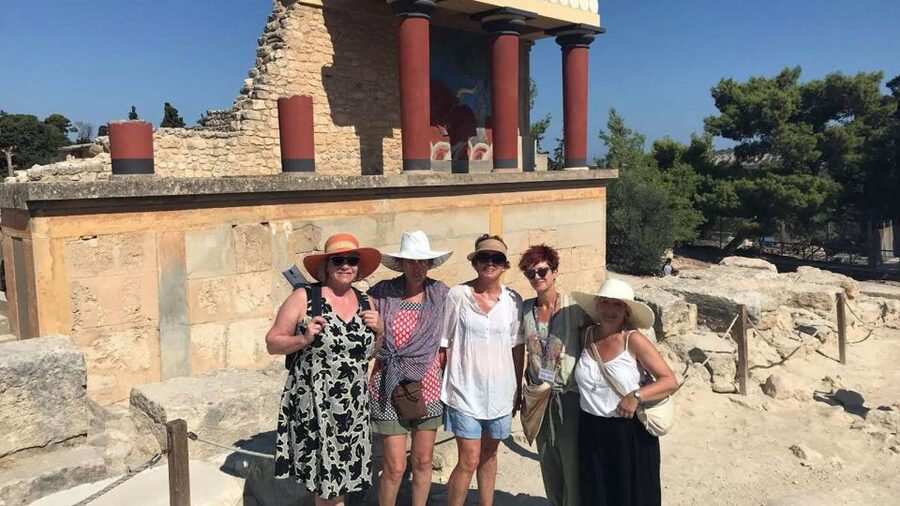
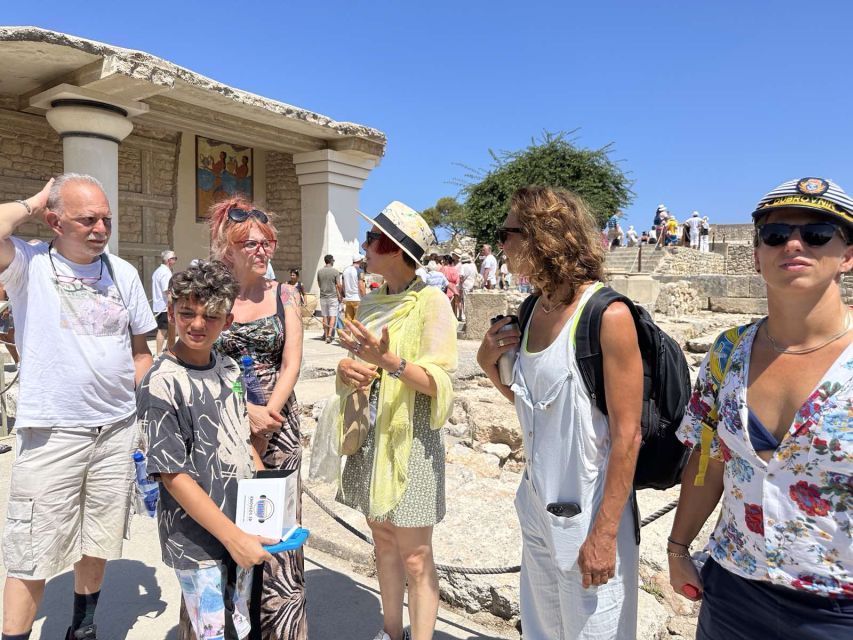
- Your guide meets you at the ticket booth: Look for the check-in operator holding a sign with the WeGuide.gr meeting-point logo. Check-in begins 20 minutes before the scheduled start.
- The private group format changes the visit: You get a licensed guide for your own group, with time for questions and explanations suited to your interests.
- The famous throne is part of the route: You will see the throne associated with King Minos, described here as the oldest throne in Europe.
- The 9 a.m. start is worth considering: One family found that this time meant less heat and fewer people, though availability depends on the date.
- Transportation is not automatic: You can reach Knossos by local bus, car, or taxi. Round-trip transfers are available from Heraklion city for an added option.
- Pack light and protect yourself from the sun: Large bags are not allowed. Bring water, sunglasses, a hat, sunscreen, and comfortable shoes.
Why a private guide helps at Knossos
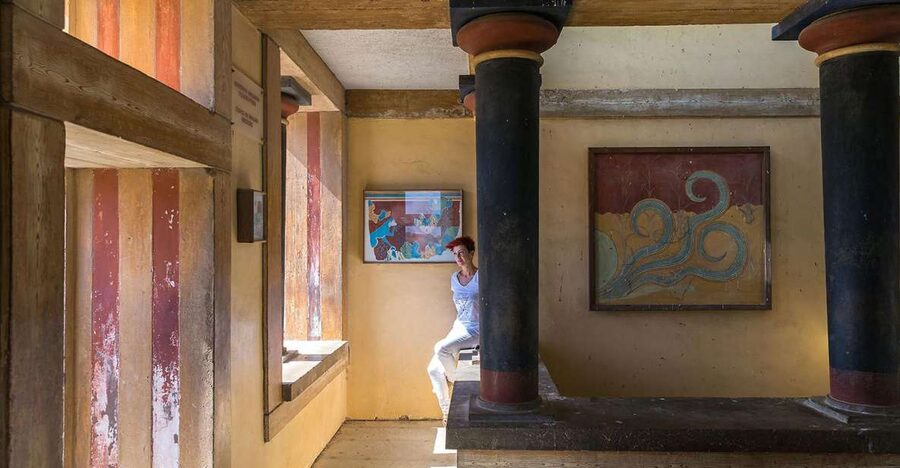
Knossos can be confusing without context. You walk among walls, stairways, storage spaces, courtyards, and painted fragments, but the ruins do not always explain themselves. A good guide gives each section a purpose and helps you picture how the palace functioned.
This tour is led by a licensed guide, with English, French, Russian, and Greek available. The private setup gives you a better chance to ask about details that catch your eye, from the palace’s drainage systems to the meaning behind its sanctuaries.
I especially like the way this experience treats mythology as a doorway rather than a substitute for archaeology. The Minotaur, King Minos, and the Labyrinth are central to the popular image of Knossos, but the guide also brings you back to the physical site: its storage jars, royal rooms, workshops, frescoes, and carefully planned water systems.
That balance matters. Knossos is not simply a setting for a famous monster story. It was a major center of Bronze Age Crete, with a large palace complex built around courts, ceremonial spaces, domestic quarters, and work areas.
More Knossos and Minoan palace days:
- Crete: Knossos Palace Entry Ticket with Optional Audio Guide
★ 3.9 · 2,251 reviews - Crete: Palace of Knossos E-Ticket and Audio Guide
★ 3.8 · 1,540 reviews - Knossos: Knossos Palace Skip-the-Line Guided Walking Tour
★ 4.8 · 1,380 reviews
Entering the Palace of Knossos without the long ticket queue
Your meeting point is by the ticket booth at Knossos. The check-in operator will be holding a sign with the WeGuide.gr logo, and you should arrive early enough for the 20-minute check-in period.
The included entrance ticket is one of the tour’s practical advantages. Knossos can draw large crowds in summer, and skipping the ticket line saves time at the exact point when the sun is already beginning to feel strong. You still need to pass through the site entrance, but you avoid standing in the regular ticket queue.
Do not confuse skip-the-line entry with a private entrance to every part of the palace. The benefit is faster admission and a guide waiting to lead your group once you are inside.
The site is easy to reach from Heraklion by local bus, car, or taxi. If you prefer not to arrange transport, you can select round-trip transfer service from Heraklion city. Transfers from other locations may cost extra, so ask for a quote before booking if you are staying outside the city.
The first palace and the rise of Bronze Age Knossos
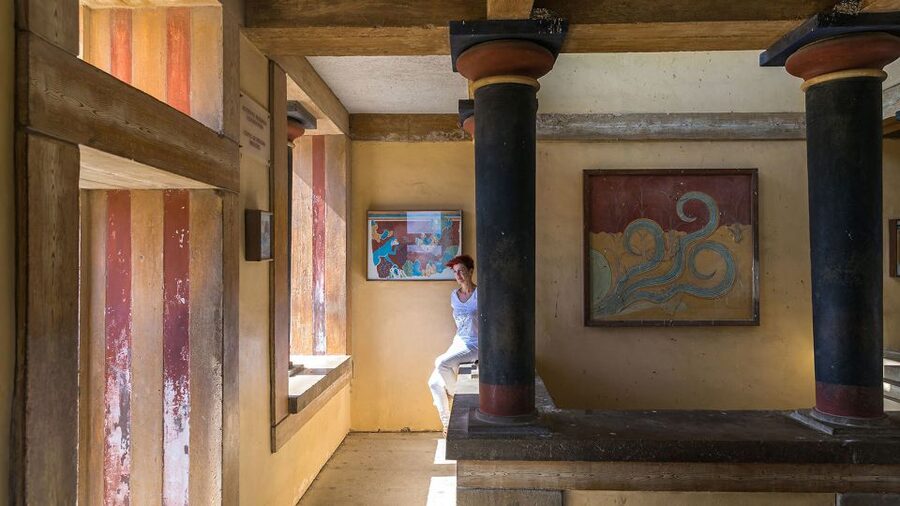
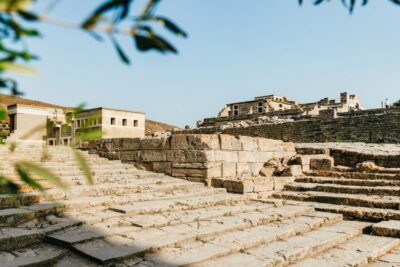
Your guide will place the ruins in a broad time frame. The first palace at Knossos was built soon after 2000 BC. An earthquake destroyed it around 1700 BC, and a second palace was built soon after.
That later palace remained a major center of power for more than 300 years. Its scale is what makes the place so striking. The complex had hundreds of rooms spread across as many as four levels, along with large storage areas, workshops, courts, and spaces for ceremonies and feasts.
The palace was not designed like a simple block with one grand hallway. It grew as a connected system of rooms and passages, which helps explain the Labyrinth tradition. The word can make you expect a dark maze, but the real fascination is the way the buildings combine practical systems with ceremonial display.
Look for the evidence of planning. Huge clay storage jars, or pithoi, show how supplies were kept. Drainage systems point to a society that paid close attention to water and sanitation. Some rooms were set lower into the ground, giving the complex different levels and making its layout harder to grasp at a glance.
Your guide’s explanation is especially useful here. Without it, you might see broken pottery and low walls. With context, those same remains become clues about food storage, administration, craft work, and palace life.
Seeing the throne linked to King Minos
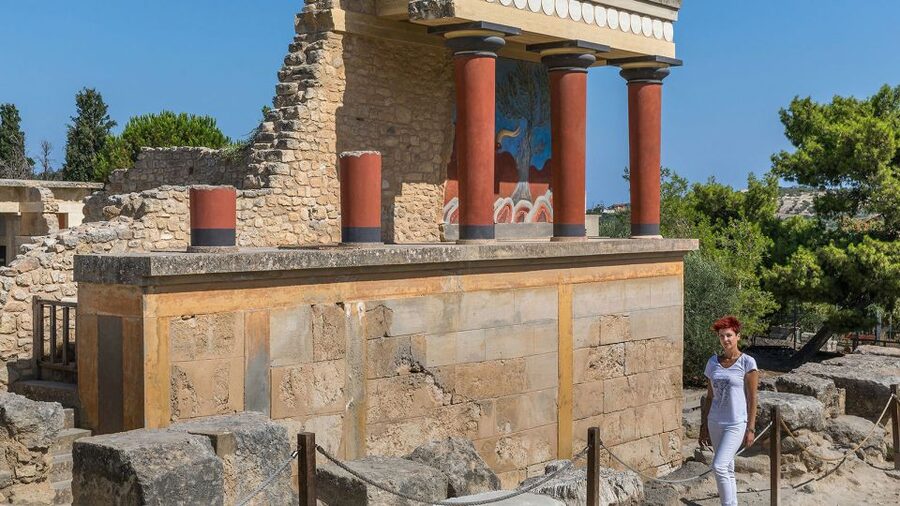
The throne room is one of the major moments of the visit. Here you can see the throne associated with King Minos, described as the oldest throne in Europe.
The room is important not only because of the object itself, but also because it shows how myth and archaeology overlap at Knossos. The name Minos belongs to the legendary king of Crete, yet the surviving throne is a real, carefully made object in a real room. Your guide can help separate what the site proves from what later stories add.
This is the sort of stop that benefits from a private guide. You can ask how the throne room may have been used, what is original, and how later interpretation shaped the way Knossos is presented today.
The visit does not turn the throne into a simple fairy-tale prop. Instead, it uses the object to show why Knossos has held such a strong place in European imagination. You get the myth, but you also get the physical evidence.
A few more Crete half-days to weigh up
- Knossos Palace Skip-the-Line Ticket & Private Guided Tour
★ 4.9 · 633 reviews - Essential Athens Highlights Plus Cape Sounion Skip-The-Line Tour
★ 5.0 · 705 reviews - Athens Skip the Line: Open Air Ancient Greek Theatre Performance
★ 4.5 · 520 reviews - Acropolis Of Athens & Acropolis Museum Skip The Line Private Guided Tour
★ 5.0 · 102 reviews
The royal quarters and Queen Pasiphae’s dolphin apartment
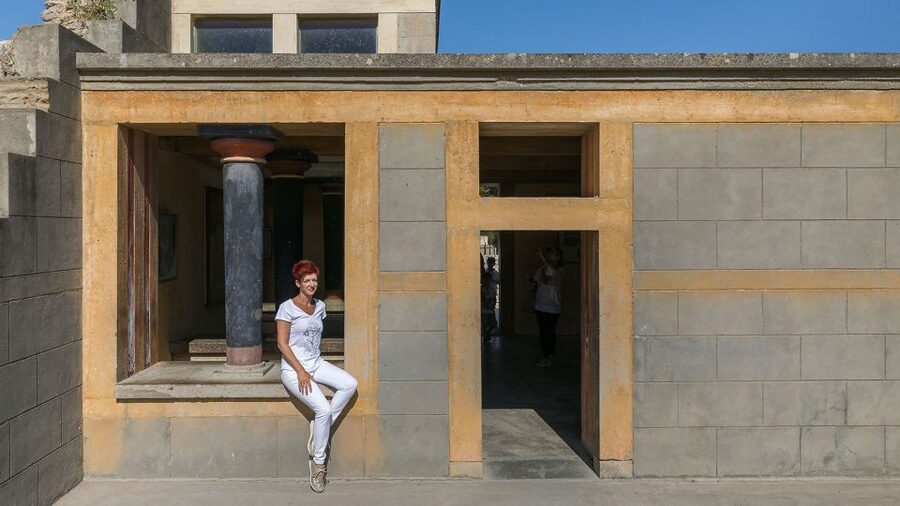
The royal domestic rooms offer a different view of Knossos. Rather than focusing on power and ceremony, this part of the palace points toward daily life and luxury.
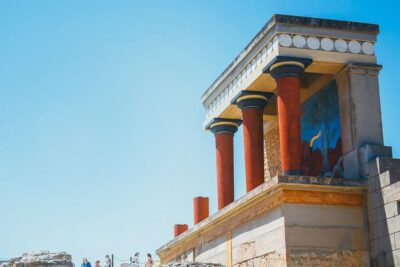
You will see the area known as Queen Pasiphae’s dolphin apartment, one of the more decorative spaces associated with the royal family. Its dolphin imagery gives the room a lighter, more graceful character than the storage and service areas elsewhere in the complex.
The palace’s wall paintings are another highlight. Their colors and flowing forms later inspired Art Nouveau artists, and your guide can help you notice the curves, movement, and natural subjects that make these fragments so memorable.
Keep your expectations realistic. The palace is a ruin, and not every painting or architectural feature survives in its original condition. Some of what you see reflects reconstruction and interpretation, while other sections are bare walls, foundations, or partial rooms.
That mix is part of the experience. You are not touring an untouched palace. You are piecing together an ancient center from surviving remains, restored elements, and expert explanation.
Myths, Minotaur stories, and archaeological reality
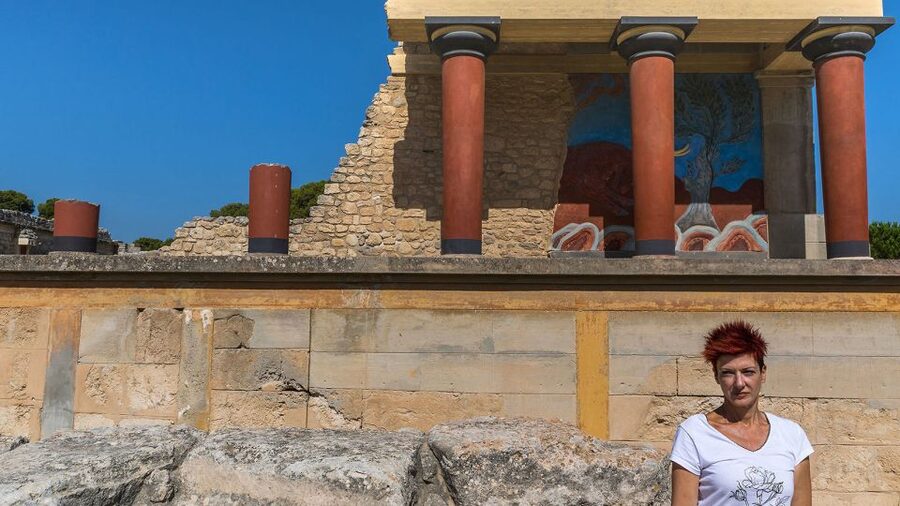
Knossos is tied to several of the best-known Greek myths. The Labyrinth, the Minotaur, King Minos, and Queen Pasiphae all belong to the story world surrounding the palace.
A strong guide can make those stories enjoyable without presenting them as straightforward fact. This tour specifically focuses on unraveling the myths and legends, which should appeal to anyone who wants more than a dry list of dates.
Akrivi Chatzigeorgiou is the named experience provider, and one especially praised guide, also named Akrivi, was noted for connecting the mythology with what archaeology can actually tell us. That approach is useful for families and first-time visitors. Teenagers can follow the Minotaur story, while adults can pay attention to the palace’s construction, rituals, and political role.
One family of two adults and two teenagers found that the 90-minute length worked well and that the guide connected Knossos to things they had already seen at the archaeological museum. If you visit that museum in Heraklion before coming here, the palace can make many of its objects easier to picture in their original setting.
What the 90-minute itinerary feels like
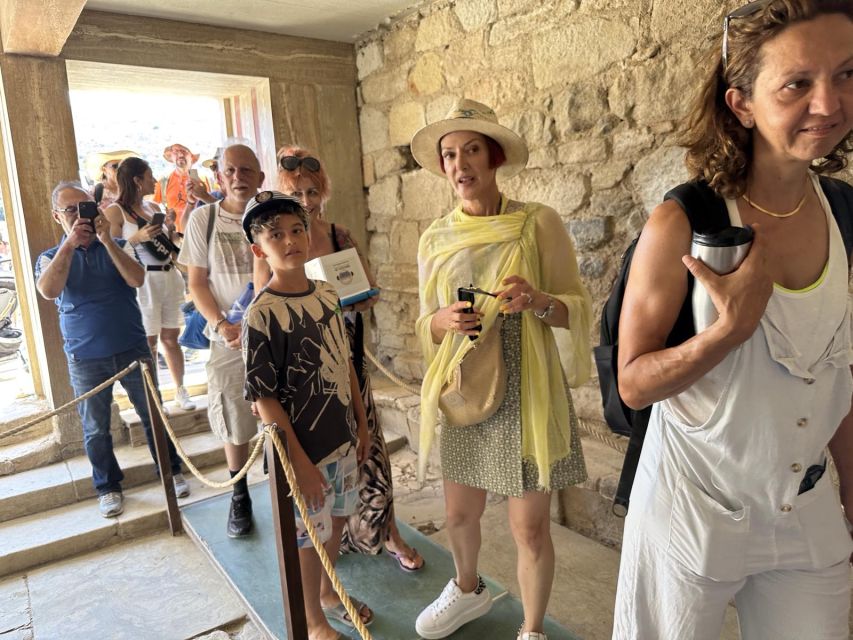
The itinerary is simple. You meet at the Knossos ticket booth, enter with your guide, spend about 1.5 hours touring the palace, and finish back at the meeting point area.
The first part is likely to establish the site’s layout and major story. This is where you begin to understand the scale of the complex and why people associate it with a labyrinth.
The middle portion focuses on the key rooms and features: the throne of Minos, royal quarters, Queen Pasiphae’s dolphin apartment, frescoes, storage jars, sanctuaries, and drainage systems. Your guide’s job is to select the most meaningful stops rather than march you through every surviving wall.
The final part brings the pieces together. You should leave with a clearer idea of how the palace functioned, how the myths grew around it, and why Knossos is often called Europe’s oldest city.
Ninety minutes is a sensible length for a hot day. It gives you a focused visit instead of an exhausting march through a very large site. The trade-off is that you will not have time to wander slowly through every area or linger at each feature.
If you want more time for photographs, sketching, or quiet exploration, plan on staying nearby after the guided portion if site rules and opening arrangements allow. The tour itself is designed as a concentrated introduction, not a full-day archaeological study.
Timing, heat, crowds, and what to bring
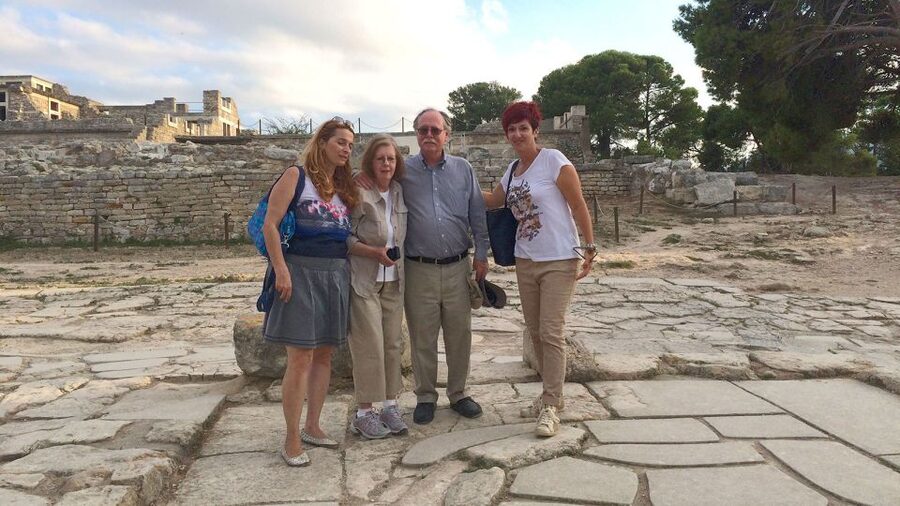
Summer conditions can shape your opinion of Knossos. Much of the visit takes place outdoors, and shade may not be available exactly when you want it. A morning booking is the safest choice if you dislike heat or want a calmer start.
One family specifically recommended 9 a.m. because it was cooler and less crowded. That timing also leaves the rest of your day open for Heraklion’s archaeological museum, lunch, or other plans.
Wear shoes that can handle uneven archaeological surfaces. Bring water, sunglasses, a sun hat, and sunscreen. You should also carry a passport or ID card, and children need identification as well.
Large bags and luggage are not allowed. This is worth taking seriously if you are coming directly from a hotel changeover or arriving with airport luggage. A small day bag is the practical choice, but confirm that it meets the site’s current restrictions.
The experience is not suitable for wheelchair users or people with mobility impairments, and it is not recommended for pregnant women. The combination of uneven ground, outdoor walking, and archaeological ruins makes this a tour to choose with care if walking is difficult.
Is $206 per person good value?
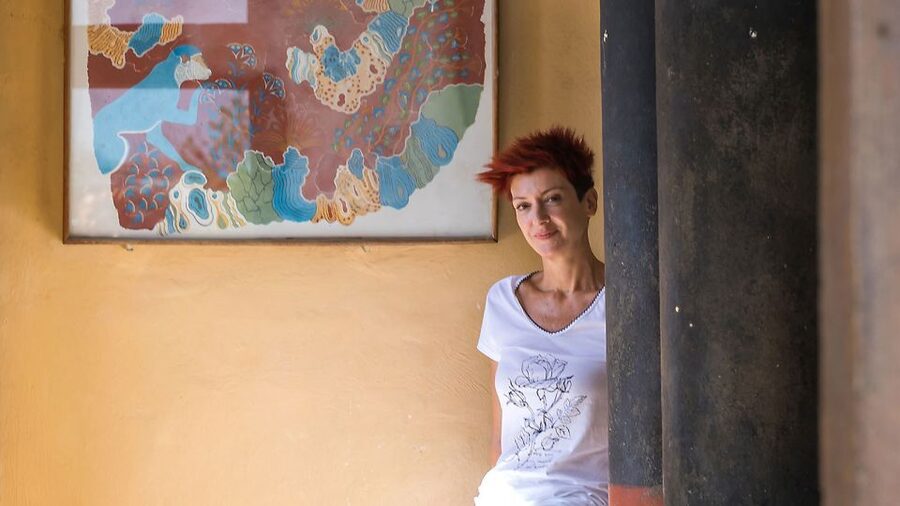
At $206 per person, this is not a budget entry ticket. You are paying for a private group, a licensed guide, and admission, with skip-the-line access included.
The value depends on how much explanation you want. If you are happy to read signs, follow a guidebook, and make sense of the ruins yourself, the price may feel high for 90 minutes. If you want the palace’s myths, architecture, and archaeological evidence explained in a personal setting, the cost is easier to justify.
Private touring is most useful for a small family, a couple, or a group with mixed interests. You can ask questions, move at a sensible pace, and avoid being one face in a large crowd. The guide can also adjust the explanation for children or connect Knossos with what you have already seen in Heraklion.
The included ticket and skip-the-line entry add real convenience during the busy summer period. Still, this is not an all-day excursion. Food and drinks are not included, and hotel pickup and drop-off are not part of the standard price.
I would call it a premium, focused experience. It offers good value for travelers who place a high price on time, personal attention, and a clear explanation. It offers weaker value if your main goal is simply to enter the site as cheaply as possible.
Who should book this Knossos tour?
I would choose this tour if you want the palace to make sense rather than simply want to walk through ancient ruins. It is especially suited to first-time visitors, families, history fans, and anyone interested in the connection between Greek myth and Bronze Age Crete.
The tour also fits well into a short Heraklion stay. At 1.5 hours, it gives you a structured visit without taking the entire day. Pairing it with the archaeological museum can be particularly helpful because the museum provides objects and the palace provides the setting.
I would think twice if you need step-free access, dislike outdoor heat, or want several hours for slow independent exploration. The price also requires a clear interest in guided touring.
The strongest reason to book is the guide. The best moments here come from explanation: why the palace is laid out as it is, what the throne represents, how the drainage worked, and where mythology parts company with archaeology. The guide associated with Akrivi Chatzigeorgiou has been praised for clear storytelling, current archaeological context, and moving groups away from excessive heat and crowded spots.
Should you book it?
Book this private Knossos tour if you want a well-organized introduction with a licensed guide, included admission, and a better chance of avoiding the longest entry queue. Choose an early start, bring water and sun protection, and arrive at the ticket booth 20 minutes before departure.
Skip it if you are looking for the lowest-cost way into Knossos, need accessible touring, or want a long self-guided visit. For most first-time visitors who value context and personal attention, the 90-minute format gives the famous palace a clearer shape, and the private setting makes the $206 price easier to defend.
FAQ
Where does the Knossos tour meet?
The check-in point is by the ticket booth at the Palace of Knossos. An operator will be holding a sign with the WeGuide.gr meeting-point logo.
How early should I arrive?
Check-in begins 20 minutes before the scheduled tour start time. Arrive early enough to find the ticket booth and meet the operator without rushing.
How long does the guided tour last?
The guided visit lasts 1.5 hours, or 90 minutes.
Is the entrance ticket included?
Yes. Entrance tickets are included with the private guided tour.
Does the tour skip the ticket line?
Yes. The experience includes skip-the-line access to the ticket queue at Knossos.
Is transportation included?
Hotel pickup and drop-off are not included as standard. Optional round-trip transfers are available from Heraklion city, and a transfer from another location may involve an additional fee.
Which languages are available?
The live guide is available in English, French, Russian, and Greek.
Can I bring luggage or a large bag?
No. Luggage and large bags are not allowed at the site. Bring only a small practical bag that complies with the site rules.
Can I cancel the tour or pay later?
You can cancel up to 24 hours in advance for a full refund. The reserve-now, pay-later option lets you book without paying immediately.
Just added around Crete
- VIP Luxury Private Tour – Full Day – 4×4 Excursion with LandRover★ 5.0 · 32 reviews
- Lasithi –Plateau Traditional Vilages★ 5.0 · 40 reviews
- Private Full-Day Knossos-Lasithi Plateau-Cave of Zeus from Elouda★ 5.0 · 28 reviews
- Knossos Palace and Pottery experience (Luxury Adventure)★ 4.5 · 32 reviews
- Sarakina Gorge, Kritza, Oliveoil Tasting, Mountains, South Coast★ 5.0 · 92 reviews
- Full-Day Land Rover Safari from Rethymno with Lunch Swimming★ 5.0 · 215 reviews
- Island Spinalonga, Milatos Cave,private Speedboat,OliveOilTasting★ 4.5 · 39 reviews
- Richtis Waterfall, History, Azoria, OliveTasting, NorthCoast★ 5.0 · 83 reviews
Knossos Palace Tours, compared.
Knossos Palace Entry Ticket with Optional Audio Guide
Read our review →
Knossos: Knossos Palace Skip-the-Line Guided Walking Tour
Read our review →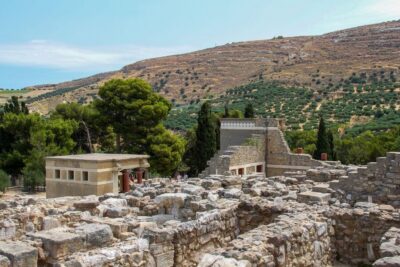
Knossos Palace and Museum E-Tickets with Audio Guides
Read our review →
Knossos-Zeus Cave -Old Traditional Villages-Olive Oil Factory
Read our review →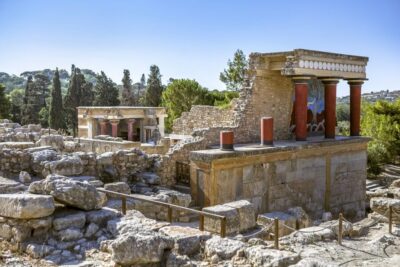
Knossos Palace Skip-the-Line Ticket & Private Guided Tour
Read our review →
Knossos, Lasithi, Lasinthos and Olive Farm Combo Tour
Read our review →Browse the lists this tour appears in