
Reviewed · ACROPOLIS TOURS
Parthenon & Acropolis Guided Tour in Spanish -Option Tickets
Start before the Acropolis heats up. This two-hour walking tour gives you a clear path through Athens’ most important ancient site, from the Theatre of Dionysus to the Parthenon and the Caryatids. I especially like the early start, which can help with heat and crowds, and the fact that the tour is conducted entirely in Spanish by an official, certified guide. The $33 price is reasonable if your ticket is included, but check the booking option carefully, since admission is not included with every choice.
The pace is active without trying to rush the hill. Guides such as Efi and Simon have earned praise for making complicated history easy to follow, using myths, politics, art, and practical advice rather than simply reciting dates. The main limitation is that this is not a private visit, and the Acropolis terrain is not suitable for wheelchair users. Bags, food, drinks, strollers, and non-folding wheelchairs are also not allowed.
In This Review
- Key points at a glance
- Why this Acropolis tour works well in Spanish
- Meeting at the southern entrance
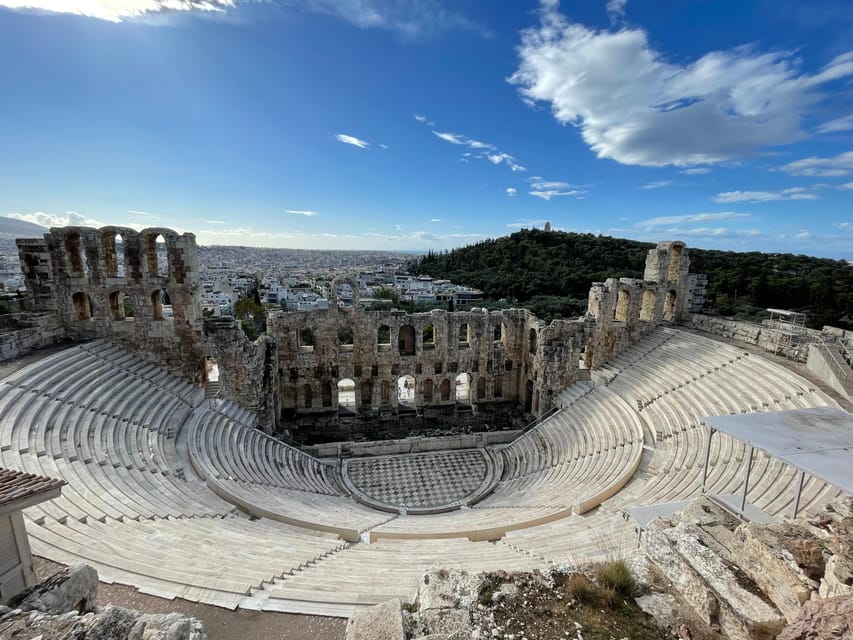
- The Theatre of Dionysus, where Greek drama began
- The Asklepieion and ancient ideas about healing
- The Odeon of Herodes Atticus
- Entering through the Propylaea
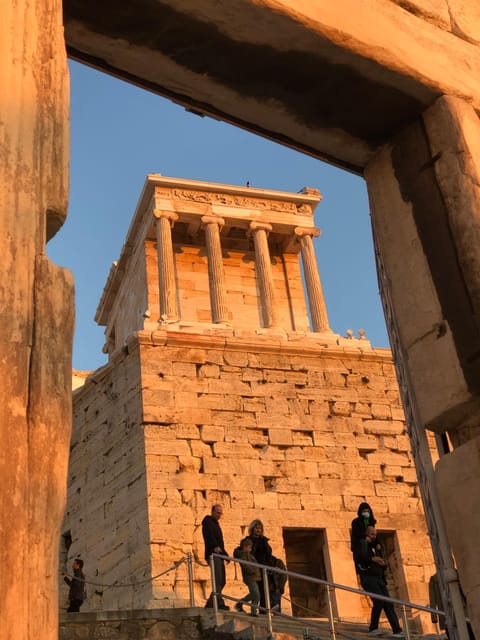
- Temple of Athena Nike and the Parthenon
- The Erechtheion and the famous Caryatids
- The final view from the top
- How the guides shape the experience
- Is $33 a fair price?
- Who should book this tour?
- Practical advice before you go
- Should you book it?
- FAQ
- How long does the Acropolis tour last?
- What language is the tour conducted in?
- Is the entrance ticket included?
- Where is the meeting point?
- How do I find the guide?
- Does the tour include hotel pickup?
- Are headphones provided?
- Can I bring food and drinks?
- Are strollers and bags allowed?
- Is the tour suitable for wheelchair users?
Key points at a glance
- Spanish from start to finish: The live guide speaks Spanish exclusively, useful for families and couples who want more than a translated audio guide.
- A complete route inside the Acropolis: You visit the Theatre of Dionysus, Asklepieion, Odeon of Herodes Atticus, Propylaea, Temple of Athena Nike, Parthenon, Erechtheion, and Caryatid Porch.
- Early entry matters: Beginning in the morning can mean cooler conditions and better chances of avoiding the heaviest crowds.
- The guide shapes the experience: Efi and Simon are praised for clear explanations, warmth, storytelling, and a good walking pace.
- Free time at the summit: The guided portion ends on top of the hill, allowing you to take photos and enjoy the 360-degree views at your own speed.
Why this Acropolis tour works well in Spanish
The Acropolis can feel confusing on your first visit. Temples, theatres, sanctuaries, retaining walls, and later repairs all occupy one rocky hill. Without context, you may admire the columns but miss why each building mattered.
A Spanish-speaking guide gives the site a useful order. You move from the southern slope into the ancient religious and theatrical center, then pass through the Propylaea before reaching the Parthenon and Erechtheion. That sequence helps you understand the hill as a place of worship, public life, healing, art, and civic identity.
I like that the explanations include both history and mythology. You hear about Athena and Poseidon competing to become the city’s protector, along with the olive tree and water source associated with that contest. These stories are not just colorful extras. They help explain why Athena mattered so much to Athens and why the buildings here were designed around the city’s religious identity.
The Spanish format is also practical. English-language tours are common at major European sights, but a guide who can explain architecture and ancient customs in your preferred language may make the difference between recognizing a name and actually following the story.
More ways to see the Acropolis:
- Athens: Acropolis & up to 5 Archaeological Sites Combo Pass
★ 4.4 · 12,619 reviews - Athens: Acropolis Ticket with Optional Audio or Live Guide
★ 4.2 · 11,055 reviews - Athens: Acropolis, Parthenon & Acropolis Museum Guided Tour
★ 4.8 · 9,316 reviews
Meeting at the southern entrance
The meeting point is at the Tourist Information Center Athens, beside the southern entrance of the Acropolis and across from the Acropolis Museum. The Acropolis metro stop is only a few meters away, which makes this a convenient starting point if you are coming by public transport.
Look for the guide holding the TOP TOURS GREECE office sign. Arrive with enough time to find the group. The southern slope is not the same as the upper entrance, and arriving at the wrong side of the hill could create unnecessary stress before the tour begins.
The tour starts on foot and does not include hotel pickup or transfers. You should also eat before entering if needed, since food and drinks are not allowed inside the site. Bring only what is permitted. Bags, baby strollers, electric wheelchairs, and non-folding wheelchairs are specifically excluded.
Headphones are provided so you can hear the guide clearly. That matters on a busy archaeological site, where groups may gather near the same monument and the guide may need to speak while you stand a short distance away.
The Theatre of Dionysus, where Greek drama began
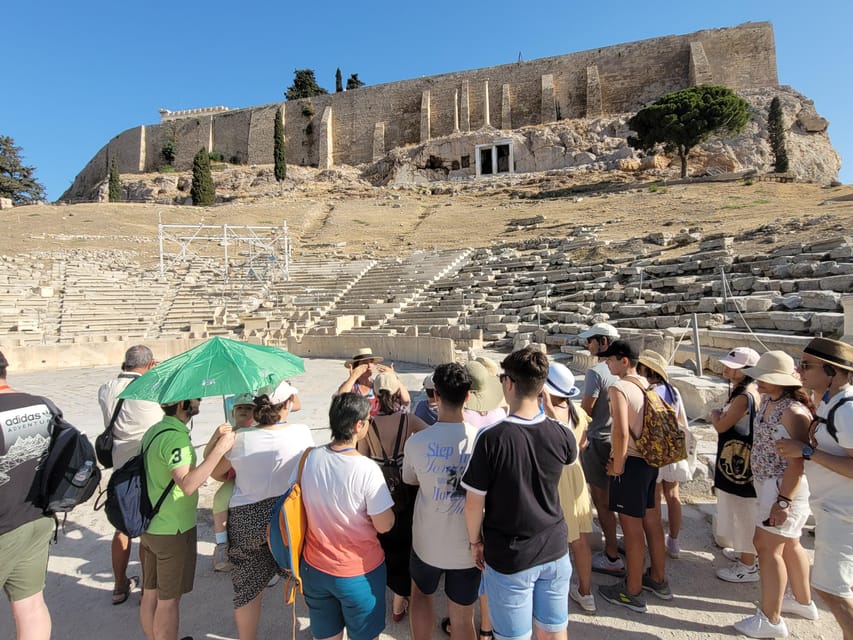
The first guided stop is the Theatre of Dionysus, with about 10 minutes devoted to the site. Built in the fifth century BC, it was dedicated to Dionysus, the god associated with wine and theatre, and could hold around 17,000 spectators.
This is a strong opening because it connects the Acropolis to ordinary public life. Ancient Athens was not only about temples and sacrifices. Drama was a major civic event, and performances helped people think about justice, power, family, war, and the behavior of the gods.
You will not have unlimited time to sit and study every row of stone. Ten minutes is enough for an explanation and a good look, but anyone fascinated by classical theatre may want to return later on their own if the site rules and opening hours allow.
The Asklepieion and ancient ideas about healing
Next comes the Asklepieion of Athens, also known as the sanctuary of Asclepius. The guide spends around 10 minutes here explaining a place connected with the ancient god of medicine.
This stop adds a useful change of subject. The Acropolis was not only a place for grand monuments and state religion. It also included spaces linked to health and healing, with important archaeological finds related to medicine.
The value of having a guide here is clear. Foundations and fragments can be difficult to interpret alone. A good explanation helps you picture how the sanctuary fit into the wider life of the hill, even when much of the original structure is no longer intact.
A few more Athens half-days to weigh up
- Athens: Cape Sounion & Poseidon Temple Sunset Half-Day Trip
★ 4.8 · 8,241 reviews - Athens: Acropolis and Parthenon Guided Walking Tour
★ 4.6 · 5,882 reviews - All Day Cruise -3 Islands to Agistri,Moni, Aegina with lunch and drinks included
★ 5.0 · 4,958 reviews - Athens, Piraeus, and Coastline: Blue Hop-On Hop-Off Bus
★ 3.9 · 4,849 reviews
The Odeon of Herodes Atticus
The route then reaches the Odeon of Herodes Atticus, another 10-minute stop. This grand stone theatre once had a roof and is still used for performances today.
It is one of the Acropolis’ most striking reminders that ancient buildings are not simply dead ruins. The Odeon was designed for music and performance, and its modern use gives the structure an unusual link between ancient Athens and the present day.
Your guide will explain the building from the outside. The tour does not promise a concert or evening event, so treat this as a cultural and architectural stop, not a performance visit. Even so, the view into the theatre is memorable, especially when you consider its original roof and purpose.
Entering through the Propylaea
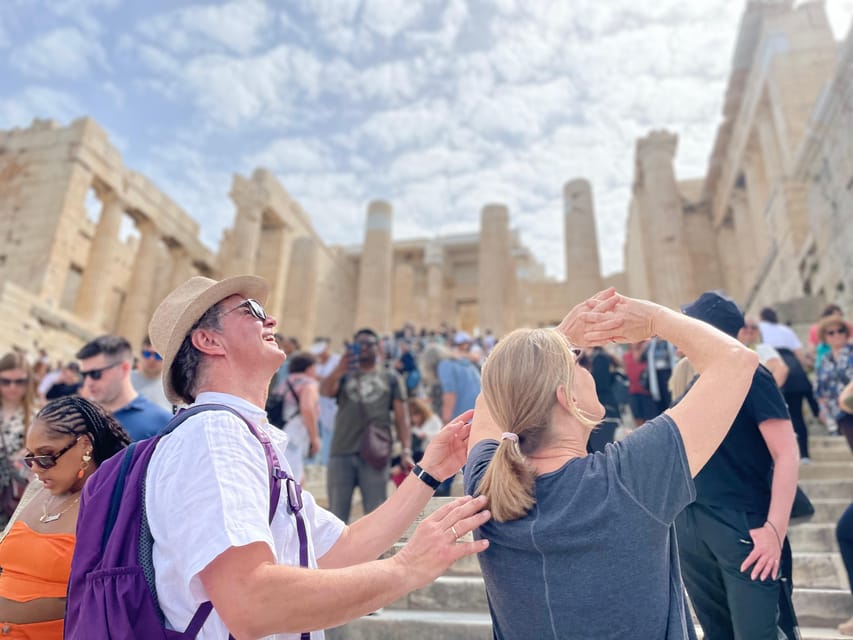
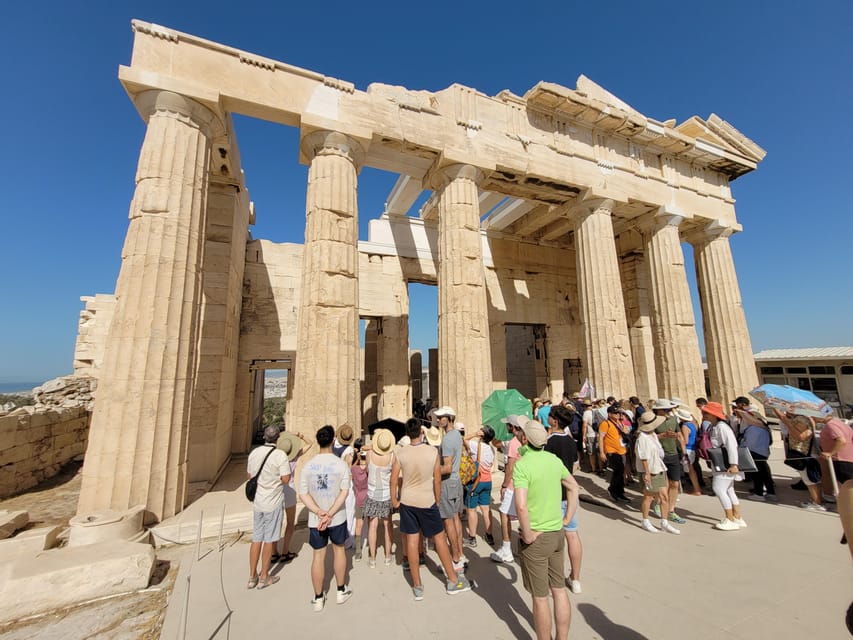
The Propylaea is the monumental gateway to the upper Acropolis. The guide allows about 10 minutes here, pointing out the use of both Doric and Ionic architectural styles.
This is where the visit begins to feel grander. The gateway was not an ordinary entrance. It prepared people for the sacred buildings beyond it, using scale and design to mark the transition from the city below to the holy hill above.
The Propylaea is also a good place to pay attention to the way ancient Greek architecture worked as a complete experience. Columns, passageways, sightlines, and elevation all helped shape how people approached the sanctuaries.
The group moves through rather than lingering for a long architectural study. If you enjoy noticing small details in column capitals and stonework, listen closely and stay near the guide.
Temple of Athena Nike and the Parthenon
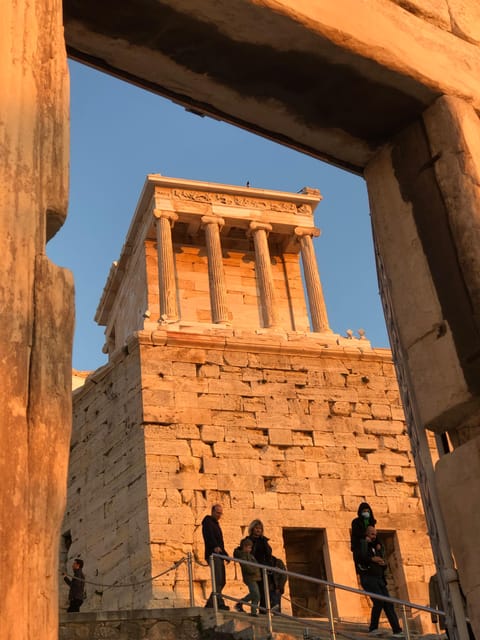
The Temple of Athena Nike receives a shorter explanation of about five minutes. Though compact beside the Parthenon, it honors Athena in her role as bringer of victory.
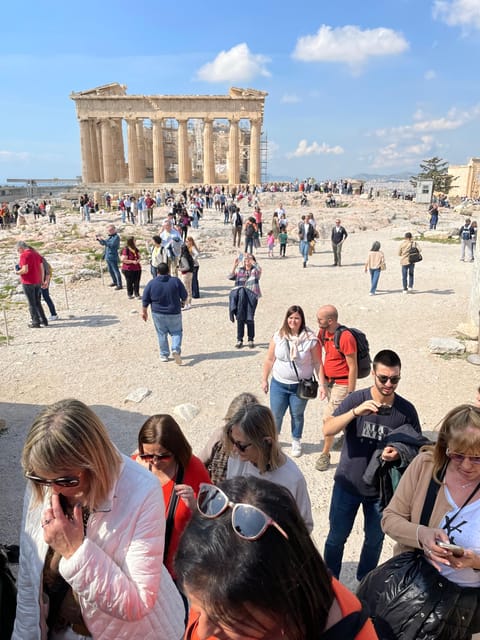
That short stop works as a bridge to the Acropolis’ main monument. You then spend roughly 20 minutes at the Parthenon, the temple dedicated to Athena, the city’s protective goddess.
The Parthenon is often described as the perfect temple of the ancient world. That language can sound grand, but the building’s proportions and visual balance explain why it has held such power for centuries. Your guide can help you look beyond the familiar outline and understand the temple’s religious and civic purpose.
You should expect crowds around the Parthenon, especially later in the day. The early morning schedule is one of this tour’s most useful features. It cannot guarantee an empty monument, but it gives you a better chance of seeing the site before the strongest heat and largest groups arrive.
Do not expect to walk inside the Parthenon. The tour focuses on viewing the monument, its design, its history, and the setting around it. Your guide also helps connect the temple to the wider Acropolis rather than treating it as an isolated photo stop.
The Erechtheion and the famous Caryatids
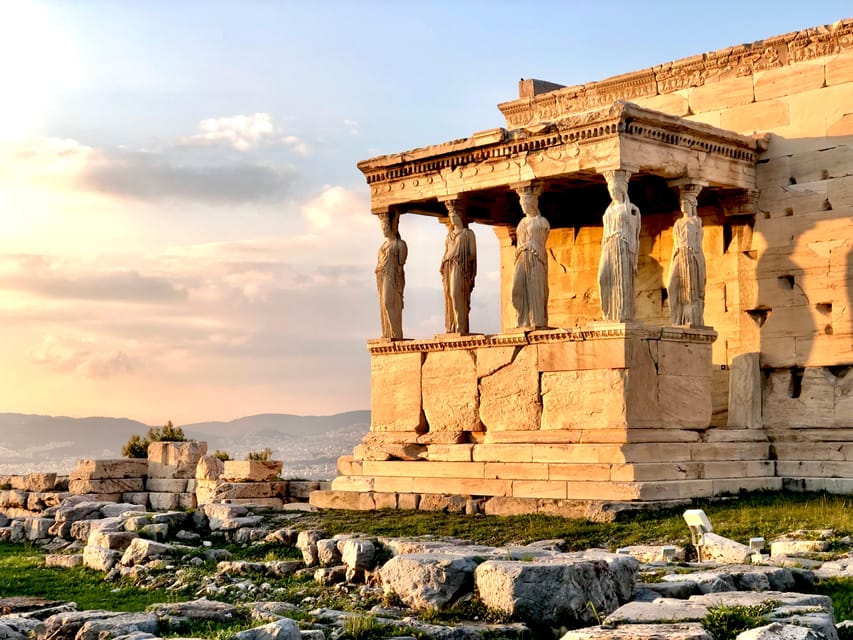
The Erechtheion is next, with around 10 minutes of explanation, followed by a specific look at the Porch of the Caryatids. The Caryatids are the famous female-shaped columns supporting the porch.
This is one of the tour’s most rewarding moments for first-time visitors. The figures look decorative at a glance, but their role as architectural supports makes the porch unusual and memorable. Your guide can also explain why the Erechtheion is different in design from the Parthenon.
The building is tied to the legends of Athena and Poseidon. The marks of their contest, including the city’s sacred olive tree and Poseidon’s water source, connect the structure to the founding stories of Athens.
Keep in mind that the Caryatids visible on the Acropolis are replicas. The original sculptures are protected in the Acropolis Museum, with one Caryatid held in the British Museum. The tour itself does not include the museum, but the guide may give you useful advice about what to see there afterward. One piece of feedback praised the museum as a must-see, while noting that a museum visit can feel long if you are trying to fit it into a tight day.
The final view from the top
The tour ends at the summit of the Acropolis. This is a smart ending because you can stay after the guided portion, take photographs, and enjoy the 360-degree views without being hurried along by the group.
From the top, the ancient buildings make more sense as part of Athens rather than as isolated ruins. The city spreads around the hill, and the height explains why this location became such a powerful symbol.
The guide does not simply release you at the top and disappear. The experience is designed to conclude there, leaving you time for photos and personal viewing. You should use this pause to revisit the Parthenon, look toward the city, and decide whether you want to continue to the Acropolis Museum or nearby historic areas afterward.
The hill can be hot and exposed. Several guide comments praise Efi for finding shade and keeping the group moving sensibly during summer visits. That practical awareness is important. A tour that covers many monuments in two hours needs a guide who watches the pace as well as the clock.
How the guides shape the experience
The strongest pattern in the feedback is the quality of the guiding. Efi is repeatedly praised for her energy, clear storytelling, and ability to keep children interested. She has also been described as helpful with advice about what to do next in Athens.
Simon receives similar praise for being kind, engaging, and well prepared. Other comments describe guides who explain Greek myths, politics, art, and culture in a way that makes the ruins easier to picture.
That does not mean every guide will have the same personality. Tour quality depends partly on the individual assigned to your departure. Still, the company’s official, certified Spanish guide format gives you a stronger basis for expecting a proper interpretation rather than a simple escort around the hill.
The pace appears to be one of the tour’s reliable strengths. You cover a lot in two hours, but the route is not described as rushed. If you want an academic study of every inscription, this is too short. If you want a clear introduction with the major monuments and enough time for photos, it fits well.
Is $33 a fair price?
At $33 per person, the tour offers good value when the admission-ticket option is selected. You receive two hours with a Spanish-speaking guide, headphones, early entry, and a route that covers all the main monuments inside the Acropolis.
The value is strongest for first-time visitors. A self-guided visit may cost less if you already have a ticket and enjoy reading signs or using your own guidebook. But you would need to create your own route and supply the historical background.
Check the ticket selection before paying. The activity includes an entrance ticket only if you choose that option. If you book the guide without admission, you will need to arrange your own entry separately.
Free cancellation up to 24 hours before the tour and the reserve-now, pay-later option add useful flexibility. These policies are especially helpful when your Athens schedule may change, though they do not remove the need to arrive at the correct meeting point on time.
Who should book this tour?
I would recommend it to Spanish-speaking couples, families, and first-time visitors who want the Acropolis explained in a lively way. It is also a good match for anyone making a short stop in Athens and hoping to see the major monuments without spending half a day planning the route.
Families may appreciate the stories about Athena, Poseidon, and the gods. The guides have also shown an ability to keep children involved, which matters on a hot hill filled with stones and columns that can blur together for younger visitors.
You may want something else if you need step-free access, use a wheelchair, want to bring a stroller, or prefer a private visit. It is also not ideal if your main goal is slow photography or detailed archaeological study. Two hours gives you a strong overview, not unlimited time at each monument.
Practical advice before you go
- Choose the earliest available start if you are visiting in warm weather.
- Confirm whether your booking includes the Acropolis entrance ticket.
- Meet at the southern entrance, not at the top of the hill.
- Look for the TOP TOURS GREECE sign at the Tourist Information Center Athens.
- Wear suitable footwear for a two-hour walk over an archaeological site.
- Bring only permitted essentials, since bags, food, drinks, and strollers are not allowed.
- Stay close enough to hear through the provided headphones.
- Keep time after the tour for photos at the summit.
- Consider adding the Acropolis Museum later, especially to see the original Caryatids.
Should you book it?
Book this tour if you want the Acropolis presented in Spanish, with the major monuments arranged in a sensible two-hour route. The early start, clear storytelling, headphones, and time at the summit make it a useful choice at $33, especially when admission is included.
Skip it if you want a private guide, need wheelchair access, or prefer to explore at a very slow pace. For most first-time Spanish-speaking visitors, though, this is a well-priced way to understand far more than the famous Parthenon alone.
FAQ
How long does the Acropolis tour last?
The tour lasts two hours.
What language is the tour conducted in?
The live tour guide speaks Spanish.
Is the entrance ticket included?
The entrance ticket is included only if you choose the ticket option when booking.
Where is the meeting point?
The meeting point is at the Tourist Information Center Athens, beside the southern entrance of the Acropolis and across from the Acropolis Museum.
How do I find the guide?
The guide will hold the TOP TOURS GREECE office sign.
Does the tour include hotel pickup?
No. Hotel pickup and transfers are not included.
Are headphones provided?
Yes. Headphones are provided so you can hear the guide clearly.
Can I bring food and drinks?
No. Food and drinks are not allowed during the visit.
Are strollers and bags allowed?
No. Baby strollers and bags are not allowed.
Is the tour suitable for wheelchair users?
No. The tour is not suitable for wheelchair users, and non-folding and electric wheelchairs are not allowed.
Just added around Athens
- Delphi One Day Trip from Athens★ 4.0 · 98 reviews
- Mercedes Private Tour to Delphi and Arachova★ 5.0 · 30 reviews
- Private Delphi and Hosios Loukas Monastery – Great Lunch and Drinks Included★ 5.0 · 36 reviews
- Day tour to Ancient Olympia,Ancient Sparta Mycenae Including Meal★ 5.0 · 54 reviews
- Athens: Half Day Trip To Cape Sounio/Poseidon Temple Semi Private★ 5.0 · 131 reviews
- Athens Half-Day Private Tour Acropolis, Parthenon City Highlights★ 5.0 · 35 reviews
- From Athens: Day Tour to Mykonos★ 5.0 · 64 reviews
- Culinary Secrets of Downtown Athens★ 5.0 · 103 reviews
Acropolis Tours, compared.
Acropolis & up to 5 Archaeological Sites Combo Pass
Read our review →
Acropolis, Parthenon & Acropolis Museum Guided Tour
Read our review →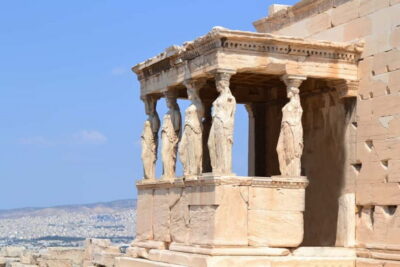
Acropolis, Parthenon & Acropolis Museum Guided Tour
Read our review →
Acropolis: Acropolis and Parthenon Guided Walking Tour
Read our review →
Acropolis monuments & Parthenon Walking Tour with Optional Acropolis Museum
Read our review →Browse the lists this tour appears in