

Reviewed · ACROPOLIS TOURS
Visit of the Acropolis with an official guide in Spanish
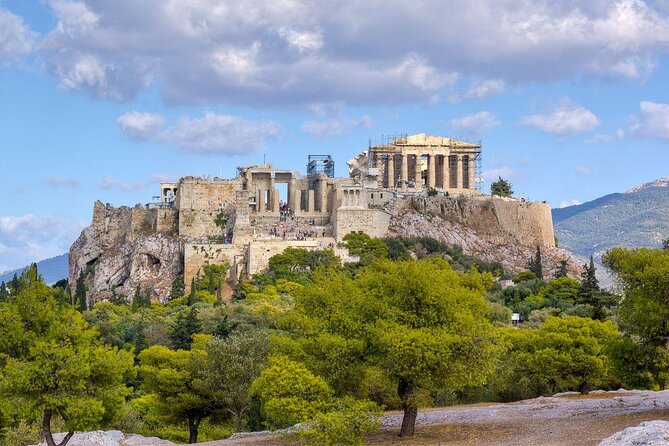
Athens makes ancient stones feel surprisingly close. This two-hour Acropolis tour gives you a clear Spanish-speaking guide, a wireless audio system, and a useful route through the Parthenon, Erechtheion, theaters, and more. I especially like the official Spanish guide and the way the visit connects mythology, politics, architecture, and daily life instead of treating the Acropolis as a pile of old marble. The price is $44.03 per person, but you must buy your own entrance ticket.
I also like that the tour begins early, at 8:30 a.m., before the heat becomes a serious nuisance, and ends at the top of the Acropolis so you can stay for photos. The main consideration is physical: the entire visit is on foot, and the site includes slopes, stone surfaces, and exposed areas. Guides such as Efi, Ari, Simon, and Maria have been praised for making the material lively, though your assigned guide may differ.
In This Review
- Key points to know before booking
- Meeting at the Acropolis entrance
- Setting the scene on the Acropolis
- The Parthenon and its changing identity
- Entering through the marble Propylaea
- The Temple of Athena Nike
- The Erechtheion and the famous Caryatids
- Looking down at the Odeon of Herodes Atticus
- Medicine at the Temple of Asclepius
- The Theatre of Dionysus and the birth of drama
- What the $44.03 price really buys
- Timing, heat, and physical effort
- Who will get the most from this visit
- Should you book the Spanish Acropolis tour?
- FAQ
- Is the Acropolis entrance ticket included?
- What language is the tour conducted in?
- How long does the Acropolis tour last?
- Where does the tour begin?
- Where does the tour end?
- Is transportation included?
Key points to know before booking
- Spanish only: The tour is designed for Spanish-speaking visitors, with an official guide and wireless audio equipment.
- The ticket is separate: The $44.03 price covers the guided visit, not admission to the Acropolis.
- A strong two-hour route: You see the Parthenon, Propylaea, Erechtheion, Odeon of Herodes Atticus, Temple of Asclepius, and Theatre of Dionysus.
- Early start helps: Meeting time is 8:30 a.m., a sensible choice for a sunny, exposed monument.
- The guide is the main value: Efi receives especially warm praise for her passion, explanations, and work with families.
- You finish at the summit: The formal tour ends at the top, leaving you free to take photographs and look around.
Meeting at the Acropolis entrance
The meeting point is the Greek National Tourism Organisation Information Point at Dionysiou Areopagitou 18. The tour starts at 8:30 a.m., and the visit is conducted entirely on foot.
You need to arrange your Acropolis admission separately. This is the most important practical detail. The tour price is not an entry ticket, so your budget must include both the guided experience and the required admission. The guide can explain the monuments once you are inside, but you cannot join the site visit without the entrance ticket.
Because the meeting point is near public transportation, you can reach it without arranging a private transfer. No hotel pickup or return transportation is included. Plan to arrive early enough to find the meeting point, deal with your ticket, and avoid beginning the tour in a rush.
The group can reach 27 people. That is not a private tour, but it is still small enough for a guide using a wireless audio system to be heard more clearly than one speaking to a large crowd without equipment. Stay close to the guide, especially in crowded areas, and keep the receiver volume at a comfortable level.
More ways to see the Acropolis:
- Athens: Acropolis & up to 5 Archaeological Sites Combo Pass
★ 4.4 · 12,619 reviews - Athens: Acropolis Ticket with Optional Audio or Live Guide
★ 4.2 · 11,055 reviews - Athens: Acropolis, Parthenon & Acropolis Museum Guided Tour
★ 4.8 · 9,316 reviews
Setting the scene on the Acropolis
The tour begins with context before the details. That is valuable here because the Acropolis is easy to admire but harder to understand. Without a guide, you see columns, steps, broken statues, and a famous temple. With a good explanation, the hill becomes a place shaped by religion, war, civic pride, changing rulers, and centuries of reuse.
The opening discussion covers the historical, mythological, and cultural role of the Acropolis. That broad start suits first-time visitors who want the basic story before tackling architectural terms.
This is also where the guide’s personality matters most. Efi is repeatedly praised for asking questions, encouraging the group to imagine past events, and explaining mythology, history, geography, and anthropology in an accessible way. Other highly praised guides include Ari, Simon, and Maria. The exact guide is not guaranteed, but the experience clearly depends heavily on having someone who can turn a technical site into a human story.
The wireless audio system should help you listen while walking rather than stopping in one tight cluster around the guide. That makes it easier to hear explanations and still keep an eye on the monuments.
The Parthenon and its changing identity
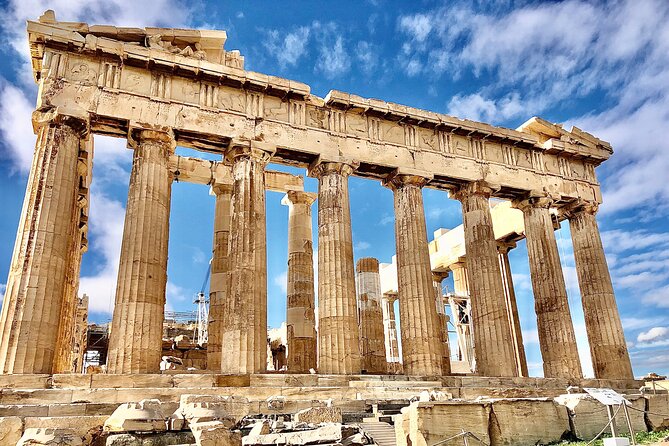
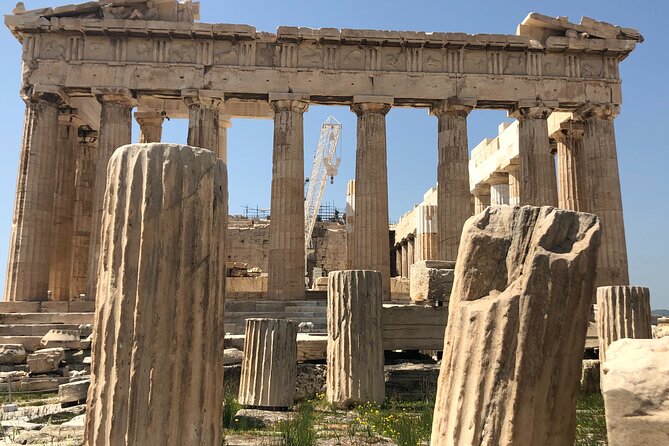
The Parthenon is the centerpiece, and the tour spends about 20 minutes explaining why it is considered one of antiquity’s most important buildings. You will hear about its construction roughly 2,500 years ago, its visual refinements, and the legends tied to it.
The architectural discussion includes the Parthenon’s optical refinements. These are the subtle adjustments that make the building appear balanced and harmonious when viewed by the human eye. This is a worthwhile subject for a guide because the temple’s power is not only its size or age. It also comes from careful proportion and design.
The guide also traces the building through several later phases. The Parthenon became a church during the Byzantine period and a mosque during Ottoman rule. Its story includes decoration, looting, damage, and the restoration work that continues today.
That wider timeline is one of the tour’s strengths. You are not asked to admire the Parthenon as if it existed untouched in classical Greece. You learn that famous monuments survive through change, conflict, reuse, and repair. At the same time, a 20-minute stop cannot cover every argument about restoration or every detail of the building. If you want an expert-level architectural study, you will need more time after the tour.
Entering through the marble Propylaea
The Propylaea is the monumental entrance to the Acropolis. The tour allows about 10 minutes here, enough to explain its imposing marble construction and its role as a carefully designed threshold.
The guide points out the different types of columns and explains why the entrance was built in this way. Its position and topography also gave it a practical role during war, acting as a funnel through which people had to pass.
This is a good reminder that the Acropolis was not designed only for distant beauty. Its buildings directed movement, shaped ceremonies, and communicated power. The Propylaea prepared ancient worshippers and modern visitors alike for the sacred area beyond.
The entrance can be one of the more crowded parts of the route, and the ground is not a smooth city pavement. Keep your attention on both the guide and your footing.
A few more Athens half-days to weigh up
- Athens: Cape Sounion & Poseidon Temple Sunset Half-Day Trip
★ 4.8 · 8,241 reviews - Athens: Acropolis and Parthenon Guided Walking Tour
★ 4.6 · 5,882 reviews - All Day Cruise -3 Islands to Agistri,Moni, Aegina with lunch and drinks included
★ 5.0 · 4,958 reviews - Athens, Piraeus, and Coastline: Blue Hop-On Hop-Off Bus
★ 3.9 · 4,849 reviews
The Temple of Athena Nike
The itinerary includes the small temple honoring Athena Nike, described as an architectural jewel above the main entrance. It commemorated Athenian victories over the Persians and celebrated the city’s golden age.
The monument is important because it packs a large political message into a compact structure. Athena Nike represented victory, and placing her temple beside the entrance meant that the idea of triumph greeted anyone entering the Acropolis.
The supplied schedule does not give this stop a separate time, so expect a short explanation as part of the route rather than a long standalone lecture. This is a recurring feature of the tour: several monuments receive focused introductions, while the overall visit keeps moving.
The Erechtheion and the famous Caryatids
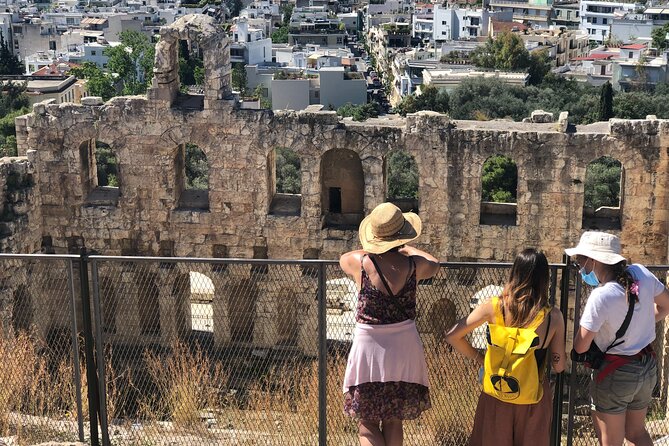
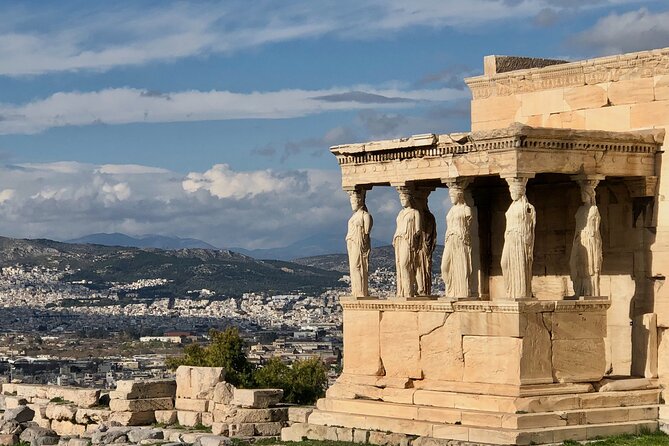
The Erechtheion is likely to be your favorite photo stop. Its Caryatids, female-shaped columns, give the building a look unlike anything else on the hill. The tour allows about 10 minutes to explain the monument and its unusual religious role.
The Erechtheion was dedicated to several divine and heroic figures, including Athena, Poseidon, and Erechtheus, the mythical first king of Athens. That shared dedication helps explain why the building is less symmetrical and more complex than the Parthenon.
You will also hear about the sacred olive tree associated with Athena. Its story connects the building to the contest between Athena and Poseidon for the protection of Athens. This is the kind of detail that makes the monument easier to remember long after the columns blur together.
The Caryatids draw crowds, so your guide’s advice on where to stand for photographs can be useful. Efi has been praised for pointing out precise photo locations, allowing people to take pictures without missing the explanation. The tour does not promise a private viewing area, so be ready to share the best angles.
Looking down at the Odeon of Herodes Atticus
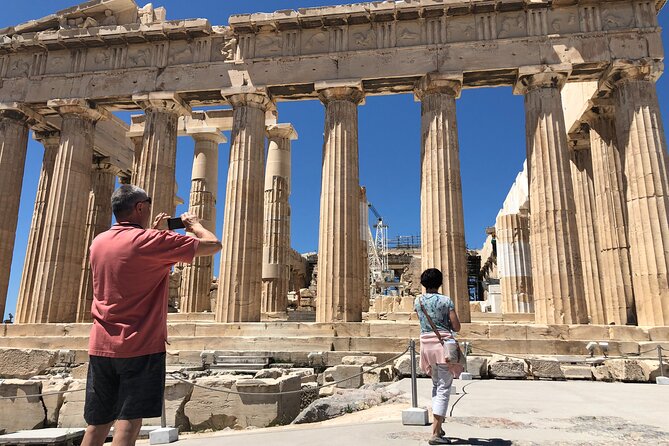
The Odeon of Herodes Atticus receives about 10 minutes. Built by the Roman governor Herodes Atticus in memory of his wife Regina, this theater could hold about 5,000 spectators.
It is also unusual because it remains in use. The fully restored building hosts performances during the Athens Festival, giving you a direct link between ancient entertainment and modern cultural life.
From the Acropolis, you mainly appreciate its setting, shape, and scale. The guide explains how the venue worked and why it remains significant. You should not expect to enter for a performance during this tour, but the view alone helps you understand how theater was fitted into the rocky slopes below the sacred hill.
Medicine at the Temple of Asclepius
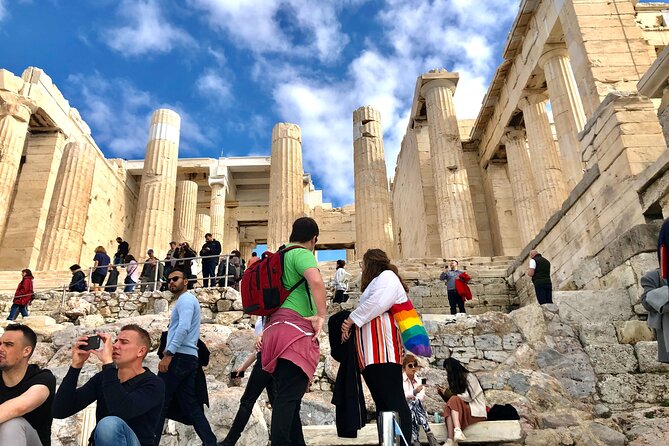
The Temple of Asclepius is a brief five-minute stop, but it adds a useful piece of social history. Asclepius was the god of medicine, and this area was connected with the treatment of patients in ancient Athens.
The guide explains how people sought healing and what kinds of votive offerings they left as thanks. These offerings show that ancient religion was not only about grand temples and city ceremonies. It also involved personal hopes, illness, recovery, and gratitude.
Since the stop is short, expect a compact explanation rather than a full account of ancient medical practice. Still, it gives the route variety and helps you see the Acropolis as a working religious center serving both public and private needs.
The Theatre of Dionysus and the birth of drama
The Theatre of Dionysus Eleuthereus is one of the oldest theaters in the world and is built entirely of marble. The tour allows roughly 10 minutes here, with attention to its capacity of about 17,000 spectators and its position on the Acropolis slope.
The site is tied to the first performances of works by Euripides, Aeschylus, Sophocles, and Aristophanes. That list alone gives the place unusual weight. You are looking at the setting where major works of drama were first presented, not simply another ancient seating area.
The guide also explains the choice of location and the use of the slope to help with acoustics. This stop works particularly well for anyone interested in literature, theater, or the political life of the ancient city.
The theater is below the summit, while the tour ends at the top. The route is therefore not a flat circuit. You will be walking up and down through a historic site with uneven surfaces, so sensible shoes and a moderate level of fitness are important.
What the $44.03 price really buys
At $44.03 per person, this is a reasonable price if you want interpretation in Spanish and do not want to navigate the Acropolis alone. The fee includes the guide, wireless audio equipment, all the listed monument explanations, and state taxes. It does not include admission, transfers, or personal expenses.
The value depends on how you like to visit major sites. If you are comfortable reading a guidebook and building your own route, a self-guided visit will cost less apart from the ticket. You will also move at your own pace. But the Acropolis can feel confusing without a clear order, and the guide gives you a framework for understanding what you are seeing.
For families, the guided format may be worth the extra cost. Efi has been praised for holding children’s attention and keeping explanations lively. The visit also works well for adults who want mythology and architecture presented together rather than as separate subjects.
The price is less attractive if you expected admission to be included. Check that point before booking and treat the $44.03 as the guiding fee, not the total cost of entry.
Timing, heat, and physical effort
Starting at 8:30 a.m. is one of the smartest features of the experience. The Acropolis is exposed, and one guide specifically kept the group engaged despite intense heat. An early visit cannot guarantee cool conditions, but it gives you a better chance of walking before the day becomes punishing.
The tour lasts about two hours. That is long enough for a strong introduction, but short enough to fit into a full day in Athens. Since you finish at the top, you can continue looking, photographing, and enjoying the monuments on your own after the formal explanations end.
Bring water, wear practical shoes, and expect a moderate physical effort. The tour does not include transfers, and every part is walked. Service animals are allowed, and the meeting area is near public transportation.
The group size of up to 27 means the pace will be shared. You may need to wait for others at certain points, and people who want long stretches of quiet photography may prefer to stay after the guided portion.
Who will get the most from this visit
I would choose this tour if Spanish is your preferred language and you want more than a quick look at the Parthenon. It is especially suitable for first-time visitors, families, and anyone who wants mythology, architecture, politics, medicine, theater, and later history linked together.
It is also a smart choice if you have limited time in Athens. Two hours gives you a strong orientation to the hill, and the finish at the summit lets you continue independently.
You may want another option if you need a private tour, require transportation, dislike group pacing, or want admission bundled into one price. The maximum group size is 27, so this is a guided group experience, not a personal archaeological consultation.
The strongest guides seem to bring warmth as well as facts. Efi is particularly praised for passion, clear explanations, questions, and help with photo locations. Simon, Ari, and Maria are also praised in the feedback supplied, but guide assignments can vary.
Should you book the Spanish Acropolis tour?
Book it if you want the Acropolis explained in Spanish by an official guide and you are happy to purchase admission separately. The route covers the essential monuments, adds useful stops that many self-guided visitors rush past, and finishes with free time at the summit.
At $44.03, I consider it good value for a well-led introduction, especially for families and first-time visitors. Just arrive ready to walk, confirm your entrance ticket, start early, and keep your expectations realistic: this is a lively overview of an enormous site, not a private deep study of every stone.
FAQ
Is the Acropolis entrance ticket included?
No. Admission to the Acropolis is not included in the $44.03 tour price. You must have a separate entrance ticket to enter the site.
What language is the tour conducted in?
The tour is conducted exclusively in Spanish with an official tourist guide.
How long does the Acropolis tour last?
The visit lasts approximately two hours.
Where does the tour begin?
The meeting point is the Greek National Tourism Organisation Information Point at Dionysiou Areopagitou 18, Athens 117 42, Greece.
Where does the tour end?
The tour ends at Theorias 21, Athens 105 58, Greece, directly at the top of the Acropolis. You can use the remaining free time to photograph the monuments.
Is transportation included?
No. Transfers are not included, and the entire visit takes place on foot.
Just added around Athens
- Delphi One Day Trip from Athens★ 4.0 · 98 reviews
- Private Delphi and Hosios Loukas Monastery – Great Lunch and Drinks Included★ 5.0 · 36 reviews
- Mercedes Private Tour to Delphi and Arachova★ 5.0 · 30 reviews
- Day tour to Ancient Olympia,Ancient Sparta Mycenae Including Meal★ 5.0 · 54 reviews
- Athens: Half Day Trip To Cape Sounio/Poseidon Temple Semi Private★ 5.0 · 131 reviews
- Athens Half-Day Private Tour Acropolis, Parthenon City Highlights★ 5.0 · 35 reviews
- From Athens: Day Tour to Mykonos★ 5.0 · 64 reviews
- Culinary Secrets of Downtown Athens★ 5.0 · 103 reviews
Acropolis Tours, compared.
Acropolis & up to 5 Archaeological Sites Combo Pass
Read our review →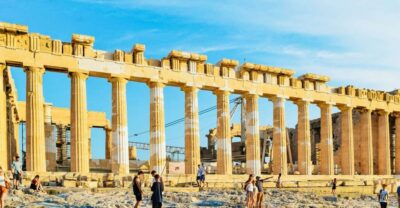
Acropolis, Parthenon & Acropolis Museum Guided Tour
Read our review →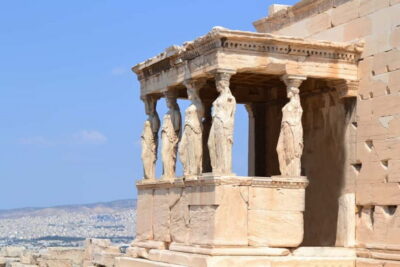
Acropolis, Parthenon & Acropolis Museum Guided Tour
Read our review →
Acropolis: Acropolis and Parthenon Guided Walking Tour
Read our review →
Acropolis monuments & Parthenon Walking Tour with Optional Acropolis Museum
Read our review →Browse the lists this tour appears in